What is Input Tax Credit Under GST and Who Can Claim It
 AuthorMehul Jagwani
 Reviewed ByMadhav Bhayani


- What is an Input Tax Credit?
- What is the Importance of Input Tax Credit?
- Who can Claim ITC?
- How to Claim ITC Under GST
- Documents Required for Claiming ITC
- Time Limit to Claim ITC Under GST
- How to Calculate Input Tax Credit
- Special Cases of ITC Under GST
- Reversal of ITC Under GST
- Ineligible Input Tax Credit under GST
- Conclusion
- FAQs on ITC Under GST
- What do you mean by Input Tax Credit?
India’s indirect taxation system has evolved from Zakat and Value Added Tax (VAT) to Goods and Services Tax (GST). In this transition many changes are implemented for the benefit of small and medium businesses and to encourage ‘Ease of Doing Business’ in India. One of the prominent positive changes is Input Tax Credit under GST. In this blog we will discuss what is Input Tax Credit, its importance and who can claim it.
What is an Input Tax Credit?
Input Tax Credit (ITC) is a key feature of GST in India, designed to prevent the cascading effect of taxes.The main aim of this feature is to reduce the cost of running a business.
Under this system, when a GST-registered person purchases goods or services for business purposes, they can offset their GST liability (calculated from outward supplies) can be offset against the ITC.
What is the Importance of Input Tax Credit?
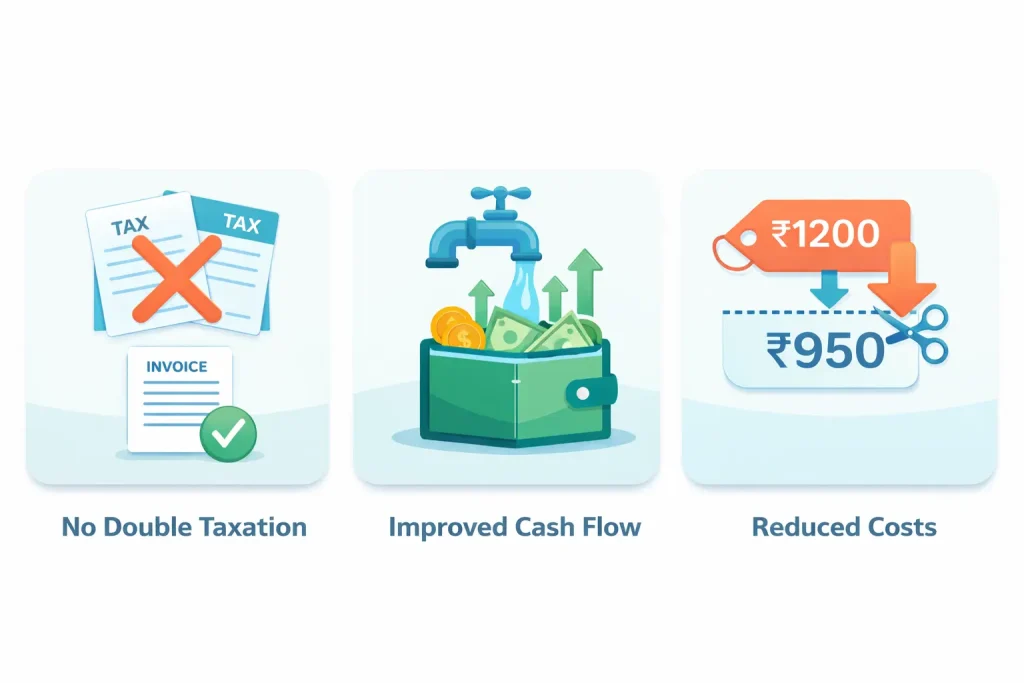
The following are the reasons which prove the importance of ITC from a business perspective:
- No double taxation:
It ensures that the tax is paid on the value addition at each stage of the business, not on the entire value of the deliverables.
- Better cash flow:
It helps maintain a healthy cash flow as it allows for the offset of tax liability.
- Cost reduction:
Businesses can decrease the selling price of their products as they claim ITC on their purchases.
Who can Claim ITC?
To claim ITC on the inward supply, the first and foremost condition is to have GST registration. Following are the criteria that you need to adhere to claim ITC:
1. Having tax invoice:
To claim ITC on the GST paid, one should have a valid invoice or any other document as proof of transaction mentioning the tax paid.
2. Receipt of goods or services:
The ITC claim can be made only after the goods have been received by the registered person, irrespective of the case where the billing and shipping address are different.
3. Tax paid:
The tax amount must be paid by the supplier for the ITC to be eligible for refund.
4. Filing the return:
The registered person has to file the return to claim the Input Tax Credit under GST.
5. Delivery-based eligibility:
If the goods are delivered in multiple lots throughout multiple months, then eligibility to claim ITC is the same.
Additional Read: Who Can Claim GST Refund
How to Claim ITC Under GST
Once you confirm your eligibility, the next step is knowing exactly how to claim Input Tax Credit under GST. The process is straightforward if you follow the right steps consistently.
Here is a step-by-step breakdown of how to claim ITC:
- Verify your purchase invoices — Ensure that each invoice from your supplier mentions the correct GSTIN, tax amount, and HSN/SAC code.
- Reconcile with GSTR-2B — Cross-check your purchase data with the auto-generated GSTR-2B statement available on the GST portal. This reflects ITC auto-populated from your suppliers’ filings.
- Report ITC in GSTR-3B — While filing your monthly GSTR-3B return, declare the eligible ITC under the relevant heads — IGST, CGST, and SGST.
- Utilise ITC for tax payment — Apply the claimed ITC against your outward GST liability before paying the remaining balance from your cash ledger.
- Maintain records — Keep all purchase invoices, debit notes, and related documents safely for audit and verification purposes.
💡 Pro Tip: Using GST return filing software like Munim simplifies ITC reconciliation with auto-populated data and 1-click filing, reducing manual errors significantly.
Documents Required for Claiming ITC
Before initiating your ITC claim, it is equally important to have the right set of documents in place. Missing or incorrect documents can lead to a rejected claim or scrutiny from tax authorities.
Here are the key documents required for claiming Input Tax Credit under GST:
- Tax Invoice issued by a GST-registered supplier (most common document)
- Debit Note issued by the supplier in case of upward revision of price or tax
- Bill of Entry for goods imported from outside India (applicable for IGST paid on imports)
- Invoice issued by Input Service Distributor (ISD) for distributed ITC
- Self-certified documents in specific cases where invoices are missing, subject to conditions
- Delivery Challan in cases where goods are received in multiple consignments
Time Limit to Claim ITC Under GST
One of the most critical and often overlooked aspects of Input Tax Credit is the deadline to claim it. Missing the time limit can result in permanent loss of the ITC, even if you are otherwise eligible.
What is the Last Date to Claim ITC?
As per the GST law, ITC on any invoice or debit note can be claimed up to the earlier of the following two dates:
- 30th November of the financial year following the year in which the invoice was issued
- The date of filing the Annual Return (GSTR-9) for that financial year
For example, if you have an invoice dated July 2024, the last date to claim ITC would be 30th November 2025 or the date you file GSTR-9 for FY 2024–25, whichever comes first.
Key Points to Remember
- ITC claims cannot be made on invoices from previous financial years once the deadline has passed.
- Delayed filings by suppliers can impact ITC availability, this is why regular GSTR-2B reconciliation is essential.
- Always track invoice dates carefully to ensure no eligible ITC is left unclaimed.
Staying on top of these deadlines is much easier when you use dedicated GST software that sends timely alerts and keeps your filing calendar in check.
How to Calculate Input Tax Credit
Understanding how to calculate ITC accurately helps businesses plan their tax liability better and avoid any compliance gaps.
Basic Formula for ITC Calculation
The general formula is simple:
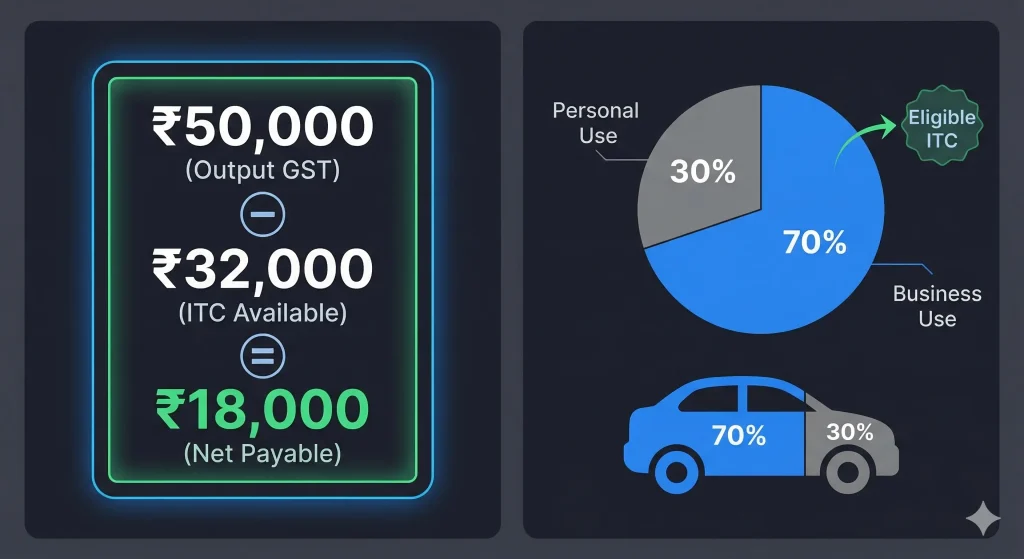
Net GST Payable = Output GST Liability − Eligible Input Tax Credit
If your Output GST is ₹50,000 and your eligible ITC is ₹32,000, then your net GST payable from the cash ledger is only ₹18,000.
ITC Calculation for Mixed-Use Purchases
In cases where goods or services are used for both business and personal purposes, ITC is available only on the business-use portion. The formula is:
Eligible ITC = (Business Use / Total Use) × Total ITC Available
For instance, if a vehicle is used 70% for business and 30% for personal purposes, only 70% of the GST paid on its maintenance is eligible as ITC.
ITC Utilisation Order Under GST
The GST law also prescribes a specific order in which ITC must be utilised:
| ITC Type | Can be Used to Pay |
| IGST Credit | IGST → CGST → SGST |
| CGST Credit | CGST → IGST |
| SGST Credit | SGST → IGST |
Note: CGST credit cannot be used to pay SGST liability and vice versa.
Tools like Munim GST automatically handle ITC offset calculations, ensuring 100% accuracy and correct utilisation order without any manual intervention.
Special Cases of ITC Under GST
While the standard ITC rules apply to most businesses, there are several special scenarios where the rules differ. Being aware of these exceptions helps businesses claim ITC correctly and stay compliant.
1. ITC on Capital Goods
Businesses can claim ITC on capital goods (like machinery or equipment) purchased for business use. However, if the capital good is used for both business and personal/exempt purposes, ITC must be proportionally calculated based on actual business use.
2. ITC for Works Contract Services
ITC on works contract services is generally not available unless the services are used for further supply of works contracts or for construction of plant and machinery.
3. ITC Under the Composition Scheme
Taxpayers registered under the GST Composition Scheme are not eligible to claim ITC. This is a key trade-off of opting for the composition scheme’s lower flat tax rates.
4. ITC on Exempt Supplies
If a business makes both taxable and exempt supplies, ITC is available only on the taxable portion. The ITC attributable to exempt supplies must be reversed.
5. ITC for Job Work
A principal manufacturer who sends goods to a job worker can still claim ITC on those goods. The goods must be returned within 1 year (3 years for capital goods) to retain the ITC benefit.
6. ITC in Case of Mergers or Acquisitions
In the event of a business merger, demerger, or transfer, the unutilised ITC of the transferor entity can be transferred to the acquiring entity, subject to conditions under GST law.
Reversal of ITC Under GST
Just as ITC can be claimed, it can also be reversed under certain circumstances. ITC reversal means returning the credit already availed back to the government. Ignoring reversal obligations can attract penalties and interest.
When is ITC Reversal Required?
- Non-payment to supplier within 180 days: If you have claimed ITC but have not paid your supplier within 180 days of the invoice date, the ITC must be reversed. It can be re-claimed once payment is made.
- Goods or services used for personal or exempt purposes: ITC claimed on purchases later used for personal consumption or exempt supplies must be reversed proportionally.
- Credit notes issued by supplier: If a supplier issues a credit note reducing the invoice value, the corresponding ITC availed must be reversed.
- Capital goods partly used for exempt supplies: If capital goods are used for both taxable and exempt purposes, a portion of ITC must be reversed periodically.
- Fraudulent or incorrect claims: ITC availed on the basis of fake invoices or without actual receipt of goods/services is liable for reversal along with penalty and interest.
How to Reverse ITC?
ITC reversal is reported in Table 4(B) of GSTR-3B under the appropriate sub-heads. The reversed amount is added back to your tax liability for that return period.
Keeping track of supplier payment schedules and ITC utilisation is crucial to avoid unintended reversals — another area where smart GST software makes all the difference.
Read More: Rule 42 & 43 ITC Reversal in GST
Ineligible Input Tax Credit under GST
To get Input Tax Credit under GST, one needs to adhere to laid out rules and regulations. Following are the cases where Input Tax Credit is not applicable.
- GST paid on goods and services for personal consumption by either registered or unregistered persons.
- GST is paid on transportation, except when used for cargo transportation or training.
- GST is paid on medical services, cosmetics, beauty treatments, food, and beverages.
- GST charged to the membership of the clubs, health, and fitness centres cannot be claimed.
- GST paid by a Non-Indian Resident or NRI taxable person, excluding those services or goods where IGST is payable.
- GST paid on travel benefits offered to employees for non-business purposes.
Conclusion
This was all about the Input Tax Credit under GST. We hope that after reading this blog, you understand the importance of ITC under GST, what eligibility criteria to claim, and who can claim. If you are looking for GST return filing software with the ability to offset ITC, then you are in the right place. Munim GST has everything you need to stay compliant with GST and offers ITC offsetting with 100% accuracy. Sign up now and get a 60-day free trial with no terms and conditions attached.
FAQs on ITC Under GST
1. What do you mean by Input Tax Credit?
ITC or Input Tax Credit is the feature of Goods and Service Tax (GST) where taxable can claim refund or offset the GST paid on goods or services rendered for business purposes.
2. What is the Input Tax Credit in GST with Example?
Input Tax Credit under GST enables businesses to get back the tax paid on inward supplies, by doing so they reduce their tax liability. Still wondering how it works? Let’s understand with an example. Suppose a business pays Rs. 10,000 as a total invoice value and out of which Rs. 2800 is accounted for GST. This tax amount i.e. Rs. 2800 is claimable under ITC.
3. How to check input tax credit in the GST Portal?
Following are the steps to check the Input Tax Credit (ITC) in GST Portal:
Step #8: Close the window by clicking on ‘Ok’.
Step #1: Go to the official GST Portal and log in with your valid credentials.
Step #2: Go to ‘Service ledger’ > ‘Electronic Credit Ledger’
Step #3: Check the details of the Input Tax under GST in the ledger. If the amount is either zero or negative, you are not eligible to claim it.
Step #4: Select the dates to view the transaction.
Step #5: Check the entries in the electronic ledger.
Step #6: You can save the transaction in PDF or Excel format. Choose the preferred option.
Step #7: Click on the description to view whether the credit amount is blocked or unblocked. The authority to change the status is reserved for tax officers.
4. What are the prior conditions for claiming an Input Tax Credit?
The prior condition to get Input Tax Credit is to have a valid GST registration and should possess either a tax invoice or debit note issued by the supplier.
5. What percentage of input tax credits business can claim?
Generally, 100% ITC can be claimed if purchase is for business purposes. However, if the purchase is done for mixed purpose i.e business as well as personal use, you are eligible to get ITC based on usage ratio.
6. Can hotels claim input tax credits?
Yes! Hotels can claim ITC under GST, provided that they are a GST-registered entity and are levying 12% or above as GST, based on their category laid out in CGST Act.
Disclaimer: "This blog post is for informational purposes only. For specific tax advice related to your business, please consult a qualified Chartered Accountant or GST practitioner."
About the author

Mehul is a seasoned content writer with a passion for simplifying complex accounting and GST topics. With a keen interest in entrepreneurship and business management, he specializes in creating informative and engaging content for themunim.com. His goal is to help businesses understand and implement accounting and GST software solutions effectively. When he's not crafting content, Mehul enjoys exploring new places and spending time with his Golden Retriever.
Post Tags
Related Articles
Explore the latest market news, useful resources for business, and Munim updates.