GST on Gold in India: Latest Rates, HSN Codes & Calculation Guide
 AuthorPriyanka Chaudhari
 Reviewed ByCA Ajay Savani



- GST on Gold: Current Rates on 22 & 24 Carat, Digital Gold, and Investment Schemes!
- GST on Gold: Rates and HSN Codes!
- How is GST Calculated on Gold?
- GST on Gold After 22 September: Did the Rates Change?
- What is the Impact of GST on Gold Jewellery?
- Can ITC be Claimed on GST Applied for Gold?
- What is the GST on Gold Exemptions: Import & Export!
- GST on Gold: Quick Reference Summary
- Related Article
- Let’s conclude
- FAQs of GST on Gold

India's relationship with gold is deep-rooted: weddings, festivals, investments, and family traditions all revolve around it. Before your next purchase, though, you need to understand GST on gold clearly.
Currently, gold attracts a 3% GST rate split equally as 1.5% CGST and 1.5% SGST. Making charges on gold jewellery are taxed separately at 5%. Even after GST 2.0 reforms, these rates have remained unchanged.
This guide covers the gold GST rate across all categories, HSN codes, step-by-step calculation examples, import/export rules, and what changed or didn't after the September 2024 GST Council meetings.
GST on Gold: Current Rates on 22 & 24 Carat, Digital Gold, and Investment Schemes!
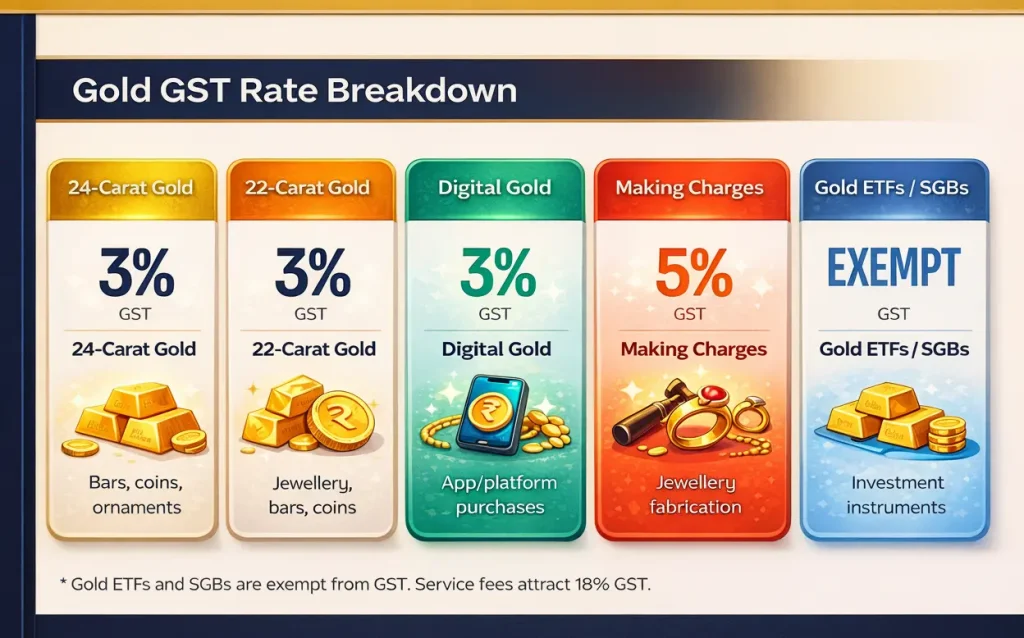
Gold comes in many forms, and the applicable gold GST rate varies slightly depending on the category. Here's a clear breakdown:
24-Carat Gold
Pure gold — whether in bars, coins, or ornaments — attracts 3% GST uniformly across all product types.
22-Carat Gold
GST on 22-carat gold jewellery, bars, and coins is also fixed at 3%. The carat purity does not affect the applicable GST slab.
Digital Gold
Purchasing gold digitally through investment apps or platforms? A flat 3% GST still applies on the transaction value.
Gold Investment Schemes
Gold ETFs, Sovereign Gold Bonds (SGBs), and gold mutual funds are exempt from GST. However, fund management fees and associated service charges attract 18% GST.
If your business also deals in silver, it's worth understanding how GST on silver jewellery and bars works; the rates and HSN codes follow a different structure than gold.
GST on Gold: Rates and HSN Codes!
| HSN codes | Gold Product Categories | GST Rate |
| 7108 | Gold bars, ingots, and raw gold | 3% |
| 7113 | Gold jewellery and its parts | 3% |
| 7114 | Other gold articles (excluding jewellery) | 3% |
Making charges on jewellery are invoiced separately and attract 5% GST, regardless of the gold weight or carat.
Not sure which HSN code to use for a specific gold product? Use Munim's free HSN/SAC Code Finder to look up codes instantly, no manual searching required.
How is GST Calculated on Gold?
1. GST on Gold Bars and Coins
For raw gold, ingots, bars, and coins, making charges do not apply. The formula is:
Total Price = Gold Rate per gram × Grams purchased GST = Total Price × 3% Final Amount Payable = Total Price + GST
Example — Buying 20 Grams of Gold Bar
| Component | Value |
| Weight | 20 grams |
| Rate per gram | ₹6,000 |
| Total Gold Value | ₹1,20,000 |
| GST @ 3% | ₹3,600 |
| Amount Payable | ₹1,23,600 |
2. GST on Gold Jewellery
For jewellery, making charges form a separate taxable component at 5%. Both GST values are added to arrive at the total payable amount.
GST on Gold = Gold Value × 3% GST on Making Charges = Making Charges × 5% Total GST = GST on Gold + GST on Making Charges
Example — Buying a 10-Gram Gold Chain
| Component | Value |
| Weight | 10 grams |
| Rate per gram | ₹6,000 |
| Total Gold Value | ₹60,000 |
| GST on Gold @ 3% | ₹1,800 |
| Making Charges (₹500/gram) | ₹5,000 |
| GST on Making @ 5% | ₹250 |
| Total GST | ₹2,050 |
| Final Price | ₹67,050 |
You can verify your gold invoice in seconds using Munim's GST Calculator.
GST on Gold After 22 September: Did the Rates Change?
Many buyers and traders searched for "GST on gold after 22 September" following discussions around GST 2.0 and the 54th GST Council meeting in late 2024. The short answer: nothing changed.
GST on gold after 22 September and throughout the subsequent GST 2.0 rollout continued at 3%. The Council introduced restructured slabs — primarily 5% and 18% for most goods, with 40% for sin and luxury items — but deliberately retained gold's unique 3% slab.
Why? Gold is not treated as a pure luxury good in India. It is a cultural staple, a mainstream savings instrument, and a livelihood for millions of small jewellers. Raising the gold GST rate would stoke inflation, hurt household savings, and damage the formal jewellery sector.So the gold GST rate of 3% on gold and 5% on making charges stands exactly as it did before the reforms.
What is the Impact of GST on Gold Jewellery?
GST replaced the fragmented pre-2017 tax regime — VAT, excise duty, and state-level entry taxes — creating a uniform, transparent system across India. Here is how it affects different stakeholders:
- Buyers: The total cost of gold includes 3% GST on the base value and 5% on making charges. These are disclosed line items on every GST invoice.
- Jewellers and Traders: Businesses must use correct HSN codes, generate compliant invoices, and file GSTR-1 and GSTR-3B returns accurately each period.
- Industry Overall: GST eliminated regional price disparities, brought unorganised jewellers into the formal economy, and standardised documentation across the supply chain.
Can ITC be Claimed on GST Applied for Gold?
Yes — jewellers and gold merchants can claim Input Tax Credit (ITC) on GST paid for raw gold purchases and making charge inputs. ITC is claimable even when tax is paid under the Reverse Charge Mechanism (RCM).
Claiming ITC correctly requires accurate records and timely GST return filing. Munim's GST software keeps your filings error-free and ensures your ITC claims are backed by matching invoice data — reducing the risk of notices or mismatches.
What is the GST on Gold Exemptions: Import & Export!
Exports
In its 31st Council meeting, the GST Council exempted gold supplied by a registered entity for export purposes from GST. This relieves exporters of the tax burden and strengthens India's competitiveness in the global gold market.
Imports
Importing gold into India involves multiple levies stacked on each other:
- Basic Customs Duty (BCD): 5%
- Agricultural Infrastructure and Development Cess (AIDC): 1%
- IGST: 3% (applied on gold value + customs duty combined)
The effective cost of imported gold is therefore significantly higher than domestically sourced gold — a factor relevant to importers, bullion traders, and large jewellery manufacturers.
GST on Gold: Quick Reference Summary
| Category | GST Rate |
|---|---|
| Gold bars, coins, ingots | 3% |
| Gold jewellery (on gold value) | 3% |
| Making charges on jewellery | 5% |
| Digital gold | 3% |
| Gold ETFs / SGBs / Mutual Funds | Exempt (service fees at 18%) |
| Gold imports (IGST component) | 3% |
| Gold exports | Exempt |
Related Article
GST on FMCG Products
One GST for Multiple Business
GST on LIC Premium
GST on Clothes
Let’s conclude
Gold's cultural weight and economic importance in India have kept its GST rate firmly at 3% — a position that was held through GST 2.0 and continues today. Whether you are a buyer, jeweller, CA, or investor, understanding GST on gold helps you make accurate decisions and stay fully compliant.Bookmark this guide for quick reference before any gold purchase or transaction.
FAQs of GST on Gold
1. What is the GST rate on gold in India?
Gold attracts 3% GST in India (1.5% CGST + 1.5% SGST). Making charges on jewellery are separately taxed at 5%.
2. How much GST applies on gold bars?
A flat 3% GST is applied on gold bars, biscuits, and ingots — making charges are not applicable for these products.
3. Did GST on gold change after 22 September or with GST 2.0?
No. GST on gold after 22 September and following the GST 2.0 rollout remained unchanged at 3%. The GST Council retained gold's special slab to protect buyers and avoid inflationary pressure.
4. Can you buy gold without paying GST in India?
No. Purchasing gold without GST violates Indian tax laws and is treated as a compliance offence. All registered dealers are required to charge and collect GST.
5. Is GST applicable on gold exports?
Gold supplied for export by a registered entity is exempt from GST, as per the 31st GST Council resolution.
6. What GST rate applies to digital gold?
Digital gold purchases attract 3% GST — the same rate as physical gold.
Disclaimer: "This blog post is for informational purposes only. For specific tax advice related to your business, please consult a qualified Chartered Accountant or GST practitioner."
About the author
Related Articles
Explore the latest market news, useful resources for business, and Munim updates.