
Debit Note: A Complete Guide to Usage, Importance, and GST Compliance
 AuthorMehul Jagwani
 Reviewed ByAjay Savani




Summary:
A debit note is a commercial document used to record upward adjustments in invoice value. In accounting, it increases the amount a buyer owes a seller. Under the GST framework in India, a debit note is issued by a registered supplier when the original tax invoice has undercharged the taxable value or the tax amount.
Every business makes billing errors. Prices get misquoted, quantities are underreported, or tax rates are applied incorrectly. In the pre-GST era, correcting these errors was often informal and inconsistent. Under the current GST regime, there is a proper legal mechanism for this: the debit note.
A debit note is one of the most commonly misunderstood documents in Indian business accounting. Many business owners confuse it with a credit note. Others are unsure who should issue it, when it applies, or how it fits into GST return filing. This guide answers all of that, clearly and practically.
Whether someone is a business owner, an accountant, or a GST practitioner managing multiple clients, understanding the debit note is not just useful. It is essential for staying compliant and audit-ready.
What Is a Debit Note?
A debit note, also known as a debit memo, is a document that records an increase in the amount owed between two parties in a transaction. In simple terms, when a seller has charged less than what they should have in the original invoice, a debit note corrects that shortfall. It tells the buyer: the earlier invoice was not sufficient, and the additional amount is now due.
- It is also referred to as a supplementary invoice
- It is most common in B2B transactions
- It can be issued by either a buyer or a seller in general accounting, but under GST, only the supplier issues it
Debit vs credit note? Learn it the simple way!
What Is a Debit Note in Accounting?
In accounting, a debit note creates an entry that increases a liability on the buyer’s books. When a buyer receives a debit note from a supplier, the buyer must record the additional amount payable. The supplier records an increase in their receivables.
Example: A wholesaler in Mumbai supplies 500 units of goods to a retailer in Pune at Rs. 200 per unit and raises an invoice for Rs. 1,00,000. Later, it turns out the agreed price was Rs. 220 per unit. The supplier raises a debit note for the difference: Rs. 10,000 (plus applicable GST).
- The buyer’s accounts payable goes up
- The seller’s accounts receivable goes up
- Both records now reflect the correct transaction value
What is debit note in accounting, at its core, is simply a mechanism to fix an undervalued invoice without cancelling it.
What Is a Debit Note in GST?
Under the Goods and Services Tax regime in India, a debit note carries a specific legal definition and compliance requirement.
A debit note is a document issued by a supplier under Section 34(3) of the CGST Act, 2017, when there is a need to increase the taxable value or the GST charged on an invoice. When the supplier issues a debit note, their tax liability increases accordingly.
Key points about what is debit note in GST:
- It is a legally recognised supplementary document
- It adjusts the output tax liability of the supplier upward
- It is not optional — if the original invoice has under-reported taxable value or tax, the supplier must issue a debit note
- There is no statutory time limit for issuing a debit note under GST, unlike credit notes
- It must be declared in GSTR-1 in the tax period in which it is issued
Simplify Your Business Operations
Designed to give you speed, control, and accuracy in daily accounting tasks.
 Save time with automated accounting workflows
- Get 35+ detailed business reports easily
- Access your business anytime, anywhere
 Save time with automated accounting workflows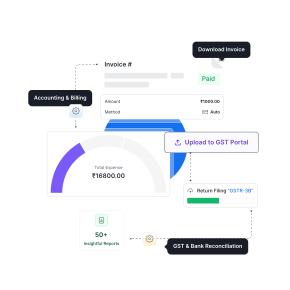
Who Issues a Debit Note?
Under GST: Under GST law, credit notes and debit notes issued only by the supplier are recognised.
- The registered supplier must issue the GST debit note
- The recipient cannot issue a GST-valid debit note
- The recipient can only receive it, record the additional liability in their books, and adjust Input Tax Credit accordingly
In general accounting (outside GST):
- A buyer may raise their own debit note when they are overcharged
- A buyer may raise it when goods arrive damaged or in short quantity
- This is a commercial debit note, not a GST debit note
These two must not be confused. For all GST compliance purposes, who issues debit notes is clearly the supplier.
When Is a Debit Note Issued?
A debit note is issued when the price charged in the original invoice is incorrect, when the quantity of goods or services supplied increases post the original invoice, or when there is a revision in tax rates applicable to the goods or services.
More specifically, a debit note is issued in the following situations:
- Price undercharged in original invoice
- Quantity supplied exceeded what was invoiced
- Lower tax rate applied
- Additional charges to be recovered
- Contract revision post-supply
Practical Example: ABC Services invoiced a client for Rs. 50,000 (including GST). After the service, an extra charge of Rs. 5,000 is agreed. ABC issues a debit note for the additional amount, increasing the taxable value and GST accordingly.
When a debit note is issued, the tax liability of the supplier increases, and the buyer records an additional amount payable.
Debit Note Format: What Must It Contain?
There is no single prescribed format under GST for a debit note. However, Rule 53 of the CGST Rules, 2017 lays out the essential fields that every debit note must include.
A valid GST debit note must contain:
- Supplier details — Name, address, and GSTIN
- Document type — Clearly identified as “Debit Note”
- Unique serial number — Within the financial year
- Date of issue
- Recipient details — Name, address, and GSTIN or UIN
- Original invoice reference — Invoice number and date being corrected
- Description of goods or services
- Taxable value and tax breakup — Rate and amount of CGST, SGST, or IGST as applicable
- HSN or SAC code — Where applicable
- Signature or digital signature of the supplier or authorised representative
How to Report a Debit Note in GST Returns
Reporting in GSTR-1
A debit note must be declared in GSTR-1 Table 9B in the tax period in which it is issued.
- B2B supplies — Credit note/debit note issued to registered persons must be reported in Table 9B, Credit/Debit Notes (Registered), with details including the note number and supply type.
- B2C supplies — Declared in Table 9B under the unregistered category
- Amendments to earlier debit notes — Reported in Table 9C, Amended Credit/Debit Notes (Registered), of the monthly GSTR-1 form
File GSTR-1 easily without errors. Know More!
Impact on GSTR-3B
- The values from debit notes reported in GSTR-1 flow automatically to GSTR-3B, raising the output tax liability
- The supplier must discharge the additional tax liability in GSTR-3B for the same tax period
Learn GSTR-3B filing in simple steps. Read More!
Impact on Recipient’s ITC
- The debit note reflects in the recipient’s GSTR-2A and GSTR-2B
- The recipient can claim additional ITC on the extra GST shown in the debit note
- The ITC timing analysis should be done with reference to the debit note under the present law, not the original invoice date
Closing Notes
A debit note is a small document with significant compliance implications. It keeps invoice records accurate, protects businesses from tax mismatches, and ensures that both buyers and sellers reflect the correct transaction value in their books and returns.
For Indian SMEs and tax professionals alike, understanding when a debit note is issued, who issues it, and how it flows through GSTR-1 and GSTR-3B is not optional. It is part of running a compliant, audit-ready business.
FAQs on Debit Note
Is there a time limit for issuing a debit note under GST?
No. Unlike credit notes, there is no statutory time limit for issuing a debit note under GST.
In which table of GSTR-1 is a debit note reported?
A debit note is reported in Table 9B of GSTR-1 for the tax period in which it is issued. Amendments to earlier debit notes go into Table 9C.
Does a debit note affect Input Tax Credit?
Yes. The recipient can claim additional ITC on the extra GST amount shown in a valid debit note.
Can a debit note be amended after filing?
Yes. Errors in a filed debit note can be corrected by reporting the amendment in Table 9C of GSTR-1 in a subsequent period.
What is the difference between a debit note and a revised invoice?
A debit note adjusts the value of a specific supply upward. A revised invoice is issued only for the pre-registration period to cover invoices raised before a GSTIN was obtained. They serve different purposes.
How long should debit note records be maintained?
As per Section 36 of the CGST Act, debit note records must be maintained for 72 months (six years) from the due date of filing the annual return for that financial year.
Disclaimer: "This blog post is for informational purposes only. For specific tax advice related to your business, please consult a qualified Chartered Accountant or GST practitioner."
About the author

Mehul is a seasoned content writer with a passion for simplifying complex accounting and GST topics. With a keen interest in entrepreneurship and business management, he specializes in creating informative and engaging content for themunim.com. His goal is to help businesses understand and implement accounting and GST software solutions effectively. When he's not crafting content, Mehul enjoys exploring new places and spending time with his Golden Retriever.
Related Articles
Explore the latest market news, useful resources for business, and Munim updates.