
Form 15G for PF Withdrawal: What It Is, Who Needs It, and How to Fill It
 AuthorMehul Jagwani
 Reviewed ByMadhav Bhayani



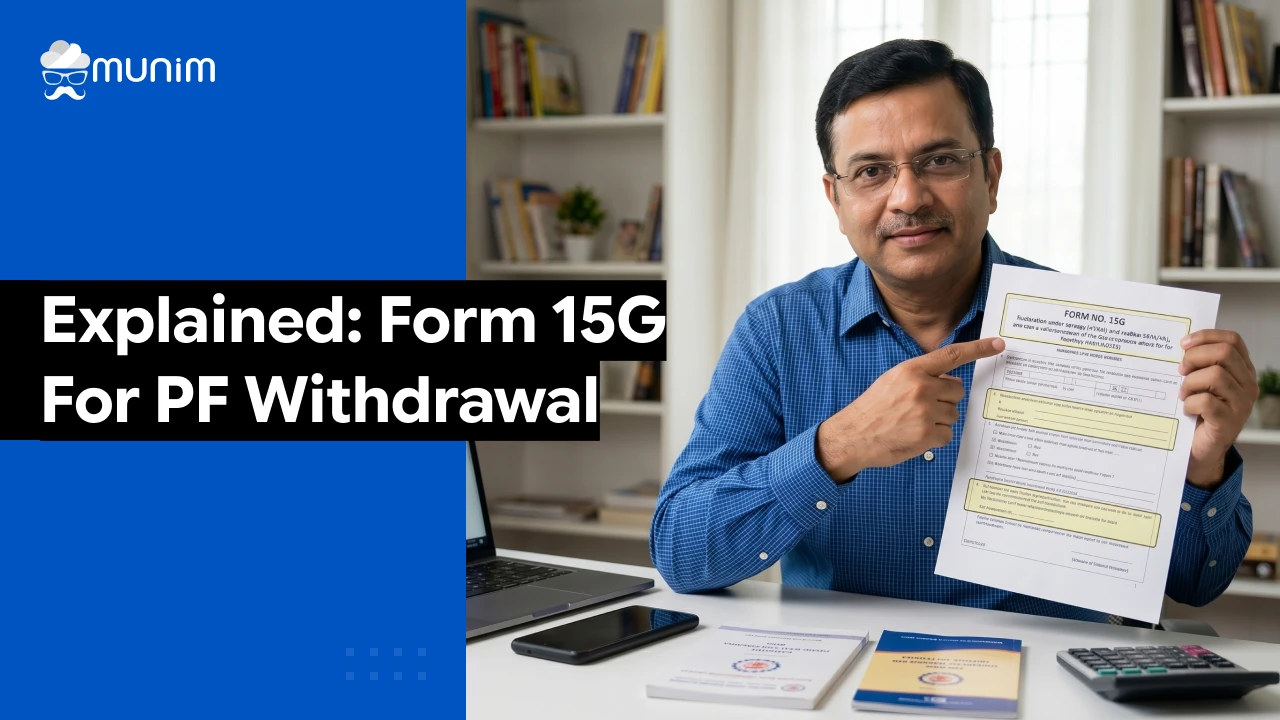
When someone withdraws their EPF balance before completing five years of continuous service, the EPFO deducts TDS on the amount if it exceeds Rs. 50,000. That deduction can often catch people off guard, especially those whose total income does not attract tax at all. This is exactly where Form 15G for PF withdrawal becomes relevant.
Form 15G is a simple self-declaration form under the Income Tax Act that tells the deductor (in this case, EPFO) that the individual’s estimated total income for the financial year is below the taxable limit. No assessment. No lengthy process. Just a declaration.
What Is Form 15G?
Form 15G is a self-declaration form prescribed under Section 197A of the Income Tax Act, 1961. It is submitted by a resident individual (below the age of 60) to declare that their estimated total income for the financial year does not exceed the basic exemption limit, and therefore, no tax should be deducted at source on a specific payment.
The form is used in multiple contexts, including fixed deposits, recurring deposits, interest income from banks, and EPF withdrawals. When used in the context of a provident fund, it is commonly referred to as EPF Form 15G.
It is important to understand that Form 15G is not a tax exemption certificate. It is a declaration of eligibility. The responsibility of providing accurate information rests entirely with the person submitting the form. If the declaration turns out to be false, penalties under the Income Tax Act may apply.
Designed for Modern Tax Professionals
A premium filing solution for CAs and tax consultants who need speed, scale, and operational clarity.
 Handle multiple clients with ease
- Reconcile and validate with confidence
- Overcome the limitations of the GST portal
 Handle multiple clients with ease
Who Can Submit Form 15G for PF Withdrawal?
Understanding the eligibility criteria before submitting EPF Form 15G avoids errors and rejection.
An individual can submit Form 15G if all of the following conditions are satisfied:
1. Age below 60 years Form 15G is only for individuals below 60 years of age. Senior citizens (aged 60 and above) must use Form 15H, which is a separate but similar declaration form.
2. Resident of India Only resident individuals can submit Form 15G. Non-Resident Indians (NRIs) are not eligible.
3. Total estimated income below the basic exemption limit The individual’s total income for the financial year, including the PF withdrawal amount, must be below the basic exemption threshold. For FY 2025-26, the basic exemption limit under the old tax regime is Rs. 2,50,000. Under the new tax regime, it is Rs. 3,00,000.
4. Tax liability is nil Even if the total income is above the exemption limit, the individual can submit Form 15G if the tax calculated on the total estimated income is zero after applicable deductions. However, this is a less common scenario and should be evaluated carefully.
5. The PF withdrawal triggers TDS Form 15G is only relevant when TDS would otherwise be deducted. If the withdrawal is below Rs. 50,000 or the employee has completed five years of service, the form is unnecessary.
How to Download Form 15G from Munim
Munim offers a direct and hassle-free Form 15G download. Simply visit the link below to get the form instantly, without navigating through government portals.
Get your Form 15G in one click — fast, free, and hassle-free.
How to Fill Form 15G for PF Withdrawal
Filling EPF Form 15G correctly is important. Any mismatch in information can lead to the rejection of the declaration or future scrutiny.
Here is a section-by-section breakdown:
Part I: Filled by the Individual
Field 1: Name of the Assessee (Declarant) Enter the full name exactly as it appears on the PAN card.
Field 2: PAN of the Assessee This is mandatory. Form 15G submitted without a valid PAN will not be accepted.
Field 3: Status Select “Individual” from the available options.
Field 4: Previous Year (P.Y.) Enter the financial year for which the declaration is being made. For example, if withdrawing in May 2025, enter 2025-26.
Field 5: Residential Status Select “Resident” if the individual is a resident of India.
Field 6: Flat/Door/Block No. and Address Provide the complete residential address.
Field 7: Email and Mobile Number Enter valid contact details for communication.
Field 8: Whether assessed to tax under the Income Tax Act, 1961 If the individual has ever filed an income tax return or has been assessed to tax, select “Yes.” Provide the last assessment year in which the income tax return was filed.
Field 9: Estimated Income for Which This Declaration Is Made Enter the EPF withdrawal amount for which the declaration is being submitted.
Field 10: Estimated Total Income of the P.Y. in Which Income Mentioned in Column 9 Is to Be Included This is the total estimated income for the financial year, including all sources such as salary, interest, business income, and the PF withdrawal amount.
Field 11: Details of Form 15G Filed Earlier During the Financial Year If Form 15G has been submitted to any other deductor in the same financial year, provide the total number of such forms and the aggregate income for which those declarations were made. This is a critical field and must not be left blank or underreported.
Field 12: Details of Income for Which Declaration Is Filed Provide the nature of income (PF withdrawal), the section under which it is taxable, and the amount.
Signature / Thumb Impression The form must be signed (or thumb impression provided) at the designated place. The date and place of signing must also be filled in.
Part II: Filled by the Deductor (EPFO)
This section is not the individual’s responsibility. EPFO officials fill and verify Part II upon receipt of the declaration. It includes the deductor’s name, TAN, address, and acknowledgement details.
How to Submit Form 15G for PF Withdrawal Online
EPFO has made the process fairly straightforward for members with a functional UAN.
Step 1: Log in to the EPFO Member Portal at unifiedportal-mem.epfindia.gov.in using UAN and password.
Step 2: Navigate to the “Online Services” tab and select “Claim (Form 31, 19, 10C and 10D).”
Step 3: Verify the bank account linked to the UAN by entering the last four digits of the registered bank account number.
Step 4: Click on “Proceed for Online Claim.”
Step 5: Select the type of claim (full settlement, partial withdrawal, pension withdrawal, etc.) from the dropdown.
Step 6: If the withdrawal is subject to TDS, the portal will display the Form 15G section. The member needs to confirm the declaration and submit.
Step 7: An OTP is sent to the registered mobile number linked to the UAN. Enter the OTP to authenticate the claim.
The declaration is submitted electronically along with the claim. There is no need to print and physically submit the form when using the online route.
Form 15G vs Form 15H: What Is the Difference?
Both forms serve the same purpose but apply to different age groups.
| Particulars | Form 15G | Form 15H |
| Who can submit | Individuals below 60 years | Senior citizens aged 60 years and above |
| Condition on tax | Tax on estimated income must be nil | Tax on estimated income must be nil |
| Residential status | Resident individuals only | Resident individuals only |
| Applicable sections | Section 197A(1) | Section 197A(1C) |
If someone is 60 years or older and wants to prevent TDS on PF withdrawal, they must submit Form 15H, not Form 15G.
Final Thoughts
Submitting Form 15G for PF withdrawal is a straightforward process for those who are eligible. It protects the individual from an unnecessary TDS deduction and keeps the withdrawal tax-free at the source. The key is to assess eligibility honestly, fill the form accurately, and report all income sources correctly.
For employees who manage their business or professional finances independently, tools like Munim can help in maintaining clean income records and financial statements throughout the year. When the time comes to estimate total annual income for Form 15G eligibility, having organised accounts makes the calculation far simpler and more reliable.
Frequently Asked Questions (FAQs)
Who can submit Form 15G for EPF withdrawal?
Resident individuals below 60 years of age whose total estimated income for the financial year does not exceed the basic exemption limit, and whose tax liability on total income is nil, are eligible to submit Form 15G.
Is Form 15G mandatory for PF withdrawal?
No. Form 15G is not mandatory. It is an optional declaration submitted
How many times can Form 15G be submitted in a year?
Form 15G can be submitted multiple times during a financial year, to different deductors.
Is online submission of Form 15G valid?
Yes. Submitting Form 15G through the EPFO UAN portal during the online claim process is fully valid. Physical submission is typically required only for offline claims.
What documents are needed along with Form 15G for PF withdrawal?
No separate documents need to be submitted along with Form 15G for online PF withdrawal. The declaration is part of the online claim process. For offline submissions, a copy of the PAN card is generally required to verify the PAN mentioned in the form.
Is PAN mandatory for submitting Form 15G?
Yes. PAN is mandatory for Form 15G. The form will not be accepted without a valid PAN.
Disclaimer: "This blog post is for informational purposes only. For specific tax advice related to your business, please consult a qualified Chartered Accountant or GST practitioner."
About the author

Mehul is a seasoned content writer with a passion for simplifying complex accounting and GST topics. With a keen interest in entrepreneurship and business management, he specializes in creating informative and engaging content for themunim.com. His goal is to help businesses understand and implement accounting and GST software solutions effectively. When he's not crafting content, Mehul enjoys exploring new places and spending time with his Golden Retriever.
Related Articles
Explore the latest market news, useful resources for business, and Munim updates.