



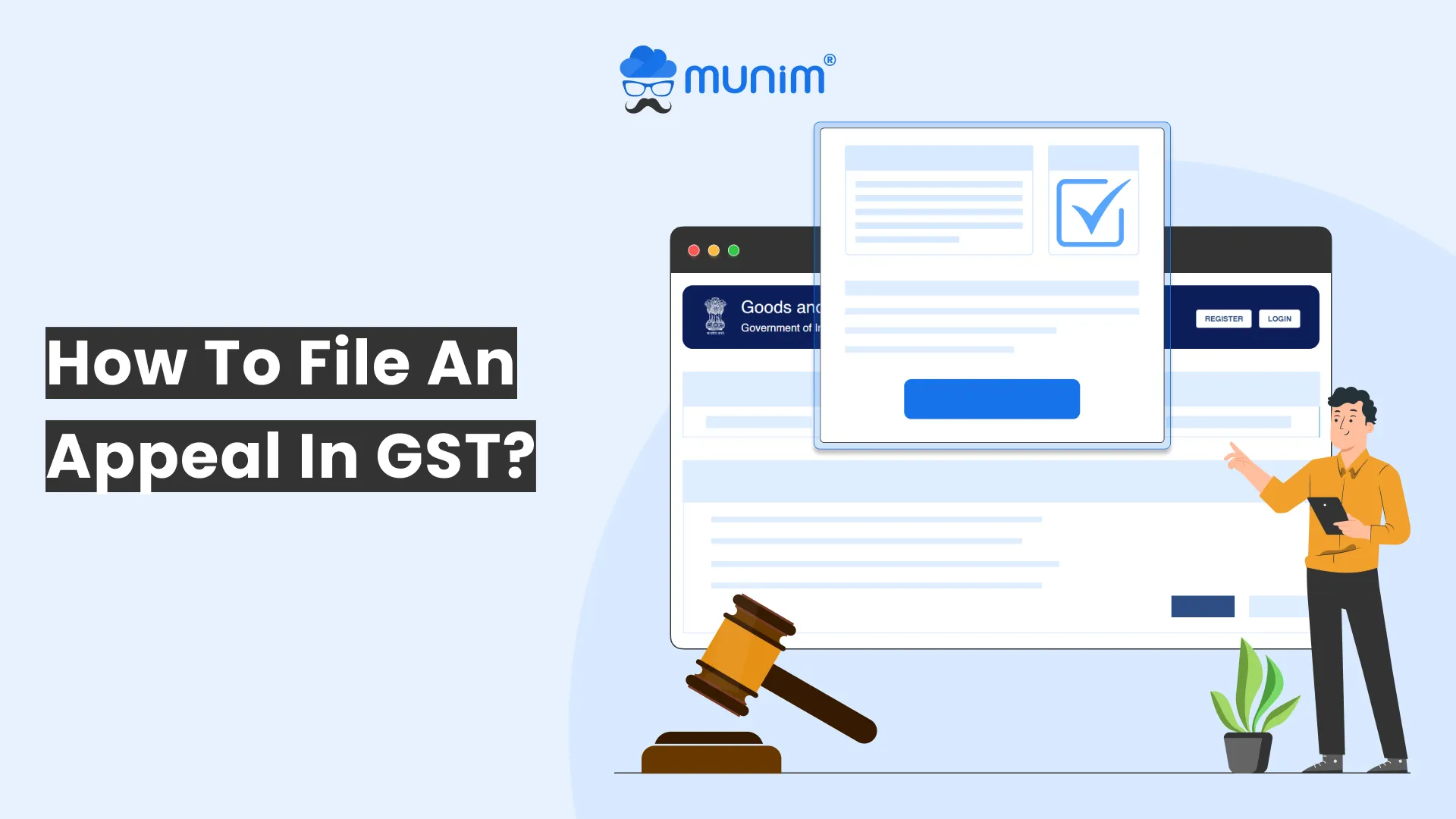
Have you ever received a GST notice, and you know that you have been framed wrongly in the case? If you have the proof to prove yourself, then you must file a GST Appeal. Don’t know how to file one? Don’t worry, we are here to help.
In this blog, we will discuss how to file a GST appeal, the time limit and pre-deposit requirements in detail. Stay tuned with us.
What is a Demand Order Under GST?
Did you ever find a notice issued by the GST portal and it says, order for demand of tax issued under Section 73/74/62… and felt confused or stressed? You’re not alone.
A Demand Order is a formal order that is made by a GST officer on the assumption that there is outstanding tax, interest or penalty that has not been paid. Simply put, it is a formal request to pay an amount that they feel is owed.
When Does a Demand Order Get Issued?
Usually when:
- There’s an ITC mismatch
- You claimed more credit than allowed in GSTR-2B.
- You reported supplies outwards less than they were.
- Suppliers didn’t file returns.
- There are discrepancies in e-way bills.
- One of the notices was not responded to.
- Inappropriate classification or valuation was utilised.
- There was a late payment of tax.
- A Demand Order is not final.
It is based on the department version of the story.
In case you have a different version, you have the right to appeal, also known as a GST Appeal.
Eligibility to Appeal Against Demand Order Under GST
The question business owners often ask: “Am I allowed to appeal this?”
Yes, in most cases you can appeal.
If you have received a Demand Order under any of the following sections, you are eligible to appeal under Section 107 of the CGST Act:
- Section 73 (non-fraud tax demand)
- Section 74 (fraud/intentional misstatement tax demand)
- Section 62 (best judgment assessment)
- Section 63 (assessment of unregistered persons)
- Cancellation of GST registration
- Rejection of revocation request
- Penalty or interest orders
- Refund rejection
You are NOT eligible to appeal only in very rare cases, such as:
- Orders that the law says are non-appealable
- Internal administrative decisions
- Cases where the timelines to appeal are already over
What is the Procedure of Appeal under GST?
Here is the complete flow of the GST appeal in a nutshell:
Step 1: Read the Order Carefully
Get to know what the officer is asserting. Do not hurry in submitting the appeal without fully understanding the matter.
Step 2: Collect Your Records.
Invoices, reconciliations, GSTR-1/GSTR-3B reports, bank proofs, email trails, everything that helps to make your case stronger.
Step 3: Determine Your Pre-Deposit.
Before filing your GST appeal, you have to pay the obligatory 10% deposit of the disputed amount before filing your appeal.
Step 4: Submit your Appeal on the GST Portal.
Go to:
Services → User Services → My Applications → Appeal to Appellate Authority
Fill out the form, attach documents, and submit.
Step 5: Respond to the additional queries
The appellate authority can request additional information; you must stay cooperative.
Step 6: Wait for the Final Appeal Order
Upon considering all these, the authority will issue the final order of either approving, revising, or rejecting your appeal.
Norms for General GST Appeals
In this (similar to any other legal process), GST appeals have their own couple of general rules that you are obliged to abide by. Consider the following as simple guidelines that ensure that the system is arranged:
- Appeals must be filed online
At the first level of appellate, there are no physical submissions.
- Pre-deposit is compulsory
Appeals without the submission of a pre-deposit are deemed invalid.
- Only a taxpayer or a representative is allowed to file.
This could be you, your CA, GST practitioner, or tax consultant.
- Paperwork should be understandable and readable.
Blurred documents or incomplete attachments weaken your case.
- The appeal should be made within 90 days of the time limit.
Appeals filed beyond the 90 days are rarely considered.
- The case has to be factual and legal.
Emotions, assumptions, and irrelevant arguments are not beneficial. Stick to facts.
An Example of a GST Appeal (Real Life Case)
Suppose you are in a textile business in Surat.
Scenario:
Your supplier submitted GSTR-1 late, and as a result, you got a demand notice of ₹4,20,000 due to an ITC mismatch.
You file an appeal:
Deposit 10% (= ₹42,000)
Upload reconciliations
Submit the supplier’s filing proof.
Explain the timeline
Result:
The Appellate Authority drops the demand.
Your ₹42,000 is refunded.
GST appeals work, but you must properly raise them.
Takeaway
We hope that after reading this blog, you understand the process of appealing under GST. Since you are now well aware of the process, time limits, and pre-deposit, you file the appeal immediately, without any further delay. Keep your documents handy while filing the appeal and stay alert. You may seek help from CA if needed.
Frequently Asked Questions
Who is the highest authority for appeals under GST?
The highest authority for appeals under GST is the Supreme Court of India.
What are the grounds of appeal under GST?
The following are the grounds of appeal under GST:
- Wrong tax computation
- Incorrect ITC disallowance
- Mismatch errors
- Refund rejection
- Penalty without a proper hearing
- Misinterpretation of documents
- Or any order that you believe is factually or legally incorrect.
How to pay GST appeal fees?
GST appeal fees are paid directly through the GST portal while filing your appeal.
What is the time limit for filing an appeal under GST?
You must file your GST appeal within 90 days from the date of receiving the order.
What is the appeal under GST?
A GST appeal is the means of appealing against an order issued by the GST department if you believe something is wrong with it and needs to be reviewed.
How can I file an offline appeal in GST?
With the existing system, first appeals cannot be made offline; the only way is online via the GST Portal. At higher stages, such as the High Court or Supreme Court, offline appeals can be made.
Disclaimer: "This blog post is for informational purposes only. For specific tax advice related to your business, please consult a qualified Chartered Accountant or GST practitioner."
About the author


Mehul is a seasoned content writer with a passion for simplifying complex accounting and GST topics. With a keen interest in entrepreneurship and business management, he specializes in creating informative and engaging content for themunim.com. His goal is to help businesses understand and implement accounting and GST software solutions effectively. When he's not crafting content, Mehul enjoys exploring new places and spending time with his Golden Retriever.
Related Articles
Explore the latest market news, useful resources for business, and Munim updates.