What is GSTR 3B and 2A Mismatch: Why It Happens, and How to Fix It
 AuthorMehul Jagwani
 Reviewed ByMadhav Bhayani



- Difference Between GSTR-2A and GSTR-3B
- Why Does a GSTR-2A and GSTR-3B Mismatch Happen?
- What Is a GSTR-2A and GSTR-3B Mismatch Notice?
- Period-Wise Rules for GSTR-2A and GSTR-3B Differences
- Can ITC Be Allowed If the Invoice Is Missing From GSTR-2A?
- Supplier or CA/CMA Certificate Requirement
- Important Update: Check Section 16(5) Before Reversing ITC
- Documents Required to Reply to the Mismatch Notice
- How to Respond to a GSTR-2A and GSTR-3B Mismatch Notice
- Is Interest Payable on the Mismatch Amount?
- Is There a Penalty for a GSTR-2A and GSTR-3B Mismatch?
- How to Prevent GSTR-2A and GSTR-3B Mismatches
- Frequently Asked Questions
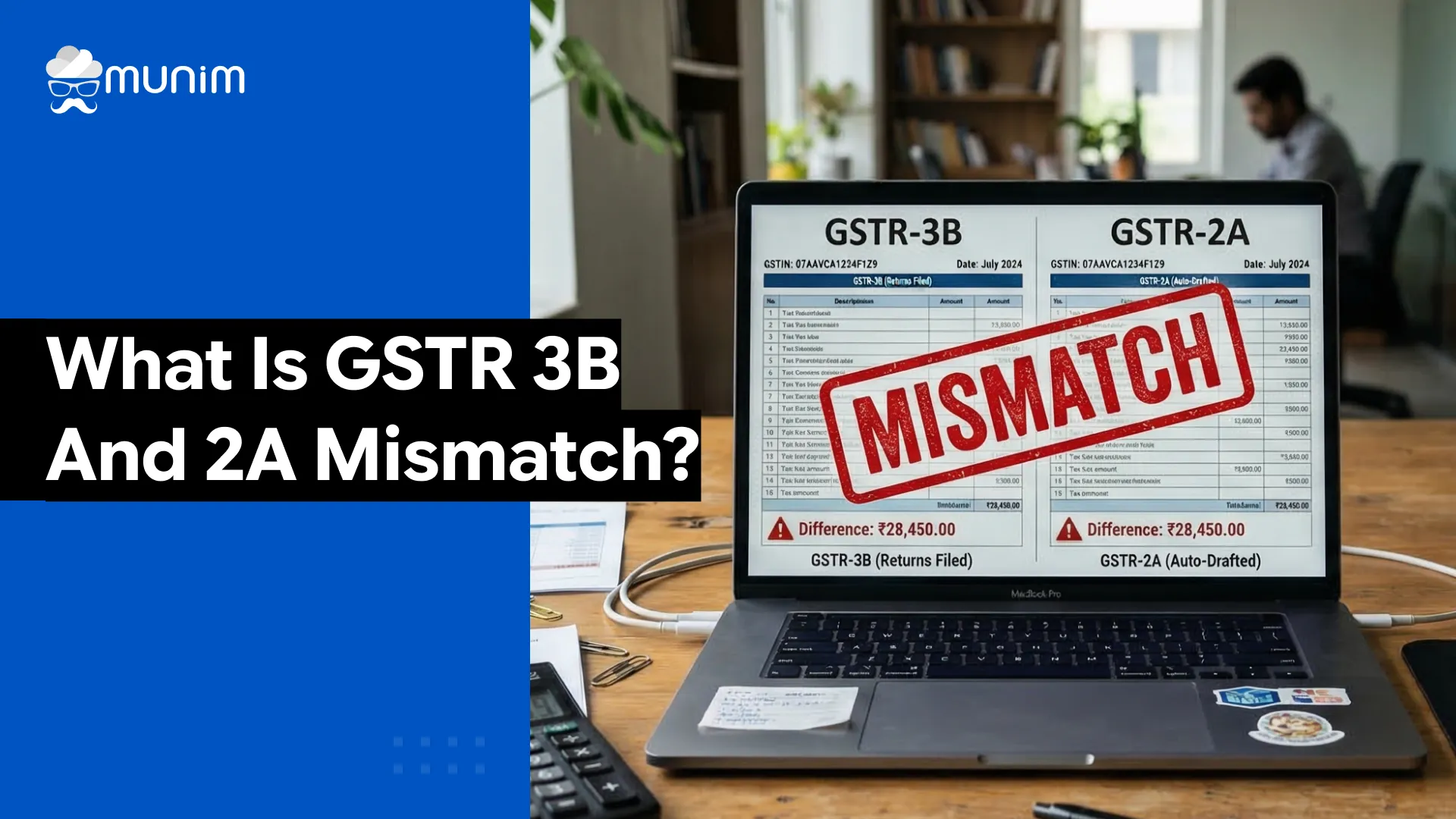
Mismatch between GSTR-3B and GSTR-2A happens when the Input Tax Credit (ITC) claimed while filing GSTR-3B does not match the with GSTR-2A, based on your supplier’s filings.
In this blog we will explain what GSTR 3B and 2A mismatch is, why it happens and what businesses can do about it.
Difference Between GSTR-2A and GSTR-3B
| Basis | GSTR-2A | GSTR-3B |
| Type | System-generated inward supply statement | Self-declared summary GST return |
| Prepared by | Generated from details reported by suppliers and other sources | Filed by the taxpayer |
| Main purpose | Shows purchase invoices and inward supply details | Reports tax liability, eligible ITC and tax payment |
| Editable | No; it is read-only | Values can be entered or edited before filing |
| Filing required | No | Yes |
| Update behaviour | Updates when suppliers upload or amend relevant details | Cannot be revised after filing |
| Role in mismatch | Shows supplier-reported ITC | Shows ITC actually claimed by the taxpayer |
Designed for Modern Tax Professionals
A premium filing solution for CAs and tax consultants who need speed, scale, and operational clarity.
 Handle multiple clients with ease
- Reconcile and validate with confidence
- Overcome the limitations of the GST portal
 Handle multiple clients with ease
Why Does a GSTR-2A and GSTR-3B Mismatch Happen?
1. Supplier did not file GSTR-1
The supplier may have paid tax through GSTR-3B but failed to file GSTR-1 for the relevant period. Consequently, the invoice does not appear in the recipient’s GSTR-2A.
This is one of the mismatch situations specifically recognised under CBIC Circular No. 183/15/2022-GST.
2. Supplier omitted an invoice from GSTR-1
The supplier may have filed both GSTR-1 and GSTR-3B but left out a particular invoice from GSTR-1. The recipient may have claimed ITC using the original purchase invoice, but the credit will not appear in GSTR-2A.
3. B2B invoice was reported as B2C
The supplier may have issued a valid tax invoice containing the recipient’s GSTIN but incorrectly classified the transaction as a B2C supply in GSTR-1.
Because B2C transactions are not reported against the recipient’s GSTIN, the invoice does not flow into that recipient’s GSTR-2A.
4. Supplier entered the wrong recipient GSTIN
A typing or mapping error in the buyer’s GSTIN can cause an otherwise valid invoice to appear in another taxpayer’s statement or not appear in the correct recipient’s GSTR-2A.
CBIC clarifies that allowing ITC to the actual recipient does not have to wait until proceedings against the incorrectly reported recipient are completed, provided the prescribed verification requirements are satisfied.
5. Supplier reported the invoice in a later period
The buyer may claim ITC based on the purchase register in one period, while the supplier reports or amends the invoice in a subsequent GSTR-1.
This creates a period-wise difference even though the invoice may subsequently appear in GSTR-2A.
6. Credit notes were not recorded correctly
A supplier credit note reduces the recipient’s eligible ITC. A mismatch may occur when:
- The credit note appears in GSTR-2A but is missing from the books.
- The credit note is recorded in a different period.
- The corresponding ITC reversal was not made.
- The supplier reported an incorrect credit-note value.
7. Purchase-register errors
Duplicate invoices, incorrect tax amounts, wrong financial-year mapping or manual data-entry errors can cause the ITC claimed in GSTR-3B to exceed the amount supported by the purchase register or GSTR-2A.
8. Ineligible ITC was included in GSTR-3B
ITC may appear in GSTR-2A but still be ineligible because it is:
- Blocked under Section 17(5).
- Related to personal or non-business use.
- Attributable to exempt supplies.
- Unsupported by receipt of goods or services.
- Subject to reversal under Sections 17 or 18.
- Claimed beyond the applicable statutory time limit.
Therefore, GSTR-2A reconciliation and ITC eligibility verification are separate checks.
What Is a GSTR-2A and GSTR-3B Mismatch Notice?
A GSTR-2A and GSTR-3B mismatch notice is a communication asking the taxpayer to explain why the ITC claimed in GSTR-3B is higher than the credit reflected in GSTR-2A.
The exact response process depends on the form and provision mentioned in the communication.
ASMT-10 scrutiny notice
When a return is selected for scrutiny under Section 61, the proper officer may issue Form GST ASMT-10 specifying the discrepancy.
Under Rule 99, the notice may ask for an explanation within a period not exceeding 30 days, unless the officer permits additional time. The taxpayer can submit the explanation through Form GST ASMT-11. If the explanation is accepted, the officer communicates acceptance through Form GST ASMT-12.
DRC-01A intimation or show-cause notice
In some cases, the taxpayer may receive:
- A pre-notice intimation in Form GST DRC-01A.
- A show-cause notice under the applicable demand provision.
- An audit or investigation communication.
- An adjudication order.
An ASMT-10 scrutiny notice is not the same as a final tax-demand order. The taxpayer should first identify the form, relevant section, financial year, disputed amount and response deadline.
For periods up to FY 2023-24, non-fraud demand proceedings are covered under Section 73, while proceedings involving allegations of fraud, wilful misstatement or suppression are covered under Section 74.
Period-Wise Rules for GSTR-2A and GSTR-3B Differences
The applicable rule depends on the period covered by the notice.
| Tax period | Treatment of ITC not reflected in GSTR-2A |
| FY 2017-18 and FY 2018-19 | Circular No. 183 verification procedure applies |
| 1 April 2019 to 8 October 2019 | Circular No. 183 procedure applies in full |
| 9 October 2019 to 31 December 2019 | Additional unmatched ITC restricted to 20% of eligible supplier-reported ITC |
| 1 January 2020 to 31 December 2020 | Additional unmatched ITC restricted to 10% |
| 1 January 2021 to 31 December 2021 | Additional unmatched ITC restricted to 5% |
| From 1 January 2022 | Supplier must report the invoice and it must be communicated in GSTR-2B |
Circular No. 193 states that from 1 January 2022, supplier-reported ITC cannot be allowed unless the supply is reported through GSTR-1 or IFF and communicated to the recipient in GSTR-2B. Therefore, GSTR-2A mismatch rules mainly apply to notices covering periods up to 31 December 2021.
For February to August 2020, the Rule 36(4) restriction was applied cumulatively and adjusted in September 2020. A similar cumulative adjustment applied to April to June 2021 in the June 2021 return.
Can ITC Be Allowed If the Invoice Is Missing From GSTR-2A?
For the historical periods covered by Circulars 183 and 193, ITC may be allowed even when an invoice is missing from GSTR-2A, provided the taxpayer satisfies the applicable conditions, certificate requirements and Rule 36(4) limits.
The taxpayer must establish that:
- A valid tax invoice, debit note or prescribed tax document is available.
- The goods, services or both were actually received.
- Payment of the invoice value and tax was made to the supplier.
- The supplier paid the tax to the government.
- The ITC is not blocked or otherwise subject to reversal.
- The credit was claimed within the applicable statutory time limit.
Therefore, absence from GSTR-2A alone should not be treated as conclusive proof that the credit is ineligible for the periods covered by the CBIC circulars.
Supplier or CA/CMA Certificate Requirement
Circular No. 183 prescribes different evidence depending on the supplier-wise annual difference.
| Supplier-wise difference for the financial year | Certificate required |
| Up to ₹5 lakh | Certificate from the concerned supplier |
| More than ₹5 lakh | Certificate from a Chartered Accountant or Cost Accountant with UDIN |
The certificate should confirm that:
- The supplier actually made the supplies to the taxpayer.
- Tax on those supplies was paid by the supplier through GSTR-3B.
The ₹5 lakh threshold is calculated supplier-wise for the relevant financial year, not invoice-wise or notice-wise.
Important Update: Check Section 16(5) Before Reversing ITC
Section 16(5) was inserted retrospectively to provide time-limit relief for certain old ITC claims.
For invoices or debit notes relating to FY 2017-18, FY 2018-19, FY 2019-20 and FY 2020-21, ITC may be eligible where it was claimed in a Section 39 return filed on or before 30 November 2021, subject to the other ITC conditions.
CBIC Circular No. 237/31/2024-GST directs tax authorities and appellate authorities to consider Section 16(5) and Section 16(6) in eligible pending investigations, notices, adjudication and appeal proceedings.
However, the retrospective amendment does not provide a refund of tax already paid or ITC already reversed solely because the credit subsequently became eligible under Sections 16(5) or 16(6).
Documents Required to Reply to the Mismatch Notice
Prepare a notice-wise evidence file containing:
- Copy of the mismatch notice.
- GSTR-3B filed for the disputed period.
- GSTR-2A downloaded for the relevant period.
- Invoice-level reconciliation statement.
- Purchase register.
- Original tax invoices and debit notes.
- E-way bills, goods receipt notes or delivery documents.
- Proof of receipt of services, where applicable.
- Supplier ledger and bank payment records.
- Supplier correspondence.
- Supplier certificate or CA/CMA certificate with UDIN.
- Proof of supplier GSTR-3B filing and tax payment, where available.
- ITC reversal and reclaim workings.
- Explanation for timing differences, amendments and credit notes.
Documents should be mapped against each disputed invoice rather than uploaded as an unstructured collection.
How to Respond to a GSTR-2A and GSTR-3B Mismatch Notice
Step 1: Identify the notice type and period
Check:
- Notice form.
- Applicable section.
- Financial year and tax periods.
- Disputed ITC amount.
- Response deadline.
- Whether the matter is scrutiny, audit, investigation or adjudication.
Do not assume that every portal communication is a final demand notice.
Step 2: Download GSTR-2A and GSTR-3B
Download the relevant statements and returns for the entire financial year. Annual reconciliation is important because an invoice may have been reported in a different month.
Step 3: Match invoices at the document level
Match each purchase-register entry using:
- Supplier GSTIN.
- Invoice number.
- Invoice date.
- Taxable value.
- CGST, SGST, IGST and cess.
- Credit or debit-note details.
Do not rely only on the total difference between the two forms.
Step 4: Classify every mismatch
Use clear categories such as:
- Supplier did not file GSTR-1.
- Invoice omitted from GSTR-1.
- B2B invoice reported as B2C.
- Wrong recipient GSTIN.
- Invoice reported in a later period.
- Credit-note difference.
- Purchase-register error.
- Duplicate ITC.
- Blocked or ineligible credit.
- Time-limit issue.
Step 5: Apply the correct period-wise rule
Use Circular No. 183 for FY 2017-18 and FY 2018-19. For the period from 1 April 2019 to 31 December 2021, apply Circular No. 193 and the relevant 20%, 10% or 5% Rule 36(4) restriction.
Do not apply the current GSTR-2B rule retrospectively to periods governed by the earlier GSTR-2A framework.
Step 6: Verify Section 16 conditions
Confirm possession of the invoice, receipt of supply, payment to the supplier, tax payment by the supplier and compliance with the applicable claim deadline.
Also review whether Section 16(5) provides relief for claims relating to FY 2017-18 through FY 2020-21.
Step 7: Obtain the required certificate
Where the mismatch falls within the scenarios covered by Circular No. 183, obtain:
- A supplier certificate where the supplier-wise annual difference is up to ₹5 lakh.
- A CA or CMA certificate with UDIN where it exceeds ₹5 lakh.
Step 8: Prepare a formal reconciliation statement
The statement should show:
| Field | Information |
| Supplier GSTIN | GSTIN of the supplier |
| Invoice details | Number and date |
| ITC claimed | Amount claimed in GSTR-3B |
| ITC in GSTR-2A | Amount appearing in GSTR-2A |
| Difference | Tax-head-wise variance |
| Reason | Cause of mismatch |
| Applicable rule | Circular or statutory provision |
| Evidence | Invoice, payment proof or certificate |
| Final position | Admissible, reversed or payable |
Step 9: Reverse or pay only the unsupported amount
Do not reverse the entire gross mismatch automatically.
Reverse or pay only the amount that remains ineligible after:
- Period-wise reconciliation.
- Supplier follow-up.
- Document verification.
- Application of the relevant CBIC circular.
- Consideration of Section 16(5).
- Adjustment of timing and credit-note differences.
Where payment is required, the applicable form and method will depend on the notice and stage of proceedings.
Step 10: Submit the reply within the deadline
For ASMT-10, submit the explanation through ASMT-11 with the reconciliation and supporting evidence. For another notice form, use the response facility specified on the GST portal.
Retain the ARN, filed reply, acknowledgement and complete supporting file.
Is Interest Payable on the Mismatch Amount?
Interest does not become payable merely because ITC was claimed or because GSTR-3B is higher than GSTR-2A.
Under Section 50(3), interest applies where ITC was both:
- Wrongly availed; and
- Utilised.
Rule 88B calculates interest on the wrongly availed and utilised amount from the date of utilisation until the date of reversal or payment. Utilisation is determined with reference to the balance in the electronic credit ledger.
The rate under Section 50(3) was reduced from 24% to 18% per annum with retrospective effect from 1 July 2017.
Therefore, the original statement that interest applies at 18% “from the date of claim” is incomplete. The date of utilisation and electronic credit ledger balance must be examined.
Is There a Penalty for a GSTR-2A and GSTR-3B Mismatch?
There is no automatic fixed penalty merely because a numerical mismatch exists.
The final liability depends on:
- Whether the ITC was actually ineligible.
- Whether it was utilised.
- Whether sufficient evidence is available.
- Whether the issue was a genuine supplier-reporting error.
- Whether fraud, wilful misstatement or suppression is specifically established.
- The stage at which the tax and interest are paid.
A mismatch by itself should not be treated as proof of fraud. The department must apply the relevant legal provision based on the facts of the case.
How to Prevent GSTR-2A and GSTR-3B Mismatches
Reconcile ITC every tax period
Match the purchase register with the applicable system-generated ITC statement before filing GSTR-3B.
Track supplier filing compliance
Identify suppliers that frequently file GSTR-1 late, omit invoices or report incorrect GSTINs.
Verify invoice details
Check the supplier GSTIN, recipient GSTIN, invoice number, date, taxable value and tax amount when recording each purchase.
Track credit notes separately
Maintain a register of supplier credit notes and verify that the required ITC reversals are reported in the correct period.
Maintain documentary evidence
Keep invoices, payment records, receipt evidence and supplier correspondence organised by financial year and GSTIN.
Use invoice-level GST reconciliation software
A GST reconciliation tool should identify missing invoices, duplicates, GSTIN differences, credit notes, tax-value mismatches and period differences before GSTR-3B is filed.
Frequently Asked Questions
1. What is a GSTR-2A and GSTR-3B mismatch?
There is a difference between the ITC claimed by a taxpayer in GSTR-3B and the ITC reflected in GSTR-2A based on details reported by suppliers and other sources.
2. What is the main difference between GSTR-2A and GSTR-3B?
GSTR-2A is a system-generated, read-only inward supply statement. GSTR-3B is a return filed by the taxpayer to report tax liability, eligible ITC and tax payments.
3. What is an ASMT-10 mismatch notice?
ASMT-10 is a scrutiny notice issued under Rule 99 when an officer identifies a discrepancy in a filed return.
4. Can ITC be allowed if an invoice is missing from GSTR-2A?
For periods covered by Circulars 183 and 193, ITC may be allowed subject to Section 16 conditions, documentary evidence, certificate requirements and the applicable Rule 36(4) limit.
5. Is a CA certificate mandatory for every GSTR-2A mismatch?
No. A CA or CMA certificate with UDIN is required when the difference exceeds ₹5 lakh for a supplier in the relevant financial year.
6. Is interest charged from the date ITC was claimed?
Not automatically. Interest under Section 50(3) applies when ITC was wrongly availed and utilised.
Rule 88B calculates it from the date of utilisation until reversal or payment.
7. What is the interest rate on wrongly availed and utilised ITC?
The applicable rate under Section 50(3) is 18% per annum with retrospective effect from 1 July 2017.
8. Is GSTR-2A the same as GSTR-2B?
No. GSTR-2A is a dynamic statement that changes when suppliers file or amend invoice details. GSTR-2B is the system-generated statement used for determining supplier-reported ITC for periods from 1 January 2022 onward. GSTR-2A remains relevant for investigating mismatch notices relating to earlier tax periods.
9. Should the entire mismatch amount be reversed?
No. The taxpayer should first identify timing differences, supplier-reporting errors, eligible historical-period relief, certificate-supported invoices and genuinely ineligible ITC.
Disclaimer: "This blog post is for informational purposes only. For specific tax advice related to your business, please consult a qualified Chartered Accountant or GST practitioner."
About the author

Mehul is a seasoned content writer with a passion for simplifying complex accounting and GST topics. With a keen interest in entrepreneurship and business management, he specializes in creating informative and engaging content for themunim.com. His goal is to help businesses understand and implement accounting and GST software solutions effectively. When he's not crafting content, Mehul enjoys exploring new places and spending time with his Golden Retriever.
Related Articles
Explore the latest market news, useful resources for business, and Munim updates.