
Form 124 Under Income Tax Rules 2026: The New Investment Declaration Form Replacing Form 12BB
 AuthorMehul Jagwani
 Reviewed ByMadhav Bhayani



Summary:
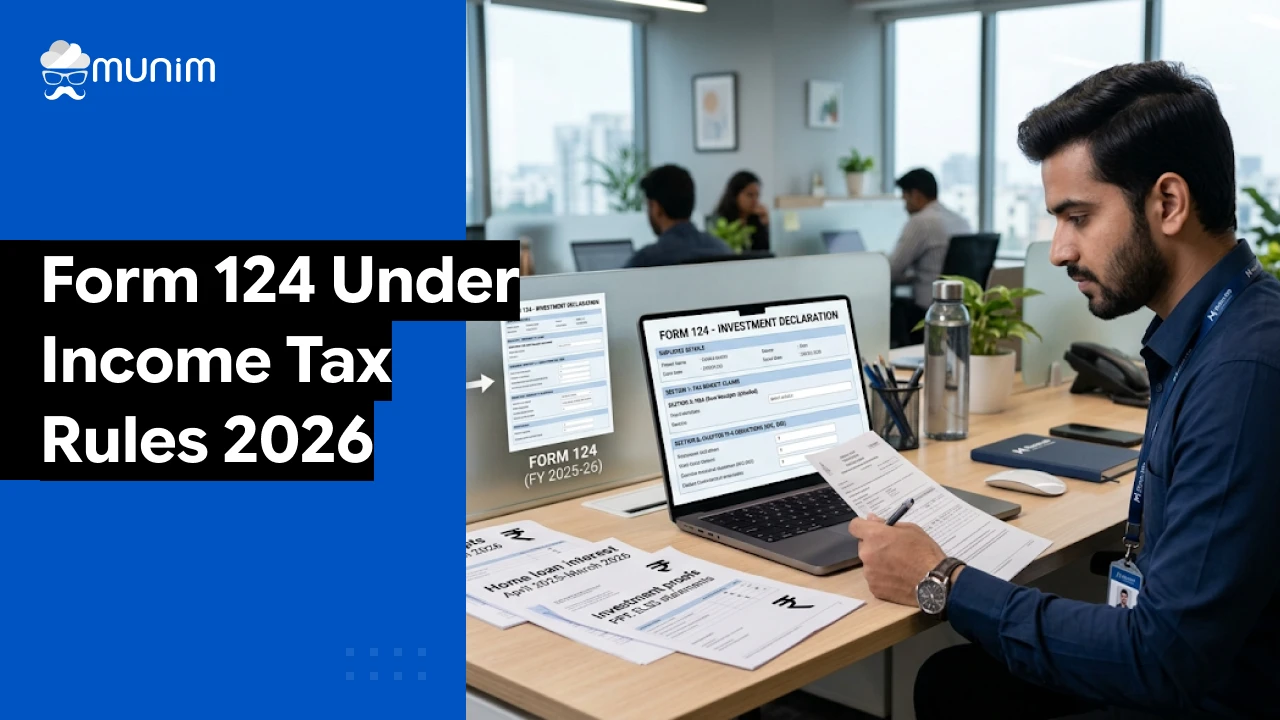
From April 1, 2026, Form 12BB has been replaced by Form 124 under the Income Tax Rules 2026. The purpose remains the same, but the form brings updated terminology, a two-part structure, and a new requirement to disclose landlord relationship details for HRA claims.
Starting Tax Year 2026-27, salaried employees in India will no longer submit Form 12BB to their employers. That familiar investment declaration form has been officially replaced by Form 124 under the Income Tax Rules 2026, which came into effect on April 1, 2026.
This article walks through everything relevant about Form 124, including what it is, how it differs from the old Form 12BB, what documents you need, and what happens if you do not file it.
What Is Form 124 Under Income Tax Rules 2026?
Form 124 is the new investment declaration form that salaried employees submit to their employer to claim tax deductions, exemptions, and allowances when computing taxable salary and TDS (Tax Deducted at Source).
It is provided under Section 392(5)(b) of the Income-tax Act, 2025, read with Rule 205 of the Income Tax Rules, 2026.
Without this form, the employer has no basis to consider those deductions. The result is higher TDS every month and a lower in-hand salary, even if the deductions are entirely valid.
Designed for Modern Tax Professionals
A premium filing solution for CAs and tax consultants who need speed, scale, and operational clarity.
 Handle multiple clients with ease
- Reconcile and validate with confidence
- Overcome the limitations of the GST portal
 Handle multiple clients with ease
What Is the Structure of Form 124?
Form 124 has two main parts:
Part A: Employee Details This section captures the basic information about the employee, including name, designation, address, PAN, contact details, and the relevant tax year.
Part B: Tax Benefit Claims with Annexures This section contains the actual declarations. It covers all the deductions, exemptions, and allowances the employee wishes to claim, supported by the required annexures and documentary evidence.
The overall layout is familiar to anyone who has filled Form 12BB before. The key updates are:
- References to the old Income-tax Act, 1961, have been replaced with references to the Income-tax Act, 2025
- The term “Assessment Year” is no longer used; it has been replaced with “Tax Year”
- The currency symbol “Rs.” has been updated to “₹”
- Taxpayer details have been standardized for consistency
What Deductions and Claims Does Form 124 Cover?
Form 124 covers the same range of deductions that Form 12BB used to cover. Here is what a salaried employee can declare:
House Rent Allowance (HRA)
An employee living in a rented property can claim HRA exemption by providing the following:
- Landlord’s name and complete address
- Monthly rent amount
- Landlord’s PAN (mandatory if annual rent exceeds ₹1,00,000)
- Copy of the rent agreement
New addition in Form 124: The form now requires employees to disclose their relationship with the landlord for HRA claims. If you are paying rent to a parent, sibling, or any relative, that must now be stated explicitly. This is designed to reduce misuse of HRA exemptions.
Leave Travel Allowance (LTA)
Employees can declare LTA claims for domestic travel undertaken by themselves and eligible family members. Boarding passes, flight or train tickets, or travel agent invoices must be submitted as proof. LTA applies only to domestic travel expenses and does not cover accommodation costs.
Home Loan Interest
Interest paid or payable on a housing loan can be declared under this section. The employee must provide:
- Name, address, and PAN of the lender
- Copy of the loan agreement
- Interest amount for the year
The deduction for home loan interest is up to ₹2 lakh per year for a self-occupied property under the relevant section of the new Act.
Chapter VI-A Deductions (80C, 80D, and Others)
This covers the wide range of tax-saving investments and expenses that salaried employees commonly declare, including:
- Section 80C / equivalent: Life insurance premiums, PPF contributions, ELSS mutual fund investments, NSC, Sukanya Samriddhi, tuition fees for up to two children, principal repayment on home loan, 5-year tax-saving FDs. Combined limit: ₹1.5 lakh.
- Section 80CCD(1B) equivalent: Additional contribution to NPS Tier I up to ₹50,000 (available only under the old regime).
- Section 80D equivalent: Medical insurance premiums for self, family, and parents. Up to ₹25,000 for self and family; up to ₹50,000 for senior citizen parents.
- Section 80E equivalent: Interest on education loans.
- Section 80G equivalent: Donations to eligible institutions.
Documents proving these investments or expenditures must be attached as supporting evidence.
Is Submitting Form 124 Mandatory?
No, Form 124 is not strictly mandatory. It only needs to be submitted if the employee wants the employer to consider tax-saving claims while computing taxable salary and TDS.
If an employee does not submit Form 124, the employer will deduct TDS without factoring in any deductions or exemptions. This means more tax gets cut from the monthly salary. The employee can still claim all valid deductions later when filing the Income Tax Return (ITR), but the excess TDS becomes a refund claim, which means less money in hand throughout the year.
So while it is not compulsory by law, submitting Form 124 is very much in the employee’s financial interest.
Conclusion
Form 124 is not a significant departure from the Form 12BB that salaried employees have been using for years. The declarations are largely the same. The deductions are the same. The process of submitting to the employer is the same. What has changed is the legal framework it sits under, a few structural improvements, and the addition of certain disclosures like landlord relationship details.
That said, the transition is real and official. From April 1, 2026, Form 12BB is no longer the valid format. Any employer still using the old form after this date is operating outside the updated rules.
Frequently Asked Questions (FAQs)
Is Form 12BB still valid from April 2026? No. Form 12BB is no longer valid for Tax Year 2026-27 onwards. It has been officially replaced by Form 124 under the Income Tax Rules, 2026. Employers should use the updated form from April 1, 2026.
What deductions can be claimed in Form 124? Form 124 covers HRA, LTA, home loan interest, and all Chapter VI-A deductions such as 80C (PPF, ELSS, LIC, NSC, tuition fees, home loan principal), 80D (medical insurance), 80CCD(1B) (NPS), 80E (education loan interest), and 80G (donations).
Can Form 124 be submitted online? Yes. Form 124 can be submitted electronically or physically to the employer.
What documents are needed for an HRA claim in Form 124? You will need a copy of the rent agreement, monthly rent receipts, the landlord’s name and address, the landlord’s PAN if annual rent exceeds ₹1,00,000, and disclosure of your relationship with the landlord.
Can a pensioner submit Form 124? Yes. Since pension is treated as deferred salary for income tax purposes, pension-receiving individuals can also submit a declaration equivalent to Form 124 to their pension-paying authority to ensure correct TDS on pension income.
Which cities are eligible for 50% HRA exemption from FY 2026-27?
From Tax Year 2026-27, the 50% HRA exemption is available in eight cities: Delhi, Mumbai, Kolkata, Chennai, Bengaluru, Pune, Hyderabad, and Ahmedabad. Employees in other cities are eligible for 40% HRA exemption.
Disclaimer: "This blog post is for informational purposes only. For specific tax advice related to your business, please consult a qualified Chartered Accountant or GST practitioner."
About the author

Mehul is a seasoned content writer with a passion for simplifying complex accounting and GST topics. With a keen interest in entrepreneurship and business management, he specializes in creating informative and engaging content for themunim.com. His goal is to help businesses understand and implement accounting and GST software solutions effectively. When he's not crafting content, Mehul enjoys exploring new places and spending time with his Golden Retriever.
Related Articles
Explore the latest market news, useful resources for business, and Munim updates.