
GSTR-4: Meaning, Due Date FY 2025-26, Applicability & How to File
 AuthorMehul Jagwani
 Reviewed ByCA Ajay Savani



- What Is GSTR-4? Meaning and Purpose
- GSTR-4 Applicability: Who Needs to File It?
- Designed for Modern Tax Professionals
- GSTR-4 Turnover Limit: What Counts?
- GSTR-4 Due Date FY 2025-26
- How to File GSTR-4: Step-by-Step
- Aggregate Turnover of Previous Financial Year in GSTR-4 — What It Means
- GSTR-4 vs CMP-08: What Is the Difference?
- Conclusion
- Frequently Asked Questions About GSTR-4
If you are registered under the Composition Scheme, GSTR-4 is the one annual return you cannot afford to miss. It covers your entire year’s summary — turnover, tax paid, and inward supplies — in a single form. This guide walks you through what GSTR-4 means, who must file it, the due date for FY 2025-26, and how to file it step by step.
What Is GSTR-4? Meaning and Purpose
GSTR-4 is the annual return that every composition taxpayer must file under GST. Prior to FY 2019-20, composition dealers filed GSTR-4 quarterly. The government then restructured the filing calendar — now, composition dealers pay tax through a quarterly challan (CMP-08) and file GSTR-4 just once a year.
The form captures a summary of:
- Total outward supplies (sales)
- Inward supplies attracting reverse charge
- Tax already paid via CMP-08 challans during the year
- Any additional tax liability or excess credit
GSTR-4 Applicability: Who Needs to File It?
GSTR-4 applicability covers all taxpayers registered under the GST Composition Scheme, including:
- Traders and manufacturers with aggregate turnover up to ₹1.5 crore
- Service providers (other than restaurant services) with turnover up to ₹50 lakh under the composition scheme
- Special category states where the threshold is ₹75 lakh
Designed for Modern Tax Professionals
A premium filing solution for CAs and tax consultants who need speed, scale, and operational clarity.
 Handle multiple clients with ease
- Reconcile and validate with confidence
- Overcome the limitations of the GST portal
 Handle multiple clients with ease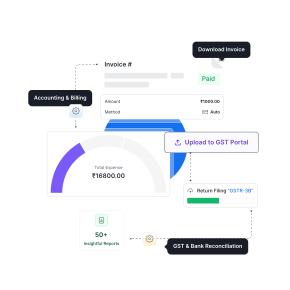
GSTR-4 Turnover Limit: What Counts?
The GSTR-4 turnover limit for the Composition Scheme is based on aggregate turnover in the previous financial year. Under GST, aggregate turnover includes all taxable supplies, exempt supplies, exports, and inter-state supplies — but excludes inward supplies taxable under reverse charge and taxes levied under CGST/SGST/IGST.
When the GST portal asks you to fill in “aggregate turnover of previous financial year in GSTR-4,” it means the total of all your business supplies across all GSTINs on the same PAN, not just one state registration.
Getting this figure right matters. It determines whether you remain eligible for the scheme and which tax rate applies to you.
GSTR-4 Due Date FY 2025-26
The GSTR-4 due date for FY 2025-26 is 30th April 2026.
This is the standard deadline set by the CBIC. Historically, the government has extended this deadline in certain years, but you should always target filing by 30th April to avoid penalties.
| Return Period | GSTR-4 Due Date |
| FY 2023-24 | 30th April 2024 |
| FY 2024-25 | 30th April 2025 |
| FY 2025-26 | 30th April 2026 |
Missing the deadline attracts a GST late fee of ₹50 per day (₹25 CGST + ₹25 SGST), capped at ₹2,000 for returns with nil tax liability, and ₹2,000 (₹1,000 CGST + ₹1,000 SGST) for others.
For quarterly tax payments, the CMP-08 challan due dates remain the 18th of the month following the quarter.
How to File GSTR-4: Step-by-Step
Filing GSTR-4 on the GST portal is straightforward once you have your records in order. Here is how to do it:
Step 1 — Log in to the GST Portal Go to gstin.gov.in and log in with your credentials.
Step 2 — Navigate to the Returns Dashboard Go to Services → Returns → Annual Return and select GSTR-4 for the relevant financial year.
Step 3 — Review Auto-Populated Data The portal auto-fills data from your CMP-08 challans and supplier invoices reported in GSTR-1. Cross-check this against your own records.
Step 4 — Fill in Table 4 (Inward Supplies) Report inward supplies from registered suppliers, unregistered suppliers, and supplies attracting reverse charge.
Step 5 — Declare Tax Payable and Paid The form computes your total tax payable based on declared turnover. Verify it matches what you already paid through CMP-08. Pay any balance before submitting.
Step 6 — Preview and File Download the preview PDF, verify all figures, then file using DSC (Digital Signature Certificate) or EVC (Electronic Verification Code).
Using the best GST return filing software can significantly reduce manual errors at this stage, especially when reconciling CMP-08 data with your sales records.
Aggregate Turnover of Previous Financial Year in GSTR-4 — What It Means
The GST portal specifically asks for “aggregate turnover of the previous financial year” when you open GSTR-4. This is not your taxable turnover alone.
Aggregate turnover = all supplies made across India on the same PAN, including:
- Taxable goods/services
- Exempt supplies
- Exports (zero-rated)
- Nil-rated supplies
It excludes taxes (CGST, SGST, IGST, Cess) and the value of inward supplies on which you pay tax under reverse charge.
If you run multiple branches under one PAN, add turnover from all of them. The portal uses this figure to validate your composition scheme eligibility for the next year.
GSTR-4 vs CMP-08: What Is the Difference?
Many composition dealers confuse these two.
CMP-08 is a quarterly statement-cum-challan. You file it four times a year to pay your advance tax based on estimated outward supplies. It is not an annual return — it is a payment mechanism.
GSTR-4 is the annual return. It reconciles all four CMP-08 payments against your actual annual turnover and tax liability. Any shortfall is paid with GSTR-4; any excess can be carried forward or refunded.
Both are mandatory. Missing either attracts separate penalties.
Conclusion
After reading this blog on GSTR-4, we hope all your questions about the businesses under the Composition scheme annual return are answered. If you still have any queries, feel free to contact us. If you want to simplify your GST filing process, we recommend signing up with Munim GST filing software. With this software, you can file GST returns with or without OTP.
Frequently Asked Questions About GSTR-4
Q: What does GSTR-4 mean?
GSTR-4 is the annual GST return filed by taxpayers registered under the Composition Scheme. It summarises total turnover, inward supplies, and tax paid for a full financial year.
Q: What is the GSTR-4 due date for FY 2025-26?
The due date is 30th April 2026.
Q: Who needs to file GSTR-4?
All composition scheme dealers — traders, manufacturers, and eligible service providers — must file GSTR-4 every year.
Q: Can I file GSTR-4 after the due date?
Yes, but you pay a late fee of ₹50 per day, capped at ₹2,000.
Q: What is the GSTR-4 turnover limit?
The Composition Scheme is available to businesses with aggregate turnover up to ₹1.5 crore (₹75 lakh for special category states, ₹50 lakh for eligible service providers).
Q: What is the aggregate turnover of the previous financial year in GSTR-4?
It is the total value of all supplies — taxable, exempt, and zero-rated — made across India under one PAN during the previous year, excluding taxes and reverse charge inward supplies.
Disclaimer: "This blog post is for informational purposes only. For specific tax advice related to your business, please consult a qualified Chartered Accountant or GST practitioner."
About the author
Related Articles
Explore the latest market news, useful resources for business, and Munim updates.