Types of Invoices in GST: All 16 You Need to Know in 2026
 AuthorMehul Jagwani
 Reviewed ByAjay Savani



Summary:
An invoice is more than a payment request. It is a legal document that records a transaction, supports GST filing, and protects both the seller and the buyer. There are multiple types of invoices used across different business scenarios in India, from a standard tax invoice under GST to a proforma invoice, credit note, or debit note.
Types of Invoices in GST: All 16 You Need to Know in 2026
Knowing the right types of invoice to use is not just a matter of good accounting practice. Under the GST framework, issuing the wrong type of document can affect your Input Tax Credit (ITC) eligibility, lead to compliance issues, and even invite scrutiny during audits.
Here is a comprehensive look at all 16 types of invoices that Indian businesses, Chartered Accountants, and tax professionals must know in 2026.
What Is an Invoice?
An invoice is a formal document issued by a seller to a buyer. It details the goods supplied or services rendered, the agreed price, applicable taxes, and the payment terms. Under the Goods and Services Tax (GST) regime in India, invoices serve as the primary document for claiming ITC and for recording outward supplies in returns like GSTR-1.
A valid tax invoice must include specific mandatory fields as prescribed under Rule 46 of the CGST Rules, 2017. These include the GSTIN of the supplier, a consecutive serial number, the date of issue, the description and HSN/SAC code of goods or services, the taxable value, the applicable tax rate, and the amount of CGST, SGST, or IGST charged.
Generate professional invoices with automatic GST calculations and HSN/SAC support. Read More!
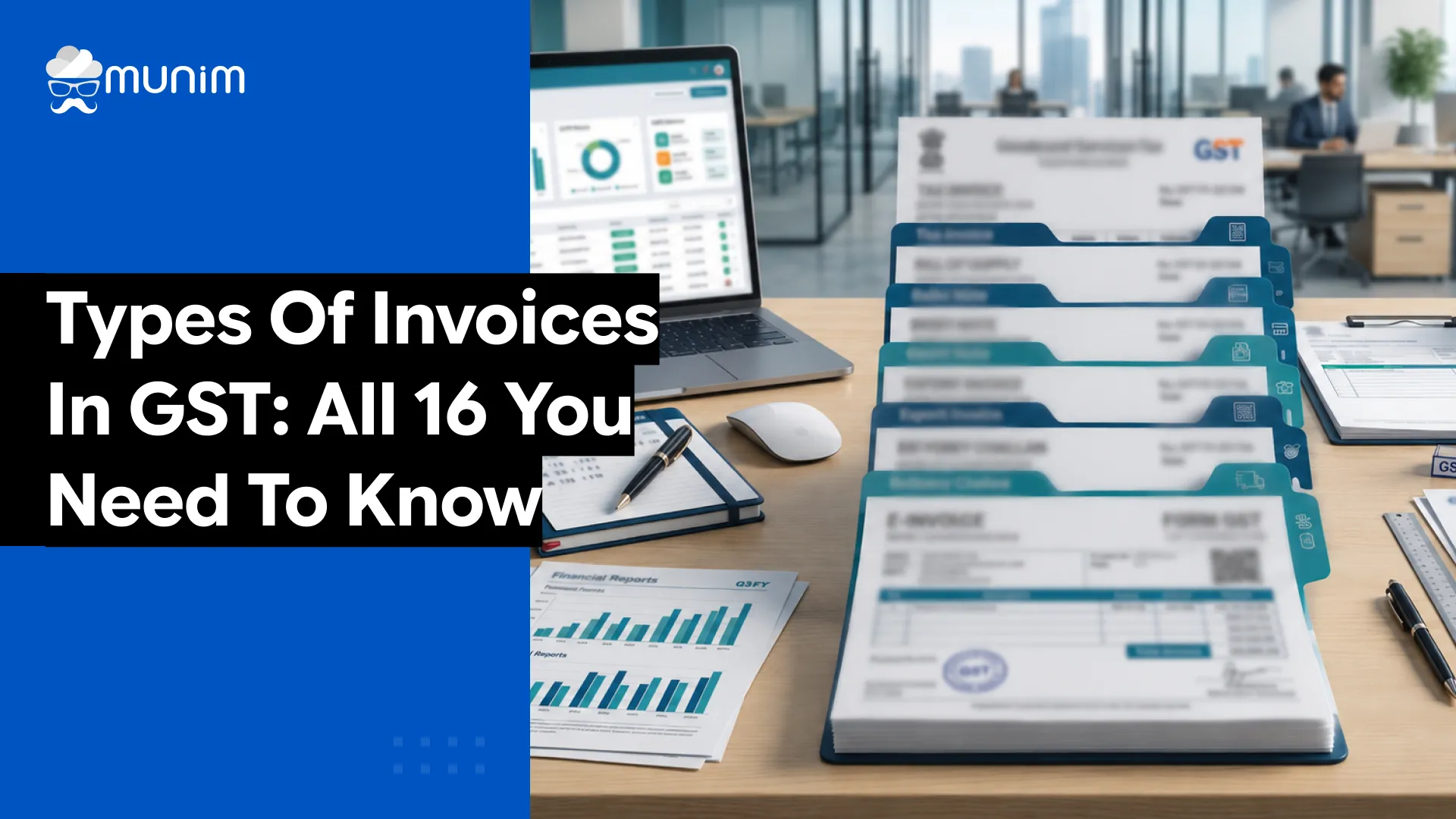
16 Types of Invoices in GST and Accounting
1. Tax Invoice
A tax invoice is the most fundamental document under GST. It is issued by a GST-registered supplier when supplying taxable goods or services to another registered or unregistered person. This is the primary document for claiming ITC.
When to use it: Every time a GST-registered business makes a standard taxable supply.
A tax invoice must be issued within 30 days of the supply of services, and immediately or within the prescribed time for goods.
2. Proforma Invoice
A proforma invoice is a preliminary bill or an estimated invoice sent before the actual delivery of goods or services. It is not a demand for payment. It gives the buyer a clear picture of what to expect in terms of price, quantity, and taxes.
When to use it: Before confirming a large order, for import or export clearances, or when a buyer requests cost confirmation before placing an order.
A proforma invoice does not create any legal obligation to pay and cannot be used to claim ITC.
3. Commercial Invoice
A commercial invoice is used primarily in international trade. It records the details of the goods being exported or imported, their value, quantity, country of origin, and terms of delivery. Customs authorities use it to assess duties and taxes.
When to use it: For any cross-border shipment of goods.
Indian exporters must ensure that the commercial invoice aligns with the shipping bill and other export documents to avoid customs delays.
4. Bill of Supply
A bill of supply is issued instead of a tax invoice in two specific situations: when a GST-registered supplier makes a supply of exempted goods or services, or when a supplier registered under the Composition Scheme makes any supply.
When to use it: Composition dealers cannot charge GST on their invoices. They must issue a bill of supply instead.
No tax amount is mentioned on a bill of supply, and the buyer cannot claim ITC based on this document.
5. Receipt Voucher
A receipt voucher is issued when a supplier receives an advance payment from a customer before the actual delivery of goods or performance of services. Under GST, receiving an advance triggers a tax liability on that advance amount.
When to use it: Any time a business collects advance payment against a future supply.
Once the actual supply happens, a proper tax invoice is issued and the receipt voucher is adjusted against it.
6. Refund Voucher
If an advance has been collected and a receipt voucher was issued, but the supply does not take place later, the supplier must return the advance and issue a refund voucher. This document cancels the tax liability created earlier.
When to use it: When a supplier refunds an advance due to order cancellation or inability to supply.
The refund voucher effectively reverses the tax obligation and is essential for maintaining accurate GST records.
7. Credit Note
A credit note is issued by the supplier to reduce the value of a previously issued invoice. This can happen due to goods being returned by the buyer, a downward revision in price after the invoice was issued, or if the goods or services are found to be deficient.
When to use it: Post-supply corrections where the taxable value needs to be reduced.
Under Section 34 of the CGST Act, a credit note must be declared in GSTR-1 for the month in which it is issued. It reduces the supplier’s output tax liability.
8. Debit Note
A debit note works in the opposite direction. It is issued by the supplier to increase the taxable value of a previously issued invoice, for example if additional charges apply or if the original invoice had an undercharge.
When to use it: When the value of supply increases after the original invoice was issued.
The recipient also has the right to issue a debit note to the supplier if they were overcharged or need to communicate a discrepancy.
9. Delivery Challan
A delivery challan is not an invoice in the traditional sense, but it is an important supporting document under GST. It is issued when goods are transported without a corresponding tax invoice, such as in the case of job work, goods sent on approval, or goods transported for reasons other than a sale.
When to use it: For job work dispatches, sample shipments, and goods sent on a returnable basis.
A delivery challan does not replace a tax invoice. The actual invoice is raised after the supply is confirmed.
10. E-Invoice
An e-invoice (electronic invoice) is a tax invoice that is generated through the Invoice Registration Portal (IRP) of the GST Network. The IRP assigns a unique Invoice Reference Number (IRN) to each invoice, along with a QR code. This makes the invoice verifiable in real time by tax authorities.
When to use it: Currently mandatory for businesses with an aggregate annual turnover exceeding Rs. 5 crore in any preceding financial year.
11. Recurring Invoice
A recurring invoice is used when a business provides the same goods or services to a client on a regular basis, such as monthly retainers, subscription services, annual maintenance contracts, or periodic consulting fees. Instead of creating a fresh invoice every billing cycle, the recurring invoice is replicated automatically.
When to use it: For subscription-based businesses, AMC contracts, and regular service agreements.
12. Interim Invoice
An interim invoice, also called a progress invoice, is issued partway through a long project. It covers the work completed up to a specific stage rather than waiting until the entire project is finished.
When to use it: Construction projects, large IT implementations, consulting projects, and any engagement that spans multiple months or milestones.
Interim invoices help maintain cash flow for the supplier and give the buyer a structured payment schedule aligned with project progress.
13. Final Invoice
A final invoice is issued at the completion of a project or after the last delivery in a multi-stage transaction. It accounts for all remaining amounts due, adjusting for any interim invoices or advance payments already made.
When to use it: At the end of a project or service engagement.
The final invoice often references all previous interim invoices and clearly shows the outstanding balance payable.
14. Consolidated Invoice
A consolidated invoice combines multiple supply transactions into a single document. Under GST, a registered supplier making multiple supplies to an unregistered person in a day can issue a single consolidated invoice for all those supplies instead of individual invoices.
When to use it: For bulk sales to unregistered buyers, such as in retail or wholesale trade.
This simplifies documentation and reduces the administrative burden for businesses that handle high transaction volumes.
15. Self-Billing Invoice
In standard practice, the supplier raises the invoice. In self-billing, the buyer raises the invoice on behalf of the supplier. This is common in industries like agriculture or raw material procurement, where the buyer consolidates supplies from multiple smaller vendors who may not have the resources or systems to invoice regularly.
When to use it: When agreed upon between buyer and supplier, especially in procurement of agricultural produce or unorganised sector supplies.
Both parties must agree to self-billing in writing, and the GST implications must be handled carefully.
16. Timesheet Invoice
A timesheet invoice is specific to service-based businesses that bill clients based on the number of hours worked. It details the person who worked, the tasks performed, the hours spent, and the applicable hourly rate.
When to use it: Freelancers, law firms, consulting firms, IT service providers, and agencies that charge on an hourly or per-project-hour basis.
A timesheet invoice typically includes a breakdown of hours alongside the service description, making it easy for clients to verify the charges.
Simplify Your Business Operations
Designed to give you speed, control, and accuracy in daily accounting tasks.
 Save time with automated accounting workflows
- Get 35+ detailed business reports easily
- Access your business anytime, anywhere
 Save time with automated accounting workflows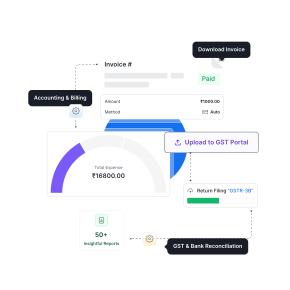
Summary Table: All 16 Types of Invoices at a Glance
| # | Invoice Type | Primary Use Case | GST Relevance |
| 1 | Tax Invoice | Standard taxable supply | Mandatory for ITC claim |
| 2 | Proforma Invoice | Pre-order estimation | Not valid for ITC |
| 3 | Commercial Invoice | International trade | Customs assessment |
| 4 | Bill of Supply | Exempt or composition supply | No tax charged |
| 5 | Receipt Voucher | Advance received | Tax on advance |
| 6 | Refund Voucher | Advance refunded | Reverses tax liability |
| 7 | Credit Note | Value reduction post-supply | Reduces output tax |
| 8 | Debit Note | Value increase post-supply | Increases output tax |
| 9 | Delivery Challan | Goods in transit without sale | Supports transport |
| 10 | E-Invoice | IRP-generated invoices | Mandatory above Rs. 5 Cr |
| 11 | Recurring Invoice | Periodic/subscription billing | Standard tax treatment |
| 12 | Interim Invoice | Progress billing | Partial tax liability |
| 13 | Final Invoice | Project completion | Settles outstanding dues |
| 14 | Consolidated Invoice | Multiple supplies to unregistered | Simplifies documentation |
| 15 | Self-Billing Invoice | Buyer raises invoice | Agreed arrangement |
| 16 | Timesheet Invoice | Hour-based billing | Service tax treatment |
Conclusion
Invoices are the backbone of any business transaction. Getting the right type right is not optional. It is a compliance requirement under GST and a best practice in accounting. Whether it is a simple tax invoice for a local B2B sale or an e-invoice for a large enterprise transaction, each document carries legal weight and tax implications.
For Indian businesses managing multiple transaction types, the task of issuing correct invoices quickly and consistently can become complex. A smart invoicing solution helps reduce that complexity significantly.
Reduce invoicing errors and simplify GST compliance with automated billing software. Know More!
Frequently Asked Questions
What are the main types of invoices under GST in India?
Under GST, the main types of invoices are the tax invoice, bill of supply, receipt voucher, refund voucher, credit note, debit note, delivery challan, and e-invoice. Each serves a specific purpose in the supply chain and affects tax liability or ITC eligibility differently.
What is the difference between a tax invoice and a bill of supply?
A tax invoice is issued for taxable supplies and allows the recipient to claim ITC. A bill of supply is issued for exempt supplies or by Composition Scheme dealers. No tax is charged on a bill of supply, and the recipient cannot claim ITC from it.
When should a credit note be issued under GST?
A credit note must be issued when the value of a supply is reduced after the original invoice was raised. Common reasons include goods being returned, a price revision, or the discovery that services were deficient. It must be declared in GSTR-1 for the relevant tax period.
Is a proforma invoice valid for claiming GST Input Tax Credit?
No. A proforma invoice is not a tax invoice and cannot be used to claim ITC. It is only an estimate or a pre-delivery document and has no legal standing under the CGST Act.
What is a receipt voucher in GST?
A receipt voucher is issued when a GST-registered supplier collects an advance payment from a customer before the goods are delivered or services are rendered. It records the advance and the GST liability on it.
What is the difference between a debit note and a credit note?
A credit note reduces the taxable value of an earlier invoice and lowers the supplier’s GST liability. A debit note increases the taxable value and raises the supplier’s liability. Both must be reported in GSTR-1 for the period in which they are issued.
Can a delivery challan replace a tax invoice?
No. A delivery challan is only used to move goods without a corresponding sale.
Disclaimer: "This blog post is for informational purposes only. For specific tax advice related to your business, please consult a qualified Chartered Accountant or GST practitioner."
About the author

Mehul is a seasoned content writer with a passion for simplifying complex accounting and GST topics. With a keen interest in entrepreneurship and business management, he specializes in creating informative and engaging content for themunim.com. His goal is to help businesses understand and implement accounting and GST software solutions effectively. When he's not crafting content, Mehul enjoys exploring new places and spending time with his Golden Retriever.
Related Articles
Explore the latest market news, useful resources for business, and Munim updates.