
Do You Need to File ITR If Your Income Is Not Taxable?
 AuthorMehul Jagwani
 Reviewed ByMadhav Bhayani



Summary:
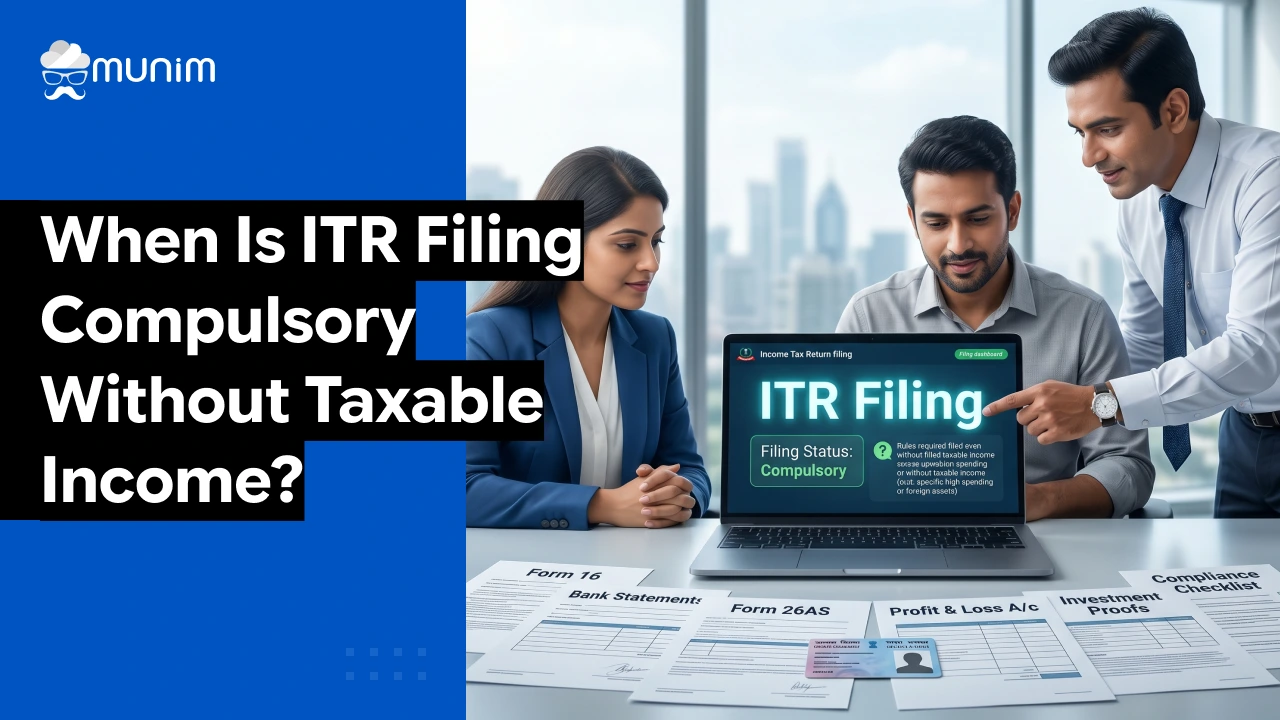
ITR filing is compulsory for certain individuals even when their income falls below the basic exemption limit. Under Section 139(1) of the Income Tax Act and Rule 12AB, specific high-value transactions, ranging from large bank deposits to foreign travel expenditure, trigger a mandatory filing obligation.
Most people think ITR filing is only for those who earn above the taxable limit. That is not entirely true. The Income Tax Act has specific provisions that make ITR filing compulsory based on what a person spends or deposits during the year, not just what they earn. These transaction-based triggers catch a surprisingly wide range of taxpayers, including retirees, homemakers, freelancers, and small business owners who may genuinely believe they have no filing obligation. Understanding these conditions is important, especially as the ITR season is now open.
What Is the Seventh Proviso to Section 139(1)?
Section 139(1) of the Income Tax Act ordinarily requires a person to file an ITR only if their total income exceeds the basic exemption limit. For individuals below 60 years, that limit is ₹2.5 lakh. For senior citizens (60 to 80 years), it is ₹3 lakh. For super senior citizens (above 80 years), it is ₹5 lakh.
The Seventh Proviso overrides this income-based threshold. It states that certain persons, even if their income does not cross the exemption limit, must still file an ITR if they have undertaken specified high-value transactions during the previous year. If you are unsure which regime applies to you, reviewing the key differences between the old and new tax regimes can help you understand how the basic exemption limit is applied in your case.
This provision applies to:
- Individuals
- Hindu Undivided Families (HUFs)
- Associations of Persons (AOPs)
- Bodies of Individuals (BOIs)
- Artificial juridical persons
It does not apply to companies or firms, since they are already required to file returns in every case, whether or not they have any income.
The logic behind this provision is straightforward. High-value transactions suggest financial capacity that is inconsistent with an income below the exemption limit. The government uses these filings to gather data, widen the tax base, and flag possible underreporting of income.
Designed for Modern Tax Professionals
A premium filing solution for CAs and tax consultants who need speed, scale, and operational clarity.
 Handle multiple clients with ease
- Reconcile and validate with confidence
- Overcome the limitations of the GST portal
 Handle multiple clients with ease
Transaction-Based Conditions That Make ITR Filing Compulsory
There are two sets of conditions: those from the original Seventh Proviso to Section 139(1), and the additional ones added later under Rule 12AB. Both are currently in force and applicable for FY 2025-26.
Conditions Under the Seventh Proviso to Section 139(1)
1. Current Account Deposits of ₹1 Crore or More
If the total deposits made in one or more current accounts with a bank or co-operative bank during the financial year equal or exceed ₹1 crore, ITR filing is mandatory. All types of deposits are covered here, whether made by cash, cheque, or online transfer. However, this condition applies only to current accounts. Savings accounts are covered separately under Rule 12AB.
2. Foreign Travel Expenditure Exceeding ₹2 Lakh
If a person has spent more than ₹2 lakh during the year on travel to a foreign country, whether for themselves or for any other person, the ITR filing obligation kicks in. This includes holiday travel, business travel, or medical travel abroad where the ticket and related expenditure is borne by the individual.
3. Electricity Bill Exceeding ₹1 Lakh
If the aggregate electricity consumption expenditure during the financial year crosses ₹1 lakh, compulsory ITR filing applies. This is one condition that catches many people off guard.
Conditions Under Rule 12AB (CBDT Notification No. 37/2022)
Rule 12AB added four more transaction-based conditions for compulsory ITR filing, effective from AY 2022-23 onwards.
1. Business Turnover Exceeding ₹60 Lakh
If total sales, turnover, or gross receipts from a business cross ₹60 lakh during the previous year, filing is mandatory, even if net income after expenses is below the exemption limit.
2. Professional Receipts Exceeding ₹10 Lakh
For those running a profession (doctors, lawyers, consultants, architects, etc.), if gross receipts from professional activities exceed ₹10 lakh in a year, ITR filing is compulsory, regardless of income after deducting expenses.
3. Aggregate TDS or TCS of ₹25,000 or More
If the total tax deducted at source (TDS) and tax collected at source (TCS) in a financial year adds up to ₹25,000 or more, a person must file an ITR. For senior citizens aged 60 or above, this threshold is higher, at ₹50,000 or more. This is an important provision because a person can have significant transactions subject to TDS without that income crossing the basic exemption limit in net terms. For a step-by-step walkthrough of TDS compliance, see how to file a TDS return and claim a tax refund online.
4. Savings Account Deposits of ₹50 Lakh or More
If the aggregate deposits across one or more savings bank accounts (including those with co-operative banks and post offices) during the financial year reach ₹50 lakh or more, ITR filing becomes mandatory. This condition applies to everyone, including senior citizens, without any age-based relaxation. If you want to understand what deposit thresholds the income tax department monitors on savings accounts more broadly, the savings bank account limit rules under the new Income Tax Act are worth reading.
Summary Table: All Transaction-Based ITR Filing Triggers at a Glance
| # | Trigger Condition | Threshold | Source |
| 1 | Current account deposits (bank / co-operative bank) | ₹1 crore or more | 7th Proviso, Sec 139(1) |
| 2 | Foreign travel expenditure (self or others) | Exceeds ₹2 lakh | 7th Proviso, Sec 139(1) |
| 3 | Electricity consumption expenditure | Exceeds ₹1 lakh | 7th Proviso, Sec 139(1) |
| 4 | Business sales / turnover / gross receipts | Exceeds ₹60 lakh | Rule 12AB |
| 5 | Gross receipts from profession | Exceeds ₹10 lakh | Rule 12AB |
| 6 | Aggregate TDS + TCS in the year | ₹25,000 or more (₹50,000 for senior citizens) | Rule 12AB |
| 7 | Aggregate savings account deposits | ₹50 lakh or more | Rule 12AB |
Any single condition from this list is sufficient to trigger the compulsory ITR filing obligation.
Additional Situations Where ITR Filing Is Mandatory
Beyond the transaction-based triggers, there are other situations under Section 139(1) where ITR filing is compulsory, regardless of income or transaction levels.
Foreign Assets or Signing Authority: If a person holds any asset outside India, is a beneficiary of any foreign asset, or has signing authority in any account outside India, filing is mandatory.
Losses to be Carried Forward: If a person has a loss under any head of income (house property, capital gains, business and profession) and wishes to carry it forward to set off against future income, the ITR must be filed within the due date.
Claim Under DTAA or Tax Relief: If a person is seeking any relief under Double Taxation Avoidance Agreements or claims foreign tax credit, an ITR must be filed.
Net Income Exceeding Basic Exemption Before Deductions: If gross income, before applying deductions under Chapter VI-A, exceeds the basic exemption limit, filing is required even if post-deduction income falls below it.
Conclusion
The days when ITR filing was purely an income-based exercise are behind us. The Seventh Proviso to Section 139(1) and Rule 12AB together make it clear that financial behaviour, not just income, determines whether an ITR is required.
For anyone who has made large bank deposits, paid high electricity bills, spent on foreign travel, received professional fees above ₹10 lakh, or had more than ₹25,000 in TDS deducted during FY 2025-26, the filing obligation exists regardless of income level.
The Annual Information Statement and the department’s data infrastructure now make it very difficult to stay below the radar. Filing correctly and on time is always the safer, simpler choice.
Frequently Asked Questions
1. Is ITR filing compulsory if my income is zero but I made large bank deposits?
Yes. If your current account deposits exceed ₹1 crore or your savings account deposits exceed ₹50 lakh during the year, ITR filing is mandatory regardless of income.
2. Does the ₹1 crore current account threshold include online transfers?
Yes. All modes of deposit, including cash, cheque, and online transfers into a current account, are counted toward the ₹1 crore threshold.
3. If my electricity bill is in my spouse’s name, does it apply to me?
The condition applies to electricity consumption expenditure incurred by the person. If you are actually paying the bill, even if the connection is in another name, it could be relevant.
4. Does foreign travel spending include visa and hotel costs, or only airfare?
The provision covers expenditure incurred on travel to a foreign country, for yourself or any other person. Most practitioners interpret this broadly to include all travel-related expenses such as air tickets, visa fees, hotel bookings, and foreign exchange spends directly linked to the trip.
Disclaimer: "This blog post is for informational purposes only. For specific tax advice related to your business, please consult a qualified Chartered Accountant or GST practitioner."
About the author

Mehul is a seasoned content writer with a passion for simplifying complex accounting and GST topics. With a keen interest in entrepreneurship and business management, he specializes in creating informative and engaging content for themunim.com. His goal is to help businesses understand and implement accounting and GST software solutions effectively. When he's not crafting content, Mehul enjoys exploring new places and spending time with his Golden Retriever.
Related Articles
Explore the latest market news, useful resources for business, and Munim updates.