

Intermediary Services Under GST: Everything Indian Businesses Need to Know
 AuthorMehul Jagwani
 Reviewed ByMadhav Bhayani




Summary:
Intermediary services under GST refer to services provided by a broker, agent, or facilitator who arranges a supply of goods or services between two or more parties without supplying on their own account. The place of supply for such services has historically been the supplier’s location in India, making cross-border intermediary transactions fully taxable. The Finance Act, 2026 has now changed this position fundamentally, and every Indian business involved in facilitation activities needs to understand the implications.
If your business earns income by connecting buyers with sellers, or by facilitating a transaction between two parties, GST treats you differently than a regular service provider. That distinction matters a lot, especially when cross-border transactions are involved.
Intermediary services under GST have been one of the most litigated topics in Indian indirect tax law since the GST rollout in 2017. The core issue? Businesses acting as brokers or agents for foreign clients were denied export benefits, making Indian intermediaries globally uncompetitive. The Finance Act, 2026 has now addressed this long-standing issue by omitting Section 13(8)(b) of the IGST Act, effective 30th March 2026.
This guide breaks down everything you need to know: what qualifies as an intermediary, how GST applies, what has changed post-Finance Act 2026, and how to stay compliant.
What Are Intermediary Services Under GST?
The Statutory Definition
Under Section 2(13) of the IGST Act, 2017, an intermediary is defined as:
A broker, an agent, or any other person, by whatever name called, who arranges or facilitates the supply of goods or services or both, or securities, between two or more persons — but does not include a person who supplies such goods or services or both or securities on his own account.
In plain terms, an intermediary is someone who acts as a middleman between two parties. They do not buy or sell goods or services on their own behalf. Their role is purely to connect, arrange, or facilitate a transaction for someone else.
A simple example: a commission agent who helps an Indian manufacturer find overseas buyers is an intermediary. The agent earns a commission, facilitates the deal, and is not the actual supplier or buyer of the goods.
Designed for Modern Tax Professionals
A premium filing solution for CAs and tax consultants who need speed, scale, and operational clarity.
 Handle multiple clients with ease
- Reconcile and validate with confidence
- Overcome the limitations of the GST portal
 Handle multiple clients with ease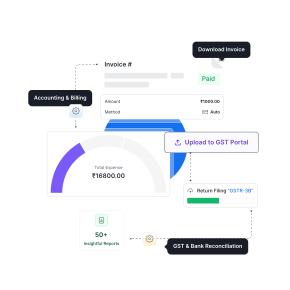
Key Characteristics of an Intermediary
For a service to qualify as intermediary services under GST, these features must be present:
- Three-party arrangement: There must be at least three distinct parties — the main supplier, the end recipient, and the intermediary facilitating the transaction.
- Facilitation, not supply: The intermediary arranges or facilitates a supply but does not provide the actual goods or services themselves.
- Commission or fee-based income: The intermediary typically earns through commission, brokerage, or a service fee, not by buying and selling.
- No own-account supply: The moment a party begins supplying goods or services on their own account, they no longer qualify as an intermediary under GST law.
GST Rate Applicable on Intermediary Services
The GST rate for intermediary services is 18%, applicable uniformly regardless of whether the transaction is domestic or cross-border (for cases where GST is payable).
For domestic intermediary transactions:
- Intra-state: 9% CGST + 9% SGST
- Inter-state: 18% IGST
Post-Finance Act 2026, for outbound intermediary services qualifying as exports:
- Zero-rated: 0% GST, with the option to claim ITC refunds
ITC on Intermediary Services: What Can Be Claimed?
Intermediaries registered under GST can claim Input Tax Credit on goods and services used in the course of providing intermediary services, subject to the standard ITC conditions:
- The goods or services must be used for business purposes
- A valid tax invoice must exist
- The supplier must have paid the tax to the government
- The supply must not fall under the negative list for ITC (Section 17(5) of the CGST Act)
Post-Finance Act 2026, Indian intermediaries exporting services can claim refunds of accumulated ITC when exporting under a Letter of Undertaking without payment of IGST. This improves cash flow significantly for export-oriented service providers.
Final Notes
Intermediary services under GST have come a long way from being one of the most disputed areas in Indian tax law to finally receiving a legislative resolution through the Finance Act, 2026. The omission of Section 13(8)(b) is a meaningful correction that brings the treatment of Indian intermediaries in line with destination-based GST principles.
For Indian businesses acting as brokers, agents, or facilitators for foreign clients, this change opens the door to zero-rated export status, ITC refunds, and more competitive pricing globally. But it also introduces new compliance responsibilities, particularly for businesses procuring intermediary services from foreign suppliers, who now face RCM liability for the first time.
Frequently Asked Questions (FAQs)
What is the definition of intermediary under GST?
Under Section 2(13) of the IGST Act, 2017, an intermediary is a broker, agent, or any other person who arranges or facilitates the supply of goods, services, or securities between two or more parties. Crucially, a person who supplies goods or services on their own account is excluded from this definition.
What is the GST rate on intermediary services?
Intermediary services attract 18% GST — either as 9% CGST + 9% SGST for intra-state transactions, or 18% IGST for inter-state transactions.
Does the RCM apply to intermediary services?
Post-Finance Act 2026, yes — for Indian businesses procuring intermediary services from foreign suppliers. Since the place of supply shifts to India (the recipient’s location), such transactions qualify as import of services, triggering RCM at 18% IGST. The Indian recipient must self-assess, pay the tax in cash, and issue a self-invoice.
Can an intermediary claim Input Tax Credit under GST?
Yes, an intermediary can claim ITC on goods and services used for providing intermediary services, subject to the standard ITC eligibility conditions under the CGST Act. Post-Finance Act 2026, Indian intermediaries exporting services can also claim refunds of accumulated ITC through Form RFD-01.
How many parties must be involved in an intermediary arrangement?
A minimum of three parties must be involved: the main supplier, the end recipient, and the intermediary facilitating the transaction between them.
Disclaimer: "This blog post is for informational purposes only. For specific tax advice related to your business, please consult a qualified Chartered Accountant or GST practitioner."
About the author

Mehul is a seasoned content writer with a passion for simplifying complex accounting and GST topics. With a keen interest in entrepreneurship and business management, he specializes in creating informative and engaging content for themunim.com. His goal is to help businesses understand and implement accounting and GST software solutions effectively. When he's not crafting content, Mehul enjoys exploring new places and spending time with his Golden Retriever.
Related Articles
Explore the latest market news, useful resources for business, and Munim updates.