
How to Start a Pooja Samagri Business in India: A Complete Step-by-Step Guide
 AuthorMehul Jagwani
 Reviewed ByCA Ajay Savani



Summary:
Starting a pooja samagri business in India can provide a steady income because people regularly buy these items throughout the year. You can sell products like agarbattis, diyas, camphor, flowers, and other religious items used in daily pooja. It can be started as a small shop, wholesale setup, or online store. Just focus on good suppliers, proper stock management, billing, and basic GST compliance. With simple planning, this business can grow steadily over time.
India runs on rituals. Every morning, millions of households light an agarbatti, fill a diya with oil, and arrange flowers on a puja thali. Festivals like Navratri, Diwali, Ganesh Chaturthi, and Dussehra bring a massive, predictable surge in demand. And that demand never really disappears; it only grows.
This guide covers how to start a pooja samagri business from scratch, from choosing a business model to GST registration, product sourcing, billing, and marketing.
How to Start a Pooja Samagri Business: Step-by-Step
Step 1: Research Your Local Market
Before investing a single rupee, spend two or three weeks understanding the demand in the chosen area.
Visit temples and note the timing and footfall. Talk to nearby shopkeepers. Check which items move fastest in the locality. A shop near a large Shiv temple will have very different demand from one near a Jain dharamshala or a coastal area with heavy festival boat processions.
Step 2: Choose Your Business Model
There are three main models for a pooja samagri business in India:
Retail shop: The most common model. A physical store in a market, near a temple, or in a residential colony. Works well with walk-in traffic and seasonal festival stocking.
Wholesale or distribution: Supplying to small retail shops, caterers, temples, and event planners. Requires higher initial stock but earns from volume. Good for towns with clusters of temples or religious institutions.
Online or hybrid: Selling through Amazon, Flipkart, Meesho, or a WhatsApp-based local delivery model. Low overhead, but requires good packaging and fast fulfilment. Many entrepreneurs now combine a small physical shop with an active online presence for maximum reach.
Pick one to start and expand later. Trying to do all three at once without proper systems usually ends in stock chaos and cash flow problems.
Step 3: Register Your Business
Business registration is a non-negotiable step, both legally and practically. Banks, suppliers, and online marketplaces require it.
Sole Proprietorship is the simplest structure for a small pooja samagri shop. Registration is minimal, and the owner takes full profit. However, the owner bears unlimited liability.
Partnership Firm suits two or three people starting together. A basic partnership deed registered with a notary is usually sufficient to start.
Private Limited Company or LLP makes sense if the plan is to scale, take outside investment, or run a larger wholesale operation. Registration is done through the Ministry of Corporate Affairs portal.
MSME/Udyam Registration is strongly recommended for any small business. It costs nothing, takes ten minutes online at udyamregistration.gov.in, and unlocks access to government schemes, priority sector lending, and credit guarantee programmes.
Shop and Establishment License is required for a physical store. The application is filed with the local municipal body. Each state has its own process.
Trade License from the municipality confirms that the nature of business is permitted at the premises.
Best business tips for small businesses. Know More!
Step 4: Understand GST Registration and Rates for Pooja Samagri
GST is a key compliance area that any pooja samagri business in India must get right from day one.
When is GST registration mandatory?
- Annual turnover exceeds ₹40 lakh
- Selling goods across state borders, even for a single sale
- Selling on e-commerce platforms like Amazon or Flipkart
- Availing Input Tax Credit on purchases
Even if turnover is below the threshold, voluntary registration can be beneficial if the business is buying from GST-registered suppliers and wants to claim Input Tax Credit on those purchases.
After registration, the business must file GSTR-1 monthly or quarterly to report outward sales, and GSTR-3B to pay net GST liability. Non-filing attracts late fees and can block the GSTIN.
Step 5: Source Your Products
Sourcing is where margins are made or lost. A good pooja samagri business builds two or three reliable supplier relationships early.
Where to source:
- Wholesale mandis: Ahmedabad’s Manek Chowk and Law Garden area, Delhi’s Khari Baoli and Sadar Bazar, Mumbai’s Bhuleshwar market, Kolkata’s Shyambazar — these are major distribution hubs for puja items.
- Direct from manufacturers: Cycle Brand and Mangaldeep agarbattis are widely distributed. For brass items, Moradabad in Uttar Pradesh is the country’s largest manufacturing hub.
- Online B2B platforms: IndiaMART and TradeIndia list hundreds of verified puja samagri suppliers. Minimum order quantities and credit terms are negotiable.
- Local distributors: Every major city has FMCG-style distributors who supply agarbattis, camphor, and packaged puja kits to retail shops.
Negotiate credit periods from the start. Most suppliers will offer 15 to 30 days credit once a working relationship is established.
Simplify Your Business Operations
Designed to give you speed, control, and accuracy in daily accounting tasks.
 Save time with automated accounting workflows
- Get 35+ detailed business reports easily
- Access your business anytime, anywhere
 Save time with automated accounting workflows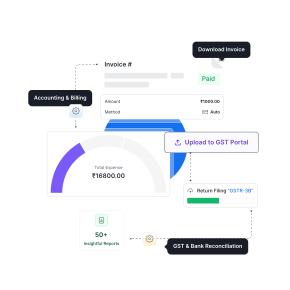
Step 6: Set Up Your Store or Online Presence
Physical store setup:
A 100 to 200 square foot shop is enough to start. Location matters enormously — near a temple, a religious market, or a dense residential colony is ideal. Good signage, clean display, and organised shelving make a big difference to perceived quality.
Invest in a proper billing counter. Handwritten bills are increasingly problematic for GST compliance, customer trust, and return management.
Online setup:
Listing on Amazon and Flipkart requires a GSTIN, a bank account, and product photographs with white backgrounds. The onboarding process takes three to seven days.
A WhatsApp Business account with a product catalogue is an effective and zero-cost tool for local delivery orders. Many pooja shops in Tier 2 and Tier 3 cities now take most of their orders through WhatsApp without any additional technology investment.
Step 7: Set Up Billing, Inventory, and Accounting
This is the step most first-time entrepreneurs skip — and it costs them dearly within a year. Poor billing and accounting creates three specific problems: GST mismatch notices from the tax department, inability to track which products are profitable, and cash leakage that goes undetected.
Billing: Every sale must generate a proper GST invoice or bill of supply (for exempt items). The bill must show the supplier’s name, address, GSTIN, item description, HSN code, quantity, rate, GST rate, and amount.
Inventory tracking: Pooja samagri involves dozens of SKUs, many with short shelf life (fresh flowers) and others with seasonal demand spikes. Tracking stock manually on paper leads to either overstocking perishables or running out of agarbattis during Navratri — both of which hurt profits.
Accounting: Recording purchases, sales, expenses, and payments in a structured ledger is the only way to know if the business is actually making money. It also makes annual tax filing, bank loan applications, and CA review far simpler.
Using cloud-based accounting software like Munim handles all three in one place. Munim allows a pooja samagri retailer to generate GST-compliant invoices, track inventory with stock-out alerts, file GSTR-1 and GSTR-3B returns, and access 35+ financial reports — all without needing a separate accountant for day-to-day entries.
Step 8: Price Your Products and Calculate Margins
Pricing strategy in pooja samagri is a balance between local competitive rates and sustainable margins.
Typical gross margin benchmarks:
- Packaged agarbattis and dhoop: 20 to 35%
- Brass items (idols, kalash): 40 to 60%
- Fresh flowers: 50 to 80% (high margin, high wastage risk)
- Puja gift sets and kits: 35 to 55%
Do not price below the local market just to attract customers. Pooja samagri buyers are loyal to convenience and quality, not just price. A regular customer who trusts the shop will pay a slight premium.
Step 9: Market Your Pooja Samagri Business
Marketing does not need to be expensive. The most effective channels for this category are:
Local presence and word of mouth: Quality, availability, and reliability build reputation faster than any advertisement. Ensuring the shop never runs out of key items during festival seasons builds long-term customer loyalty.
WhatsApp groups and broadcast lists: Sharing new arrivals, festival offers, and stock updates to local community groups and housing society groups drives repeat orders at zero cost.
Google Business Profile: A free listing on Google Maps ensures that anyone searching for “pooja samagri near me” can find the shop. Adding good photos and responding to reviews improves visibility significantly.
Social media: Short reels showing puja setup ideas, product unboxing, or festival thali arrangements on Instagram and YouTube Shorts are highly shareable and drive both online and offline enquiries.
Temple and priest network: Building relationships with local priests and pandits can lead to bulk order referrals, especially for weddings, griha pravesh ceremonies, and large puja events.
What Products Should a Pooja Samagri Business Carry?
The product range defines the shop’s character. A focused curated selection works better than an exhaustive one, especially at the start.
Core everyday items:
- Agarbatti (incense sticks) in multiple fragrances
- Dhoop sticks and cones
- Camphor tablets and camphor oil
- Diyas — earthen, brass, and electric variants
- Matchboxes and cotton wicks
- Kumkum, haldi, and sindoor
- Chandan (sandalwood powder)
- Vibhuti/bhasma
- Supari, elaichi, and cloves for puja use
- Fresh and dried flowers (marigold, rose, lotus)
- Coconuts and betel leaves
- Raw rice, sesame, and other grains for rituals
Occasional and festival items:
- Kalash sets (brass or copper)
- Puja thalis (steel, copper, or decorative brass)
- Idols — small Ganesha, Lakshmi, Durga in resin or brass
- Puja books and path collections
- Navratri and Diwali-specific sets
- Decorated puja boxes for gifting
- Janeu (sacred thread), moli, and roli sets
Premium or niche items:
- Rudraksha malas and rosaries
- Handmade agarbattis from Bengaluru or Ahmedabad suppliers
- Organic or chemical-free puja items (growing category in 2025–26)
- Puja kits in attractive packaging for corporate gifting
How Much Investment Does a Pooja Samagri Business Require?
The startup cost varies significantly based on scale and format.
| Business Format | Estimated Initial Investment |
| Small retail shop (100 sq ft, basic stock) | ₹1 lakh to ₹3 lakh |
| Medium shop (200 sq ft, full range) | ₹3 lakh to ₹8 lakh |
| Wholesale operation | ₹8 lakh to ₹25 lakh |
| Online-only (marketplace + WhatsApp) | ₹50,000 to ₹1.5 lakh |
Conclusion
A pooja samagri business in India is not just a retail venture — it is a participation in something that millions of families consider non-negotiable. The demand is real, the margins are workable, and the entry barriers are low enough for a motivated entrepreneur to start small and build steadily.
FAQs: How to Start a Pooja Samagri Business
Is a pooja samagri business profitable in India?
Yes. The business benefits from year-round demand driven by daily rituals and significantly higher sales during festival seasons.
Can I sell pooja samagri online on Amazon or Flipkart?
Yes. Both platforms have active puja and religious products categories.
How should I manage inventory for a pooja samagri business?
Using dedicated inventory management software helps track stock levels by SKU, set reorder alerts, and reduce wastage. Tools like Munim’s inventory management module allow HSN code assignment per product, multiple units of measure, and low-stock notifications that prevent stockouts during festival peaks.
Is there a scope for expanding a pooja samagri business into exports?
Yes. Diasporic Indian communities in the US, UK, Canada, and Gulf countries regularly seek authentic Indian puja items.
Disclaimer: "This blog post is for informational purposes only. For specific tax advice related to your business, please consult a qualified Chartered Accountant or GST practitioner."
About the author

Mehul is a seasoned content writer with a passion for simplifying complex accounting and GST topics. With a keen interest in entrepreneurship and business management, he specializes in creating informative and engaging content for themunim.com. His goal is to help businesses understand and implement accounting and GST software solutions effectively. When he's not crafting content, Mehul enjoys exploring new places and spending time with his Golden Retriever.
Related Articles
Explore the latest market news, useful resources for business, and Munim updates.