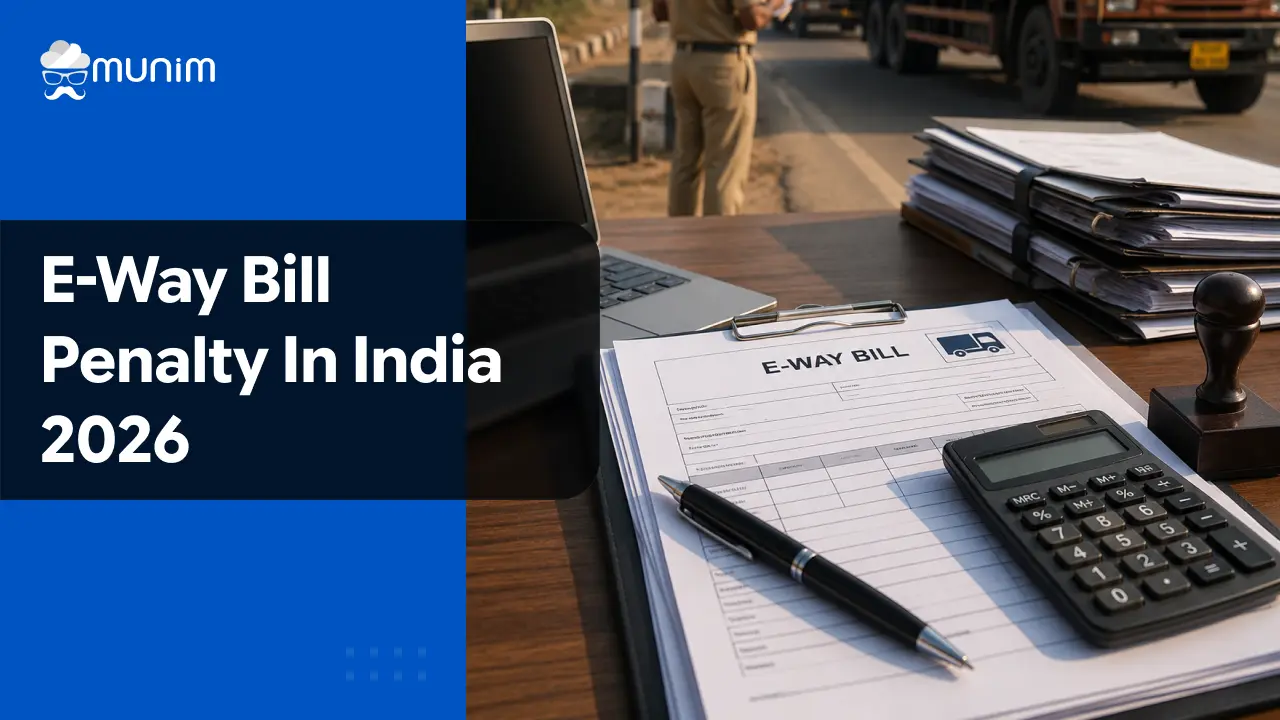
E-Way Bill Penalty in India 2026: Rules, Fines, and How to Stay Compliant
 AuthorMehul Jagwani
 Reviewed ByAjay Savani



Summary:
An e-way bill penalty in India can range from ₹1,000 for minor errors to 200% of the tax payable for serious violations under Sections 122 and 129 of the CGST Act, 2017. Transporting goods above ₹50,000 without a valid e-way bill, using an expired document, or mismatching invoice details can all trigger detention, fines, and even confiscation of goods.
Transporting goods across India without a valid e-way bill remains one of the most common GST compliance errors businesses make in 2026. Despite the system being in place for several years, the e-way bill penalty continues to catch businesses off guard, particularly when a document expires mid-transit or when invoice details do not match the bill. This article breaks down exactly what the rules say, how much the fines are, and what businesses should do to stay on the right side of the GST law.
What Is the E-Way Bill Penalty in India?
The penalty for e-way bill non-compliance falls under two main provisions of the CGST Act, 2017.
Penalty Under Section 122 of the CGST Act
Under Section 122(1)(xiv) of the CGST Act, any registered taxable person who transports goods without the required documents, including a valid e-way bill, is liable to a penalty of ₹10,000 or the amount of tax sought to be evaded, whichever is higher.
This means even a ₹500 shortfall in documentation can attract a minimum fine of ₹10,000. The law does not factor in intent at this level.
Penalty Under Section 129 of the CGST Act
Section 129 deals specifically with detention, seizure, and release of goods and conveyances. If an authorised GST officer intercepts a vehicle carrying goods without a valid e-way bill or with an expired one, the officer has the power to detain both the goods and the vehicle on the spot.
The penalty structure under Section 129, as amended by the Finance Act, 2021 (effective from 1 January 2022), is as follows:
| Situation | Penalty Applicable |
| Owner of goods comes forward (taxable goods) | 200% of the tax payable |
| Owner of goods comes forward (exempt goods) | 2% of the value of goods or ₹25,000, whichever is lower |
| Owner does not come forward | 50% of the value of goods reduced by the tax amount already paid |
| Minor errors (e.g., vehicle number off by two digits or characters) | ₹500 under CGST + ₹500 under SGST = ₹1,000 total under Section 125 |
The owner of the goods must respond and pay the penalty within seven days of the detention notice being issued. Failure to do so can escalate the matter to confiscation proceedings under Section 130 of the CGST Act.
Simplify Your Business Operations
Designed to give you speed, control, and accuracy in daily accounting tasks.
 Save time with automated accounting workflows
- Get 35+ detailed business reports easily
- Access your business anytime, anywhere
 Save time with automated accounting workflows
E-Way Bill Expired Penalty: What Happens When Validity Lapses?
An e-way bill expired penalty is one of the most frequently encountered compliance issues in India, particularly for long-distance consignments or goods stuck in transit due to delays.
How E-Way Bill Validity Is Calculated
The validity of an e-way bill is determined by the approximate distance between the point of origin and the point of destination. The current distance-based validity rule under Rule 138(10) of the CGST Rules, 2017 is as follows:
| Distance (Approximate) | Validity Period |
| Up to 200 km | 1 day |
| 201 km to 400 km | 2 days |
| 401 km to 600 km | 3 days |
| 601 km to 800 km | 4 days |
| For every additional 200 km or part thereof | 1 additional day |
| Over Dimensional Cargo (ODC): Up to 20 km | 1 day |
Important: Validity begins from the moment Part B of the e-way bill is first entered, not from when Part A is filled. The validity expires at midnight on the last valid day.
Example: A consignment travels from Surat to Pune, a distance of approximately 450 km. The e-way bill validity will be 3 days (1 day for the first 200 km, 1 day for the next 200 km, and 1 day for the remaining 50 km, which falls within the next 200-km bracket).
What Happens If an E-Way Bill Expires During Transit?
If the validity lapses while goods are still on the road, the consignment becomes non-compliant under GST. The transporter is legally prohibited from continuing the journey until the e-way bill is either extended or a new one is generated. Continuing movement with an expired bill is treated the same as transporting goods without an e-way bill and attracts the full penalty under Section 129.
Goods intercepted with an expired e-way bill can be detained on the spot by field officers. This can disrupt deliveries, damage business relationships, and result in significant financial loss.
How to Extend an Expired E-Way Bill
The CGST Rules allow the validity of an e-way bill to be extended. The extension window is 8 hours before expiry or up to 8 hours after the bill has expired. Beyond this 8-hour grace window, extension is no longer possible.
To extend, the generator must log in to the e-way bill portal, select the “Extend Validity” option, enter the e-way bill number, provide the reason, and update Part B with current vehicle and transport details.
E-Way Bill Penalty vs. Confiscation: Understanding the Difference
Detention under Section 129 gives the taxpayer an opportunity to pay the applicable tax and penalty and get the goods released. Confiscation under Section 130, however, is a more severe action. It is initiated when the detained person fails to pay within the stipulated period or when there is clear evidence of deliberate tax evasion.
Once goods are confiscated, their release requires not just payment of the applicable tax and penalty, but also an additional fine. Confiscated goods may eventually be auctioned by the department if fines remain unpaid.
Conclusion
The e-way bill penalty framework in India is clear, structured, and actively enforced. Fines can go up to 200% of the tax payable for serious violations, and goods can be detained or confiscated when compliance is not in order. With GSTN now running real-time data matching across invoices, returns, and transit documents, the chances of a mismatch being caught at a check post have only increased in 2026.
The good news is that most penalties are entirely preventable. Generating accurate bills before goods move, tracking validity periods closely, updating vehicle details when consignments change hands, and reconciling invoice data with e-way bill data before dispatch are habits that remove the majority of compliance risk.
FAQs on E-Way Bill Penalty in India 2026
Can the e-way bill be extended after it expires?
Yes, but only within 8 hours after the expiry.
Can an e-way bill be cancelled after it is generated?
Yes, an e-way bill can be cancelled within 24 hours of generation if the goods have not yet been moved or if the consignment does not materialise.
Is an e-way bill required for goods transported by rail or air?
Yes, e-way bills are required for goods transported by rail and air if the value of the consignment exceeds ₹50,000.
Is it necessary to carry a physical copy of the e-way bill?
Under GST rules, the transporter may carry either a physical copy of the e-way bill or show the e-way bill number to the officer digitally at the time of inspection.
Disclaimer: "This blog post is for informational purposes only. For specific tax advice related to your business, please consult a qualified Chartered Accountant or GST practitioner."
About the author

Mehul is a seasoned content writer with a passion for simplifying complex accounting and GST topics. With a keen interest in entrepreneurship and business management, he specializes in creating informative and engaging content for themunim.com. His goal is to help businesses understand and implement accounting and GST software solutions effectively. When he's not crafting content, Mehul enjoys exploring new places and spending time with his Golden Retriever.
Related Articles
Explore the latest market news, useful resources for business, and Munim updates.