
Monthly Bookkeeping Checklist for Small Business in India 2026:
 AuthorMehul Jagwani
 Reviewed ByAjay Savani



- Quick Reference: All Monthly Bookkeeping Tasks at a Glance
- Week 1: Start the Month With Clean Records
- Week 1 to 2: Bank Reconciliation and Payment Tracking
- Mid Month: Tax Compliance Tasks
- Week 3: Payroll and Employee Related Tasks
- Week 3 to 4: Review, Analyse, and Plan
- End of Month: Housekeeping and Preparation
- Download the Free Printable Checklist
- Common Bookkeeping Mistakes Indian Small Businesses Must Avoid
- Wrapping It Up
- Frequently Asked Questions

Summary:
Monthly bookkeeping for small businesses in India involves a recurring set of financial and compliance tasks that must be completed every month without fail. These include recording all sales and expense transactions, reconciling bank statements, filing GSTR 1 by the 11th and GSTR 3B by the 20th, depositing TDS by the 7th, processing payroll, paying PF and ESI contributions by the 15th, and reviewing the profit and loss statement, cash flow, and balance sheet before the month closes.
Every small business in India, whether it is a Surat textile trader or a Pune based IT consultancy, has the same core problem: too many financial deadlines, too little structure. A monthly bookkeeping checklist solves that. It turns scattered compliance duties into a repeatable routine. With the GST portal tightening ITC matching through GSTR 2B, the Income Tax Department pulling data from AIS for automated scrutiny, and e-invoicing thresholds dropping to Rs 5 crore, getting the books right every month is no longer just good practice. It is protection.
This guide is organised week by week. Below is a quick reference table covering all tasks at a glance. After that, each task is explained in detail. A downloadable PDF version of the checklist is also available for those who prefer to print it and pin it near their desk.
Quick Reference: All Monthly Bookkeeping Tasks at a Glance
| Week | Task | Deadline | Key Action |
| Week 1 | Record all transactions | By 3rd | Enter every sale, purchase, expense, and receipt into accounting software |
| Week 1 | Organise invoices | By 3rd | File sales and purchase invoices; verify GSTIN, HSN/SAC codes |
| Week 1 | Verify petty cash | By 5th | Match petty cash register to actual cash in hand |
| Week 1 to 2 | Reconcile bank statements | By 7th | Compare book entries with bank statement; resolve differences |
| Week 1 to 2 | Follow up on receivables | By 7th | Review ageing report; chase overdue invoices |
| Week 1 to 2 | Clear payables | By 10th | Pay outstanding vendor bills, rent, EMIs |
| By 7th | Deposit TDS | 7th of following month | File challan via Income Tax portal |
| By 11th | File GSTR 1 | 11th of following month | Report outward supplies (or use IFF for QRMP filers) |
| By 20th | File GSTR 3B | 20th of following month | Summary return with ITC claim and net GST payable |
| Mid month | GST reconciliation | By 20th | Match GSTR 1, GSTR 2B, and GSTR 3B with books |
| Week 3 | Process payroll | By 15th | Calculate salary, deduct TDS, PF, ESI |
| By 15th | Deposit PF and ESI | 15th of following month | Pay to EPFO and ESIC portals |
| Week 3 to 4 | Review financial statements | By 25th | Check P&L, cash flow, and balance sheet |
| End of month | Back up data | Last working day | Save to local drive and cloud |
| End of month | Archive documents | Last working day | Store invoices, challans, statements, payslips |
Want a printable version? A free downloadable PDF of this checklist is available at the end of this post.
Simplify Your Business Operations
Designed to give you speed, control, and accuracy in daily accounting tasks.
 Save time with automated accounting workflows
- Get 35+ detailed business reports easily
- Access your business anytime, anywhere
 Save time with automated accounting workflows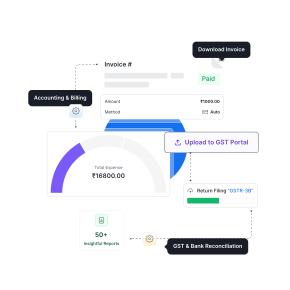
Week 1: Start the Month With Clean Records
The first week is about closing out the previous month properly so the starting position is accurate.
Record All Business Transactions
- Enter every sale, purchase, expense, and receipt from the previous month into the accounting system. Cash payments, UPI receipts, bank transfers, card swipes — nothing should be left out.
- Many small businesses in India still rely on rough notebooks or scattered WhatsApp messages. That approach breaks down fast. Tools like Munim Accounting & Billing software have made data entry significantly faster in 2026.
- Practical rule: No transaction older than 48 hours should go unrecorded. The longer a business waits, the higher the chance of missing entries entirely.
Organise and File Invoices
- Sort and file both sales invoices (issued to customers) and purchase invoices (received from vendors).
- For GST registered businesses, verify that every invoice carries the correct GSTIN, HSN/SAC code, and tax breakup.
- Since August 2025, the GST portal has tightened matching between GSTR 1 (outward supplies) and GSTR 2B (auto populated inward supplies). A missing or incorrect invoice now triggers an automatic mismatch notice.
Review Petty Cash
- Verify the petty cash register against the actual cash in hand. Investigate any shortfall or excess immediately.
- Small cash payments for tea, courier charges, auto fares, stationery, and repairs add up quickly over a month.
- Tip: For businesses in cities like Mumbai, Delhi, or Ahmedabad with frequent petty cash transactions, maintaining a simple spreadsheet alongside the cash box works well.
Week 1 to 2: Bank Reconciliation and Payment Tracking
Reconcile Bank Statements
- Compare every entry in the accounting software with the actual bank statement to identify differences. This is the backbone of any monthly bookkeeping routine.
- Common mismatches to look for:
- Cheques issued but not yet cleared
- Bank charges not recorded in the books
- Direct deposits from customers that were missed
- Auto debit payments for subscriptions or EMIs
- In 2026, most Indian banks offer downloadable statements in CSV or Excel format. Importing these into accounting software and running an automated reconciliation saves hours.
- Goal: The closing balance in the books must match the bank statement. If it does not, the error needs to be found before moving forward.
Follow Up on Outstanding Receivables
- Review the accounts receivable ageing report at the start of every month. It shows which customers owe money and for how long.
- Invoices 30 days overdue need a polite reminder. Those crossing 60 or 90 days need a firmer follow up, possibly a call or formal notice.
- With India’s UPI infrastructure processing over 18 billion transactions in March 2026 alone, there is little excuse for delayed payments.
Clear Outstanding Payables
- Track all vendor payments, utility bills, rent, and loan EMIs under accounts payable.
- Paying vendors on time directly affects input tax credit (ITC) claims under GST. If a vendor does not report the sale in their GSTR 1 because they have not received payment, the buyer may not see it in GSTR 2B, leading to ITC mismatches.
Mid Month: Tax Compliance Tasks
Tax compliance in India follows strict monthly deadlines. Missing even one can result in penalties, interest, and unnecessary scrutiny.
Deposit TDS (Tax Deducted at Source)
- Deposit the deducted TDS amount with the government by the 7th of the following month. Applies to TDS on rent, professional fees, contractor payments, and salary.
- Example: TDS deducted in May 2026 must be deposited by 7th June 2026.
- Payment is made through the Income Tax portal using a challan. Record the challan details in the books immediately.
- Penalty for delay: 1.5% per month on the outstanding amount. A common mistake is deducting TDS but forgetting to deposit it on time.
File GSTR 1 (Outward Supplies)
- File GSTR 1 by the 11th of the following month (for monthly filers). This return reports all outward supplies (sales).
- Businesses under the QRMP scheme (Quarterly Return Monthly Payment) file quarterly but must use the Invoice Furnishing Facility (IFF) to report B2B invoices in the first two months of each quarter.
- Getting GSTR 1 right is critical because it feeds into the buyer’s GSTR 2B. Any error here affects someone else’s ITC claim.
File GSTR 3B (Summary Return)
- File GSTR 3B by the 20th of the following month for businesses with annual turnover above Rs 5 crore. For QRMP filers, the quarterly deadline applies, but monthly tax payment through PMT 06 is still required by the 25th.
- GSTR 3B reports total sales, total purchases, ITC claimed, and net GST payable.
- Before filing: Cross check the ITC claimed with the GSTR 2B auto populated data. The GST authorities use advanced data analytics to spot discrepancies, and unexplained ITC claims attract notices quickly.
Reconcile GST Data
- Match the books of accounts with the GST returns filed to ensure there are no gaps.
- Verify that:
- Every invoice issued is reported in GSTR 1
- Every purchase invoice received is reflected in GSTR 2B
- ITC claimed in GSTR 3B matches eligible ITC in GSTR 2B
Week 3: Payroll and Employee Related Tasks
Process Payroll
- Calculate gross salary for each employee, deduct TDS under Section 192, deduct the employee’s share of PF and ESI (if applicable), and arrive at the net pay.
- In 2026, most small businesses with five or more employees will use payroll software. For those with fewer employees, a simple salary register with all deductions clearly recorded is sufficient.
Deposit PF and ESI Contributions
- Deposit Provident Fund (PF) contributions by the 15th of the following month. ESI contributions follow the same deadline.
- Late deposit penalty: Interest at 12% per annum for PF, plus additional penalties under ESI.
- The EPFO and ESIC portals now issue automated reminders, but relying solely on those is risky. Build the deposit dates into the bookkeeping routine a few days before the actual due date to account for banking delays.
Maintain the Salary Register and Payslips
- Generate a payslip for every employee showing gross pay, deductions, and net pay.
- Maintain a salary register. This is a legal requirement under the Payment of Wages Act and the new Labour Codes being rolled out across states.
- Even if no employee ever asks for a payslip, maintaining this record protects the business during audits and inspections.
Week 3 to 4: Review, Analyse, and Plan
Review the Profit and Loss Statement
- The monthly P&L statement shows total revenue, total expenses, and the resulting profit or loss. Review it once all transactions are recorded and taxes are filed.
- Do not wait until the end of the year. A monthly review reveals trends early: an expense category growing too fast, shrinking margins, or an underperforming product line. These questions are best answered monthly, not annually.
Check the Cash Flow Statement
- Profit and cash flow are not the same thing. A business can be profitable on paper but still run out of cash if receivables are stuck or large payments are due.
- The monthly cash flow statement shows how much cash actually came in, how much went out, and the closing cash position.
- Especially important for businesses dealing with seasonal demand (garment businesses before Diwali, AC repair services before summer). Monthly tracking is the only way to plan working capital needs.
Update the Balance Sheet
- Review the balance sheet snapshot at the end of each month. It shows what the business owns (assets), what it owes (liabilities), and the owner’s equity.
- Even a basic monthly review helps business owners track whether the business is building wealth or accumulating debt.
Analyse Key Financial Ratios
- Current ratio (current assets divided by current liabilities): shows short term financial stability.
- Gross margin percentage: shows how efficiently the business converts sales into profit before operating expenses.
- Debtor days: shows how long customers take to pay on average.
- None of these require advanced accounting knowledge. Most accounting software in India generates them automatically.
End of Month: Housekeeping and Preparation
Back Up Financial Data
- Take a complete backup of all financial data and store it in at least two locations: one on a physical drive and one on a cloud service.
- Cloud based accounting tools handle backups automatically, but verifying that the backup is current and accessible is still a good practice.
- Data loss is a real risk, especially for businesses relying on local installations of software like Tally.
Review and Update the Fixed Asset Register
- Add any new asset purchased during the month (laptop, machinery, furniture, vehicle) to the fixed asset register with the purchase date, cost, and depreciation rate.
- Remove any asset that was sold or discarded.
- This register matters for claiming depreciation under the Income Tax Act, which directly reduces taxable income.
Verify Statutory Compliance Calendar for the Next Month
- Check the compliance calendar for the upcoming month before closing:
- Are there quarterly TDS return filings due?
- Is it a month for advance tax payment (June, September, December, or March)?
- Are there state level deadlines such as professional tax?
- Staying a step ahead prevents last minute scrambles.
Archive Documents
- Archive all invoices, bank statements, payment receipts, challan copies, and employee records for the month.
- Physical documents: Use a labelled folder system.
- Digital documents: Use a structured folder on Google Drive, Dropbox, or a dedicated document management tool.
- Retention requirement: The Income Tax Act requires records for at least eight years from the end of the relevant assessment year. GST records must be kept for at least six years.
Download the Free Printable Checklist
A PDF version of this monthly bookkeeping checklist is available for download. Print it, pin it near the desk, and check off each task as the month progresses. It covers all 20+ tasks with indicative deadlines, organised by week. No signup required.
PDF Version of Monthly Bookkeeping Checklist. Download Now!
Common Bookkeeping Mistakes Indian Small Businesses Must Avoid
Even with a solid routine in place, mistakes happen. Here are the ones that show up most often.
Mixing personal and business finances. This is the number one issue with sole proprietors and small partnership firms. Every business should have a dedicated current account, and personal expenses should never flow through it.
Ignoring small cash transactions. That Rs 200 auto fare or Rs 500 courier charge might seem insignificant, but over a year, unrecorded small transactions can lead to thousands of rupees in unexplained differences.
Delaying GST reconciliation. Waiting until the annual return to reconcile GST data almost always leads to mismatches, penalties, and stress. Monthly reconciliation is the only sustainable approach.
Not reviewing financial statements. Recording transactions is only half the job. The other half is reviewing what the numbers say. Business owners who do not read their own P&L statement every month are essentially driving blind.
Relying entirely on the CA. A chartered accountant is essential for compliance and advisory work, but the day to day discipline of keeping books must come from within the business. The CA can review and audit, but the business owner or an in house accountant must maintain the records.
Wrapping It Up
A monthly bookkeeping checklist is not just about compliance. It is about clarity. When a small business owner knows exactly where the money is coming from, where it is going, and what the tax obligations look like, every business decision becomes more informed and more confident.
The tasks outlined in this guide are not complicated individually. Recording transactions, reconciling banks, filing GST returns, and reviewing financial statements are all straightforward when done regularly. The challenge is consistency. And that is precisely what a structured checklist solves.
Frequently Asked Questions
How often should a small business reconcile its bank statements?
Ideally, bank reconciliation should be done every month. For businesses with high transaction volumes, a weekly reconciliation is even better. The goal is to identify and resolve discrepancies before they snowball into larger issues.
What is the deadline for filing GSTR 1 in India?
GSTR 1 must be filed by the 11th of the month following the tax period. For example, the GSTR 1 for May 2026 is due by 11th June 2026. Businesses under the QRMP scheme file GSTR 1 quarterly but should use the IFF facility for B2B invoices in the first two months.
What is the penalty for late TDS deposit in India?
Late deposit of TDS attracts interest at 1.5% per month (or part of a month) from the date the TDS was deducted to the date it is actually deposited. Additionally, a penalty under Section 271C may apply for failure to deduct or deposit TDS.
Disclaimer: "This blog post is for informational purposes only. For specific tax advice related to your business, please consult a qualified Chartered Accountant or GST practitioner."
About the author

Mehul is a seasoned content writer with a passion for simplifying complex accounting and GST topics. With a keen interest in entrepreneurship and business management, he specializes in creating informative and engaging content for themunim.com. His goal is to help businesses understand and implement accounting and GST software solutions effectively. When he's not crafting content, Mehul enjoys exploring new places and spending time with his Golden Retriever.
Related Articles
Explore the latest market news, useful resources for business, and Munim updates.