Budgeting Software vs Accounting Software: What Should a Small Business Use?
 AuthorMehul Jagwani
 Reviewed ByAjay Savani



Summary:
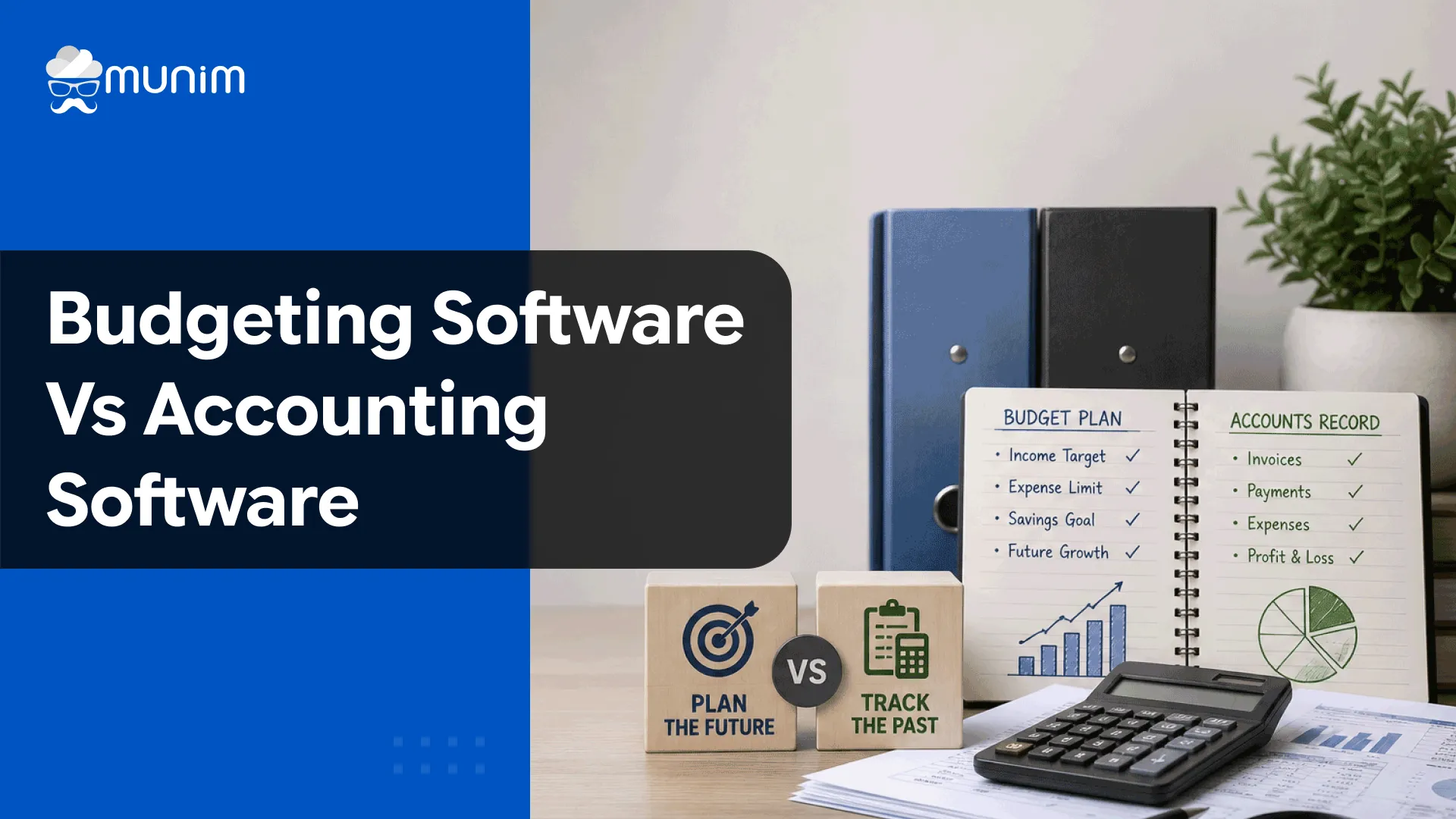
Budget software helps a small business plan future income, expenses, and cash requirements. Accounting software records actual transactions and supports invoicing, GST compliance, reconciliation, and financial reporting. Most established Indian businesses need accounting software first.
The main difference between budget software and accounting software is that one supports planning while the other records financial transactions and assists in compliance work.
In this blog, we will understand how budget software is different from accounting software and what small businesses require while starting a business.
What Is the Main Difference Between Budgeting and Accounting Software?
The following is the difference between budgeting and accounting software in detail:
| Area | Budget software | Accounting software |
| Main purpose | Financial planning and control | Transaction recording and financial management |
| Time focus | Future | Present and past |
| Primary data | Estimates and assumptions | Actual invoices, receipts, payments, and entries |
| GST invoicing | Usually not available | Commonly available |
| Ledger management | Limited or unavailable | Core function |
| Bank reconciliation | Sometimes limited | Commonly supported |
| Financial statements | Forecast reports | Actual profit and loss statement and balance sheet |
| Variance analysis | Core function | Available in some systems |
| Cash flow forecasting | Common | Available in selected systems |
| Compliance support | Limited | Often supports Indian tax workflows |
| Main users | Business owners and management | Owners, accountants, finance teams, and CAs |
| Best suited for | Planning revenue, expenses, and cash | Maintaining accurate books and compliance records |
Both tools serve different purposes; hence, they should not be treated as a substitute for each other.
Simplify Your Business Operations
Designed to give you speed, control, and accuracy in daily accounting tasks.
 Save time with automated accounting workflows
- Get 35+ detailed business reports easily
- Access your business anytime, anywhere
 Save time with automated accounting workflows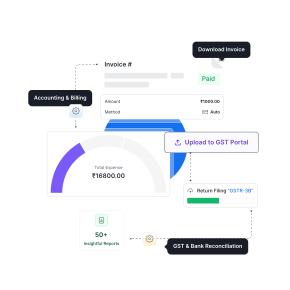
What Is Budget Software?
The Budget Software is a financial planning tool that assists a business to forecast its projected cashflow, and income and expenses for a future period.
A business can use it to prepare monthly, quarterly, or annual budgets. It can also help to compare the expected figures with the actual ones and find out in which areas the business is lagging behind.
For example, a small manufacturer may estimate the following monthly expenses:
- Raw materials worth ₹4 lakh
- Salaries of ₹1.5 lakh
- Rent and utilities of ₹60,000
- Marketing expenses of ₹40,000
- Loan repayment of ₹50,000
Budgeting software organises these estimates and helps management understand whether the expected sales will be sufficient to cover them.
It answers questions such as:
- How much can the business afford to spend?
- Will enough cash be available to pay suppliers?
- Can the business hire another employee?
- Is the marketing budget producing adequate returns?
- How much working capital will be needed next quarter?
- What happens if sales decline by 10 percent?
What Is Accounting Software?
Accounting software keeps track of financial transactions and classifies them according to the business they occur in, and reports them.
It can help an Indian small business to make invoices, record purchases, track payments, maintain ledgers, reconcile bank transactions, handle GST information and prepare financial reports. As financial operations become increasingly digital, businesses can also use technologies such as conversational AI in finance to streamline financial interactions, answer routine queries, and provide faster access to relevant financial information.
A typical accounting system may handle:
- Sales and purchase entries
- GST invoices
- Receipt and payment vouchers
- Customer and supplier ledgers
- Accounts receivable
- Accounts payable
- Bank reconciliation
- Inventory records
- Profit and loss statements
- Balance sheets
- Cash flow reports
- E-invoices and e-way bills
- GST return-related data
Therefore, an accounting software is concerned primarily with completed transactions and the present financial position of the business.
Why Do Indian Small Businesses Need Accounting Software First?
The vast majority of businesses that are running need to maintain records of the sales, purchases, receipts, payments, taxes and outstanding balances daily. These transactions have a direct impact on cash flow, collections from customers, payments to suppliers and statutory obligations.
An accounting system is required prior to budgeting software for the reasons listed below.
Reason#1: The Business Needs Reliable Books of Accounts
If sales, expenses, assets, liabilities, and payments are not recorded accurately, it will be difficult for a business to make financial decisions.
It may be possible to plan using spreadsheet estimates, but this does not necessarily give an accurate accounting trail. Accounting software will enable each reported amount to be traced back to the appropriate transaction.
Reason#2: Businesses Need to Track Customer and Supplier Balances
A business may appear profitable but still face a cash shortage because customers have not paid on time.
Accounting software can show:
- Customers with overdue invoices
- Amounts payable to suppliers
- Upcoming liabilities
- Credit notes and debit notes
- Unadjusted advances
- Ageing of receivables
- Available cash and bank balances
With budget software, you might be able to forecast collections, but not necessarily keep a record of each customer’s ledger.
Reason#3:Actual Accounting Data Makes Budgets More Reliable
A budget built entirely on assumptions can quickly become unrealistic.
Accurate accounting records provide factual information to help with planning. Once a business has finished preparing a budget, it can review actual sales, gross margins, seasonal costs, collection timelines and how suppliers pay.
That’s why accounting should be the first thing done. A good historical record makes for a better forecast.
When Does a Small Business Need Budget Software?
Budget software is necessary for a business that requires more detailed financial planning.
This usually happens when the business has:
- Multiple departments or locations
- Several product lines
- Regular differences between planned and actual spending
- Seasonal sales or purchasing cycles
- Large inventory requirements
- Business loans or repayment commitments
- Expansion plans
- Multiple people responsible for approving expenses
- Frequent cash flow shortages
- Investors or lenders requiring forecasts
For a new business, a simple month-to-month budget can be created on a spreadsheet. When operations begin to expand, dedicated budget software can help with planning, version control, approvals, and variance analysis.
Frequently Asked Questions
Does every small business need accounting software?
Yes. It is particularly useful for GST-registered businesses, inventory-based businesses, and firms handling frequent invoices and payments.
Which is more important, budgeting or accounting?
Accounting is usually the first priority because the business needs accurate transaction records.
Can budget software generate GST invoices?
Most budget software cannot generate complete GST-compliant invoices.
Can budget software file GST returns?
Budget software is not generally designed for GST return preparation or filing.
Can accounting software prepare a business budget?
Some accounting systems include basic budgeting and cash flow forecasting.
Is budget software useful for a startup?
Yes. It can help a startup estimate cash runway, hiring costs, marketing expenses, technology spending, and funding requirements.
Can budgeting software prevent overspending?
It cannot physically prevent every expense, but it can set limits, flag variances, support approvals, and show the effect of overspending on future cash.
Disclaimer: "This blog post is for informational purposes only. For specific tax advice related to your business, please consult a qualified Chartered Accountant or GST practitioner."
Related Articles
Explore the latest market news, useful resources for business, and Munim updates.