
Break Even Analysis: Importance, Limitations and How to Calculate It
 AuthorMehul Jagwani
 Reviewed ByAjay Savani



- What Is Break Even Analysis?
- Break Even Analysis Meaning: Understanding the Basics
- Importance of Break Even Analysis for Indian Businesses
- How to Calculate Break Even Point: The Formula
- Step by Step Process: How to Do Break Even Analysis
- Limitations of Break Even Analysis
- Break Even Analysis in Different Indian Business Contexts
- Frequently Asked Questions
Summary:
Break even analysis is a fundamental financial tool that helps businesses figure out exactly when their total revenues will equal total costs. For Indian entrepreneurs, startup founders, and small business owners, understanding break even point analysis can mean the difference between running a profitable venture and burning through capital blindly.
Whether someone is launching a new business or scaling an existing one, understanding when revenue will finally cover all costs is one of the most important financial milestones. Break even analysis provides exactly that clarity. This guide breaks down the concept, walks through the formula with real Indian examples, and explains why every business owner should make this calculation a regular part of their financial planning.
What Is Break Even Analysis?
At its core, break even analysis is a financial calculation that determines the point at which a business’s total revenue equals its total costs. At this point, the business is neither making a profit nor suffering a loss. It is simply
Break Even Analysis Meaning: Understanding the Basics
Before diving into formulas, it helps to understand the break even analysis meaning through its key building blocks. Three cost concepts and one critical margin form the foundation of this entire calculation.
Fixed Costs
- These are expenses that do not change regardless of how much a business produces or sells.
- Common examples include rent for a shop, salaries of permanent staff, insurance premiums, annual software subscriptions, and loan EMIs.
- For instance, if a bakery owner in Pune pays Rs. 40,000 per month in rent, that amount stays the same whether the bakery sells 100 cakes or 1,000 cakes.
Variable Costs
- Variable costs fluctuate directly with production or sales volume.
- Common examples include raw materials, packaging, shipping charges, sales commissions, and transaction fees on UPI or payment gateways.
- If that same bakery spends Rs. 150 on ingredients for each cake, then producing 100 cakes costs Rs. 15,000 in variable costs, while producing 500 cakes costs Rs. 75,000.
Simplify Your Business Operations
Designed to give you speed, control, and accuracy in daily accounting tasks.
 Save time with automated accounting workflows
- Get 35+ detailed business reports easily
- Access your business anytime, anywhere
 Save time with automated accounting workflows
Selling Price Per Unit
- This is the price at which each unit of the product or service is sold to the customer.
- It represents the revenue generated from each individual sale.
- The relationship between selling price, fixed costs, and variable costs determines the break even point. Understanding this relationship is what makes break even analysis such a powerful planning tool.
Contribution Margin: The Hidden Engine
- There is one more concept that plays a critical role: the contribution margin.
- It is calculated as the selling price per unit minus the variable cost per unit.
- Formula: Contribution Margin = Selling Price Per Unit − Variable Cost Per Unit
- This margin represents the portion of each sale that goes toward covering fixed costs.
- Once enough units are sold to cover all fixed costs through their contribution margins, the business reaches its break even point.
Importance of Break Even Analysis for Indian Businesses
Understanding the importance of break even analysis goes far beyond academic exercises. For businesses operating in India’s competitive and often unpredictable market, it serves multiple critical functions that directly impact financial decisions.
- Informed pricing decisions. Many Indian MSMEs either underprice out of fear or overprice without understanding their cost structure. Break even analysis provides a data driven foundation for setting prices that cover costs and leave room for profit.
- Cost control and efficiency. When a business knows its break even point, it becomes easier to identify which costs are dragging it down.
- Risk assessment for new ventures. Before launching a new product line or opening a second location, businesses can use break even analysis to assess financial risk.
- Seasonal business planning. Break even analysis helps businesses plan for lean months by knowing exactly how much revenue they need to stay afloat during slow periods.
How to Calculate Break Even Point: The Formula
Now for the part most readers are looking for. Here is how to calculate break even point using the standard formula.
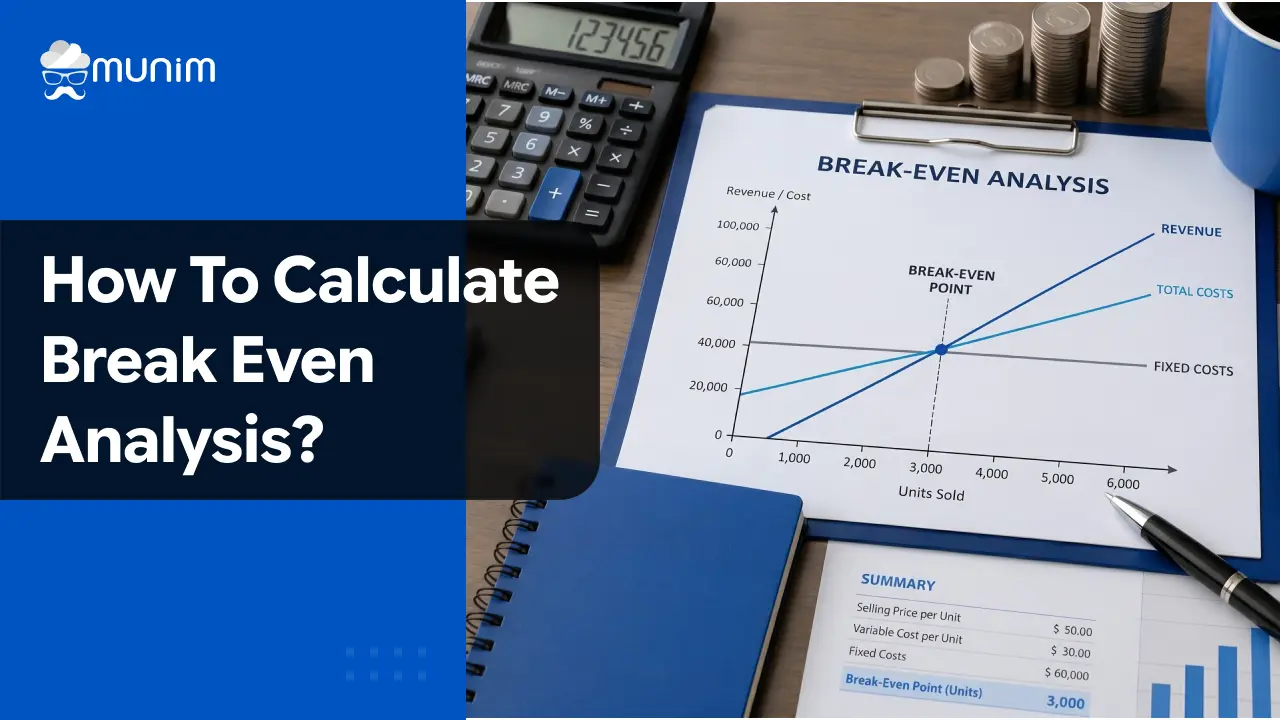
Break Even Point Formula (In Units)
Break Even Point (Units) = Fixed Costs ÷ (Selling Price Per Unit − Variable Cost Per Unit)
Or equivalently:
Break Even Point (Units) = Fixed Costs ÷ Contribution Margin Per Unit
Break Even Point Formula (In Revenue)
Break Even Point (Revenue) = Fixed Costs ÷ Contribution Margin Ratio
Where:
Contribution Margin Ratio = (Selling Price Per Unit − Variable Cost Per Unit) ÷ Selling Price Per Unit
A Practical Indian Example
Let us say Meera runs a handmade candle business from her home in Jaipur. She sells her candles online through Instagram and a Shopify store. Here are her numbers:
Fixed Costs (Monthly): Rent for storage space: Rs. 8,000 Internet and phone bills: Rs. 2,000 Packaging equipment lease: Rs. 3,000 Website hosting and tools: Rs. 2,000 Total Fixed Costs: Rs. 15,000 per month
Variable Costs Per Candle: Wax, fragrance, and wick: Rs. 80 Packaging material: Rs. 20 Shipping charges: Rs. 50 Total Variable Cost Per Unit: Rs. 150
Selling Price Per Candle: Rs. 400
Now, applying the formula:
Contribution Margin = Rs. 400 − Rs. 150 = Rs. 250
Break Even Point = Rs. 15,000 ÷ Rs. 250 = 60 candles
This means Meera needs to sell at least 60 candles every month just to cover all her costs. Her 61st candle sale is where actual profit begins.
In revenue terms:
Contribution Margin Ratio = Rs. 250 ÷ Rs. 400 = 0.625 (or 62.5%)
Break Even Revenue = Rs. 15,000 ÷ 0.625 = Rs. 24,000
Meera needs to generate at least Rs. 24,000 in monthly sales to break even.
Another Example: A Service Based Business
Ravi operates a small digital marketing agency in Hyderabad with three employees. His monthly fixed costs, including salaries, office rent, and software subscriptions, total Rs. 2,80,000. He charges clients an average of Rs. 35,000 per project, and his average variable cost per project (freelancer payments, ad spend management fees, and miscellaneous) is Rs. 12,000.
Break Even Point = Rs. 2,80,000 ÷ (Rs. 35,000 − Rs. 12,000)
Break Even Point = Rs. 2,80,000 ÷ Rs. 23,000 = 12.17 projects
Ravi needs to complete at least 13 projects per month to move past the break even point. This kind of clarity is invaluable when he is deciding whether to hire a fourth team member or invest in new tools.
Step by Step Process: How to Do Break Even Analysis
For readers who want a structured approach, here is a practical step by step method.
Step 1: Identify and List All Fixed Costs Go through every monthly expense that stays constant regardless of sales volume. Include rent, salaries, insurance, loan payments, subscriptions, and depreciation.
Step 2: Determine Variable Costs Per Unit Calculate how much it costs to produce or deliver one additional unit. Include raw materials, direct labor (if paid per piece), packaging, shipping, and payment processing fees.
Step 3: Set the Selling Price Per Unit This should be the actual price customers pay, net of any platform commissions or discounts if those are consistently applied.
Step 4: Calculate the Contribution Margin Subtract variable cost per unit from selling price per unit.
Step 5: Apply the Break Even Formula Divide total fixed costs by the contribution margin to get the break even point in units. Multiply by selling price to get break even revenue.
Step 6: Validate Against Real Sales Data Compare the calculated break even point against actual or projected sales figures. Is the break even volume achievable? If not, something in the cost structure or pricing needs to change.
Step 7: Run Sensitivity Scenarios What happens if raw material costs increase by 10%? What if the selling price drops during a sale? Running multiple scenarios helps businesses prepare for different market conditions.
Limitations of Break Even Analysis
No financial tool is perfect, and understanding the limitations of break even analysis is just as important as knowing how to use it. Here are the key constraints every business owner should keep in mind.
- Assumes costs are strictly fixed or variable. In reality, many costs like electricity and overtime are semi variable. Break even analysis oversimplifies this by forcing costs into two rigid categories.
- Assumes a constant selling price. Indian businesses frequently offer bulk discounts, seasonal offers, and tiered pricing. The formula does not account for these fluctuations.
- Ignore changes in cost over time. Raw material costs, rent, and wages change due to inflation and market conditions. The analysis does not automatically adjust for rising input costs unless recalculated periodically.
- Works best for single product businesses. For multi product businesses, which represent the majority of Indian enterprises, a weighted average approach is needed, adding complexity and approximation.
- Does not account for market demand. The analysis tells a business how much it needs to sell but says nothing about whether the market actually wants to buy that much.
- Ignores the time value of money. It treats all revenue and costs as if they occur simultaneously, without considering that a rupee earned six months later is worth less than a rupee earned today.
- Provides a static snapshot, not a dynamic model. It does not model growth trajectories, market shifts, or competitive dynamics. Businesses should treat it as one input among many, not the sole basis for strategy.
- Overlooks external factors. Policy changes, GST rate revisions, supply chain disruptions, and shifts in consumer behavior can invalidate a break even calculation overnight. The 2026 updates to e-invoicing thresholds, for instance, have changed cost structures for many mid-sized businesses.
Break Even Analysis in Different Indian Business Contexts
Manufacturing Businesses
For manufacturers, variable costs tend to be a larger portion of total costs. Raw material prices in India, especially steel, chemicals, and agricultural inputs, can be volatile. Break even analysis helps manufacturers set minimum order quantities and negotiate better supplier terms.
Retail and E-commerce
With platforms like Amazon, Flipkart, and Meesho charging commissions, the effective selling price for online sellers is lower than the listed MRP. Break even analysis for e-commerce sellers must factor in platform fees, return rates, and advertising costs as part of variable expenses.
Service Based Businesses
For freelancers, consultants, and agencies, fixed costs are often lower, but the challenge lies in accurately estimating the variable cost per engagement. Time is the key variable, and underestimating project hours is a common mistake that pushes the break even point higher than expected.
Food and Hospitality
Restaurants and cloud kitchens in India operate on thin margins. Food costs, staff wages, Swiggy and Zomato commissions, and GST all eat into revenue. Break even analysis is not just useful here; it is essential for survival.
Conclusion
Break even analysis is not a complicated concept. But it is a deeply practical one. For Indian businesses navigating rising costs, competitive markets, and evolving regulatory environments, knowing the exact point at which revenue covers expenses is not just useful. It is necessary.
The formula itself is simple. The real value lies in what business owners do with the insight. Adjusting prices, cutting unnecessary costs, evaluating new opportunities, and communicating financial viability to investors and lenders all become easier when the break even point is clearly defined.
Frequently Asked Questions
What is break even point analysis?
Break-even point analysis is a financial calculation that determines the exact sales volume or revenue level at which a business covers all its costs, both fixed and variable, without making a profit or incurring a loss. It helps business owners understand the minimum performance threshold needed for financial sustainability.
What is the formula for break even point?
The break even point in units is calculated as: Fixed Costs divided by (Selling Price Per Unit minus Variable Cost Per Unit). For break even revenue, divide Fixed Costs by the Contribution Margin Ratio, which is the Contribution Margin Per Unit divided by the Selling Price Per Unit.
What is the difference between break even analysis and profitability analysis?
Break even analysis identifies the point of zero profit or zero loss. Profitability analysis goes further by examining how much profit a business generates at various levels of sales beyond the break even point.
Disclaimer: "This blog post is for informational purposes only. For specific tax advice related to your business, please consult a qualified Chartered Accountant or GST practitioner."
About the author

Mehul is a seasoned content writer with a passion for simplifying complex accounting and GST topics. With a keen interest in entrepreneurship and business management, he specializes in creating informative and engaging content for themunim.com. His goal is to help businesses understand and implement accounting and GST software solutions effectively. When he's not crafting content, Mehul enjoys exploring new places and spending time with his Golden Retriever.
Related Articles
Explore the latest market news, useful resources for business, and Munim updates.