Circular Trading in GST: Definition, Red Flags, and Penalties
 AuthorMehul Jagwani
 Reviewed ByMadhav Bhayani


- What Is Circular Trading in GST?
- Why Circular Trading Exists: The ITC Incentive
- How Circular Trading Works: A Step-by-Step Example
- How GST Authorities Detect Circular Trading
- How to Protect Your Business from Circular Trading Risk
- Why Businesses Engage in Circular Trading
- Types of Circular Trading Schemes Under GST
- Penalties for Circular Trading Under GST
- Final Notes
- Frequently Asked Questions
Summary:
Circular trading in GST is a fraudulent practice in which businesses create a loop of fake invoices among connected entities, without any actual movement of goods or services, to wrongfully claim Input Tax Credit or inflate reported turnover.
Circular trading in GST is one of the most well-documented and persistent forms of GST fraud in India. It involves multiple entities raising invoices against each other in a closed loop, generating Input Tax Credit on paper while no actual goods or services change hands. The problem is not new, but it has grown significantly in scale and sophistication since GST’s rollout in 2017.
Understanding what circular trading in GST is, how it operates, and what the law says about it is not just useful for compliance officers and Chartered Accountants. It matters to every GST-registered business that deals with third-party suppliers, because an innocent party in the chain can also face consequences if a fraudulent supplier is found upstream.
What Is Circular Trading in GST?
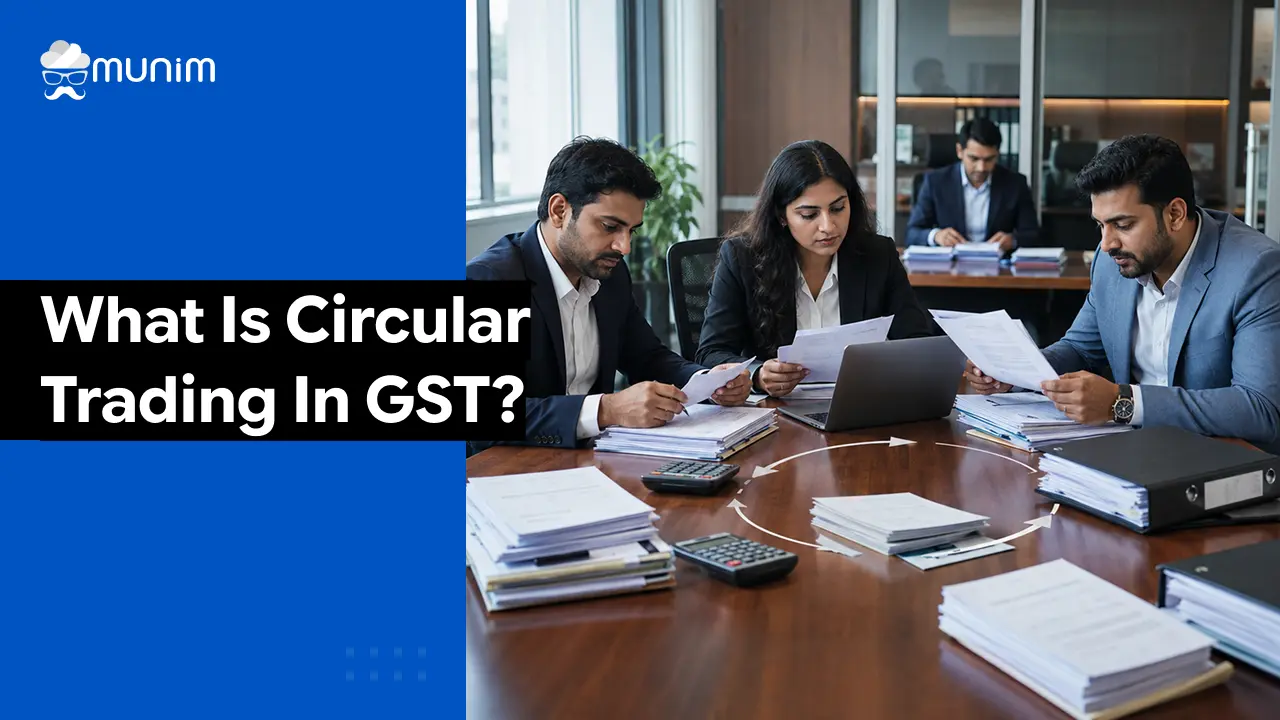
Circular trading in GST is a scheme in which two or more businesses raise invoices to each other in a circular sequence, without any actual supply of goods or services taking place. The invoices rotate among participating entities, creating the appearance of legitimate commercial transactions on paper. In reality, nothing moves, no genuine value is exchanged, and the “taxes” shown on these invoices are never actually remitted against real economic activity.
Why Circular Trading Exists: The ITC Incentive
To understand why businesses engage in circular trading in GST, one needs to understand how Input Tax Credit works.
Every GST-registered business can offset the tax it has paid on its purchases (input tax) against the tax it collects on its sales (output tax). This is ITC, and it reduces the net cash tax outgo. For businesses with high purchase volumes and relatively lower output tax, ITC can represent significant savings.
Fraudsters exploit this feature. By generating fake invoices, they create a paper trail showing that GST has been paid on purchases. They then claim this as ITC to eliminate or drastically reduce their actual tax liability. In export-linked schemes, the accumulated fake ITC is claimed as a cash refund from the government, given that exports are zero-rated under GST.
This makes ITC fraud directly profitable. And circular trading is the mechanism used to manufacture that ITC.
Designed for Modern Tax Professionals
A premium filing solution for CAs and tax consultants who need speed, scale, and operational clarity.
 Handle multiple clients with ease
- Reconcile and validate with confidence
- Overcome the limitations of the GST portal
 Handle multiple clients with ease
How Circular Trading Works: A Step-by-Step Example
Here is a realistic example to illustrate how circular trading in GST unfolds in practice.
Entities involved: Company A, Company B, and Company C. All three are GST-registered. All three are controlled by the same promoter group, directly or through benami arrangements.
Step 1: Company A raises a GST invoice for Rs 10 lakh to Company B for the supply of, say, pharmaceutical goods. No goods physically move from A’s premises to B’s.
Step 2: Company B raises an invoice for Rs 12 lakh to Company C for the same category of goods. Again, no actual delivery takes place.
Step 3: Company C raises an invoice for Rs 9.5 lakh back to Company A, completing the loop.
How GST Authorities Detect Circular Trading
The detection toolkit available to GST authorities has expanded considerably, and the sophistication of the analytics behind it has grown.
GSTR-1 vs GSTR-2B vs GSTR-3B Cross-Verification
The most fundamental check. The GST system compares what a supplier reports in GSTR-1 with what appears in the buyer’s auto-populated GSTR-2B, and what the buyer actually claims in GSTR-3B. A mismatch triggers a system-generated alert. If a supplier has not filed GSTR-1 for a period, the buyer cannot claim ITC from that supplier for that period.
GSTN Invoice Graphing and Network Analysis
GSTN maps relationships between GSTINs using invoice data. If Company A invoices B, B invoices C, and C invoices A, the network graph shows a closed loop. DGARM (the Directorate General of Analytics and Risk Management) uses these graphs to generate risk scores for individual GSTINs and flag circular trading patterns to field formations for investigation.
Biometric Aadhaar Verification at Registration
New GST registrations in risk-flagged categories require biometric Aadhaar authentication and physical document verification. This is designed to stop shell entities from entering the GST ecosystem in the first place.
Return-Flow Tightening from July 2025
From July 2025, auto-populated tax liabilities in GSTR-3B are effectively locked, with corrections channelled through GSTR-1A on the supplier’s side. This reduces the scope for post-submission manipulation of ITC claims, which was a common mechanism in circular trading schemes.
Field Inspections and Physical Verification
Officers verify whether a business actually operates from its registered address, whether it has any workforce, warehousing, or physical stock. A supplier that has no infrastructure, no employees, and is registered at a residential address with no evidence of any commercial activity is immediately suspect.
PAN-GSTIN Link Analysis and Geo-Signals
GSTN’s analytics correlate PAN numbers across multiple GSTINs to identify common promoters operating several entities. Geo-signals flag cases where entities claim interstate movement of goods but show no corresponding e-way bill generation or logistics activity.
How to Protect Your Business from Circular Trading Risk
An honest business can find itself caught in the crossfire of a circular trading investigation simply because one of its suppliers turned out to be a fraudulent entity. Protecting against this requires active compliance behaviour, not just passive trust in the supply chain.
Verify Supplier GSTINs Before Transacting
Use the GST search tool to confirm a supplier’s GSTIN is active, check its filing history, and see whether it has a track record of regular returns. A supplier showing nil or irregular filings is a red flag.
Reconcile GSTR-2B Before Claiming ITC
ITC should only be claimed after confirming that the supplier’s invoice appears in the buyer’s auto-populated GSTR-2B. If a supplier has not reported an invoice in GSTR-1, it will not appear in GSTR-2B, and the ITC is not admissible.
Use the Invoice Management System
The Invoice Management System enables buyers to review every inward invoice before it flows into ITC calculations. Accepting only verified and legitimate invoices through the IMS creates a documented due-diligence trail that protects the business in the event of a future audit.
Maintain Complete Physical Documentation
For every purchase, maintain proof of actual receipt: lorry receipts, delivery challans, weighment slips, and bank payment records that align with the invoice value. Circular trading schemes have no corresponding physical documentation for goods movement, and the absence of such records is itself evidence of fraud.
Avoid Round-Trip Financial Arrangements
Be cautious of any arrangement where money leaves the business and returns through informal or cash channels. This is the hallmark of layered circular trading schemes and puts the business in direct legal jeopardy.
Use a Reliable GST Filing Platform
A structured GST compliance platform that reconciles purchase data against GSTR-2B automatically, flags mismatches, and maintains clean records reduces the risk of inadvertently claiming fraudulent ITC. Platforms like Munim GST support accurate and timely filing of GSTR-1, GSTR-3B, and GSTR-9, keeping records consistent and audit-ready at all times.
Why Businesses Engage in Circular Trading
Circular trading in GST is not driven by a single motive. Tax authorities have identified at least three distinct objectives behind these schemes.
1. Fraudulent ITC Claims
This is the most common motive. Participating entities claim ITC they were never entitled to, using it to offset genuine output tax liability. Some pass the fake credit downstream to other businesses through further invoice chains.
2. Turnover Inflation for Bank Finance
Not all circular trading is about ITC. Some businesses engage in round-tripping of invoices purely to show high turnover on their books, making themselves appear larger and more creditworthy than they are. This is done to qualify for working capital loans, overdraft limits, or contract tenders.
3. Export Refund Fraud
In export-linked circular trading, a chain of entities builds up a pool of fake ITC, which eventually reaches an exporting company. The exporter then claims a large refund from the government on its zero-rated exports, backed by a credit balance that was never genuinely generated.
Types of Circular Trading Schemes Under GST
Tax authorities have identified several recurring structures in which circular trading operates.
Shell Company Networks
A central operator incorporates a group of dormant or shell entities. These entities issue invoices to each other on the web, and ultimately pass the accumulated fake ITC to a real operating business. The shell companies often operate from residential addresses, have no employees, and file nil returns or are eventually cancelled for non-compliance. Understanding how fake invoices are identified and validated can help businesses flag suspicious counterparties early.
Round-Trip Money Layering
Funds are transferred from Company A to B to C through formal RTGS transfers, lending apparent legitimacy to the invoices. The same funds are then returned to the original party in cash through informal hawala channels, with a commission deducted. This pattern was documented in the November 2025 enforcement action by the Chennai North Commissionerate, which busted a large interstate fake GST invoicing racket.
Export Refund Schemes
A carefully constructed invoice chain reaches an exporter at the end. The exporter claims ITC refund on zero-rated supplies, backed by a credit balance built up entirely through fictitious trades. Given that export refunds involve real government cash outflows, these schemes tend to attract severe enforcement attention.
Penalties for Circular Trading Under GST
The penalty structure for circular trading in GST is comprehensive and was tightened further by the Finance Act 2020.
For Participating Entities: Under Section 122(1), the penalty equals the full quantum of tax evaded or ITC wrongly claimed, with a floor of Rs 10,000. There is no upper ceiling: the higher the fraud, the higher the penalty.
For Beneficiaries and Facilitators: Under Section 122(1A), any person who retains the benefit or orchestrated the scheme is equally exposed, regardless of whether they hold a GST registration.
ITC Reversal with Interest: The wrongly claimed ITC must be reversed in full, along with interest at 18% per annum under Section 50, calculated from the date the ITC was availed.
Criminal Prosecution: Evasion above Rs 5 crore invites prosecution under Section 132. Depending on the amount involved, the punishment can range from one year to five years of imprisonment.
GST Registration Cancellation: Under Section 29(2), a registration obtained through fraud can be cancelled, effectively shutting down the entity’s formal GST existence.
Final Notes
Circular trading in GST is not a victimless compliance shortcut. It drains public revenue, distorts market competition, and draws every participant in the invoice chain, knowingly or otherwise, into serious legal exposure. The enforcement machinery under CBIC and GSTN is active, analytically sophisticated, and producing real results: billions of rupees in fraudulent ITC detected, thousands of bogus firms dismantled, and prosecution proceedings initiated across multiple states.
Frequently Asked Questions
What is circular trading in GST?
Circular trading in GST is a fraudulent arrangement in which two or more entities issue invoices to each other in a closed loop, without any actual supply of goods or services underlying those transactions. The primary objective is typically to generate fake Input Tax Credit, which is then used to reduce tax liability or claim refunds. Some schemes also use circular trading to artificially inflate business turnover for non-tax reasons such as securing bank finance.
What is the difference between circular trading and fake invoicing in GST?
Fake invoicing is a broader term covering any invoice raised without a genuine underlying supply. Circular trading is a specific type of fake invoicing where the invoice chain forms a closed loop, with the same goods or services nominally rotating among two or more entities and eventually returning to the starting point. All circular trading involves fake invoices, but not all fake invoicing follows the circular structure.
Disclaimer: "This blog post is for informational purposes only. For specific tax advice related to your business, please consult a qualified Chartered Accountant or GST practitioner."
About the author

Mehul is a seasoned content writer with a passion for simplifying complex accounting and GST topics. With a keen interest in entrepreneurship and business management, he specializes in creating informative and engaging content for themunim.com. His goal is to help businesses understand and implement accounting and GST software solutions effectively. When he's not crafting content, Mehul enjoys exploring new places and spending time with his Golden Retriever.
Related Articles
Explore the latest market news, useful resources for business, and Munim updates.