

10 Common Accounting Mistakes Indian Businesses Must Stop Making
 AuthorMehul Jagwani
 Reviewed ByAjay Savani




Summary:
Accounting mistakes are more common in Indian small businesses than most owners realise. From mixing personal and business funds to missing GST deadlines, these errors quietly erode profit, invite penalties, and create audit risk.
Accounting is not just a back-office task. It is the financial nervous system of a business. Yet a large number of Indian small and medium businesses commit the same accounting mistakes year after year, often without realising it until the damage is done.
The cost is real. Late GST filing attracts interest at 18% per annum. A mismatched ITC claim can trigger a department notice. A single data entry error can throw off an entire year’s P&L. These are not hypothetical situations. They happen to thousands of businesses across India every month.
These 10 Accounting Mistakes Every Indian SME Must Fix
Mistake 1: Mixing Personal and Business Finances
This is one of the most widespread accounting mistakes among sole proprietors and small business owners in India. The business owner uses the same bank account for personal shopping, household expenses, and business transactions.
The result is chaos at year-end. It becomes nearly impossible to separate what was a business expense from what was personal spending. Tax deductions get miscalculated. The actual profit of the business remains unclear.
The fix: Open a dedicated current account for the business, even for a proprietorship. Every transaction related to the business should flow through that account and nowhere else.
Mistake 2: Ignoring Bank Reconciliation
Bank reconciliation means matching the company’s internal cash book with the bank statement. Many businesses skip this entirely, assuming that if the bank shows a certain balance, that must be the final word.
It is not. Cheques issued but not yet cleared, direct bank charges, or ECS debits that were not recorded internally, all create discrepancies. When left unresolved for months, these discrepancies compound and create serious errors in the books.
The fix: Reconcile bank accounts at least once a month. Modern accounting software like Munim makes bank reconciliation a fast, step-by-step process rather than a manual exercise.
Mistake 3: Not Maintaining Proper Invoices and Bills
Under GST, every purchase and sale must be backed by a valid tax invoice. Businesses that do not maintain proper invoices for expenses lose Input Tax Credit (ITC), which is the right to offset GST paid on purchases against GST collected on sales.
A missing bill worth Rs. 50,000 at 18% GST means Rs. 9,000 of ITC lost. Multiply that across a year and the cost is significant.
The fix: Adopt a strict document management policy. Every vendor bill must be collected, verified, and entered immediately. Use e-invoicing where mandatory, and maintain digital backups.
Mistake 4: Errors in GST Input Tax Credit (ITC) Claims
ITC is one of the most valuable provisions under the GST framework. It is also one of the most error-prone areas. Businesses claim ITC on ineligible expenses, such as food and beverages, personal vehicles, or services used for non-business purposes, all of which are blocked credits under Section 17(5) of the CGST Act.
Some businesses also claim ITC without verifying whether the supplier has filed their GSTR-1. If the supplier has not filed, the credit does not appear in the buyer’s GSTR-2B, and claiming it invites scrutiny.
The fix: Always cross-check ITC claims against GSTR-2B before filing GSTR-3B. Maintain a list of blocked credit categories and train whoever handles GST returns to check it routinely.
Mistake 5: Missing Filing Deadlines
GST return deadlines are fixed. GSTR-1 is due by the 11th of the following month for monthly filers. GSTR-3B is due by the 20th. Missing these dates attracts late fees of Rs. 50 per day (Rs. 25 CGST + Rs. 25 SGST) for regular returns, and interest at 18% per annum on the outstanding tax liability.
Similarly, TDS returns under income tax, advance tax payments, and income tax return filing all carry penalties for delay.
The fix: Maintain a compliance calendar with all due dates marked. Use GST return filing software that sends reminders and automates return preparation, reducing the risk of a missed deadline significantly.
Simplify Your Business Operations
Designed to give you speed, control, and accuracy in daily accounting tasks.
 Save time with automated accounting workflows
- Get 35+ detailed business reports easily
- Access your business anytime, anywhere
 Save time with automated accounting workflows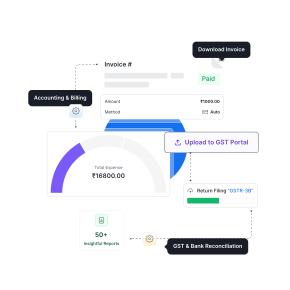
Mistake 6: Incorrect Classification of Expenses
Not every payment is the same from an accounting and tax perspective. Many businesses record capital expenditure as revenue expenditure or the other way around. Buying a laptop worth Rs. 80,000 is a capital expense, it should be capitalised and depreciated, not recorded as an office expense in the P&L.
Getting this wrong affects depreciation claims, net profit figures, and tax liability. It also creates problems during audits.
The fix: Understand the basic distinction: capital expenditure creates an asset that lasts more than one year; revenue expenditure is consumed in the same year. When in doubt, consult a chartered accountant before booking the entry.
Mistake 7: Not Tracking Accounts Receivable Properly
Raising an invoice does not mean the money is collected. Many small businesses lose track of which customers have paid and which have not. Outstanding dues pile up. Some become bad debts that could have been recovered if followed up in time.
Poor accounts receivable management also creates a misleading picture of cash flow. The books show profit because sales were recorded, but the bank account is empty because collections are lagging.
The fix: Reconcile receivables monthly. Follow up on overdue invoices within 30 days. Use software that tracks outstanding payments and flags overdue accounts automatically. Munim’s accounts receivable tools make this process straightforward for small businesses.
Mistake 8: Overlooking Depreciation
Depreciation is the accounting method by which the cost of a fixed asset, such as machinery, computers, or furniture, is spread over its useful life. Many small business owners either forget to record depreciation or record it incorrectly.
This results in inflated asset values on the balance sheet and understated expenses in the P&L, which means the business appears more profitable than it actually is. This also leads to incorrect income tax calculations, since depreciation under the Income Tax Act has its own rates specified under Section 32.
The fix: Maintain a fixed asset register. Apply the correct depreciation rates. Accounting software with a built-in asset management module can automate this entirely.
Mistake 9: Doing Everything Manually Without Any Software
This is a common mistake in accounting for businesses that are scaling beyond the proprietorship stage. Manual entries in Excel spreadsheets or paper registers are prone to data entry errors, formula mistakes, and version conflicts. There is no audit trail. Generating a financial report takes days instead of minutes.
As transaction volumes grow, manual accounting becomes increasingly unreliable. A single transposed digit can distort the entire trial balance.
The fix: Move to cloud-based accounting software that automates bookkeeping, generates GST-compliant invoices, reconciles bank statements, and produces real-time financial reports. This is not a luxury. For any business processing more than a few hundred transactions a month, it is a necessity. Munim’s accounting software is built specifically for Indian SMEs and offers all of these features in one platform.
Mistake 10: Not Reviewing Financial Reports Regularly
Profit and loss statements, balance sheets, and cash flow statements exist for a reason. They tell the owner whether the business is actually growing, where money is leaking, and whether the business can meet its upcoming obligations.
Many business owners look at these reports only at year-end or only when the CA asks for them. By that point, problems that could have been corrected in March are discovered in November, when they are much harder to fix.
The fix: Set aside time every month to review basic financial reports. Track gross margin trends, monitor overhead costs, and check whether cash flow projections match actual bank balances. Regular reviews turn accounting from a compliance task into a genuine business management tool.
Conclusion
Accounting mistakes are rarely dramatic. They creep in gradually through skipped reconciliations, misfiled returns, and overlooked invoices. But over time, they create serious financial and compliance risk.
The good news is that most of these common mistakes in accounting are entirely preventable. The solutions are not complicated: good habits, a structured process, and the right tools.
If the current accounting setup feels error-prone, now is a good time to review it. A cloud-based accounting solution built for Indian businesses can address many of these issues automatically, freeing up time to focus on actually running the business.
FAQs: Common Accounting Mistakes
How do accounting mistakes affect GST compliance?
Errors in accounting directly impact GST returns. Incorrect ITC claims, mismatched invoice data, or missed filing deadlines attract late fees, interest charges, and in serious cases, department notices or audits.
How often should a small business reconcile its bank accounts?
At a minimum, monthly. For businesses with high transaction volumes, weekly reconciliation is advisable. Regular reconciliation catches errors early and ensures the books reflect the actual financial position of the business.
What is the most costly accounting mistake for an Indian SME?
Incorrect ITC claims and missed GST filing deadlines tend to have the highest direct financial cost because they attract immediate government penalties.
How does mixing personal and business finances affect tax filings?
It makes it very difficult to accurately compute business income and legitimate deductions. Personal expenses may get claimed as business expenses, which is a tax violation.
Disclaimer: "This blog post is for informational purposes only. For specific tax advice related to your business, please consult a qualified Chartered Accountant or GST practitioner."
About the author

Mehul is a seasoned content writer with a passion for simplifying complex accounting and GST topics. With a keen interest in entrepreneurship and business management, he specializes in creating informative and engaging content for themunim.com. His goal is to help businesses understand and implement accounting and GST software solutions effectively. When he's not crafting content, Mehul enjoys exploring new places and spending time with his Golden Retriever.
Related Articles
Explore the latest market news, useful resources for business, and Munim updates.