

Common Errors in GSTR-3B Filing and How to Fix Them
 AuthorMehul Jagwani
 Reviewed ByMadhav Bhayani



Summary:
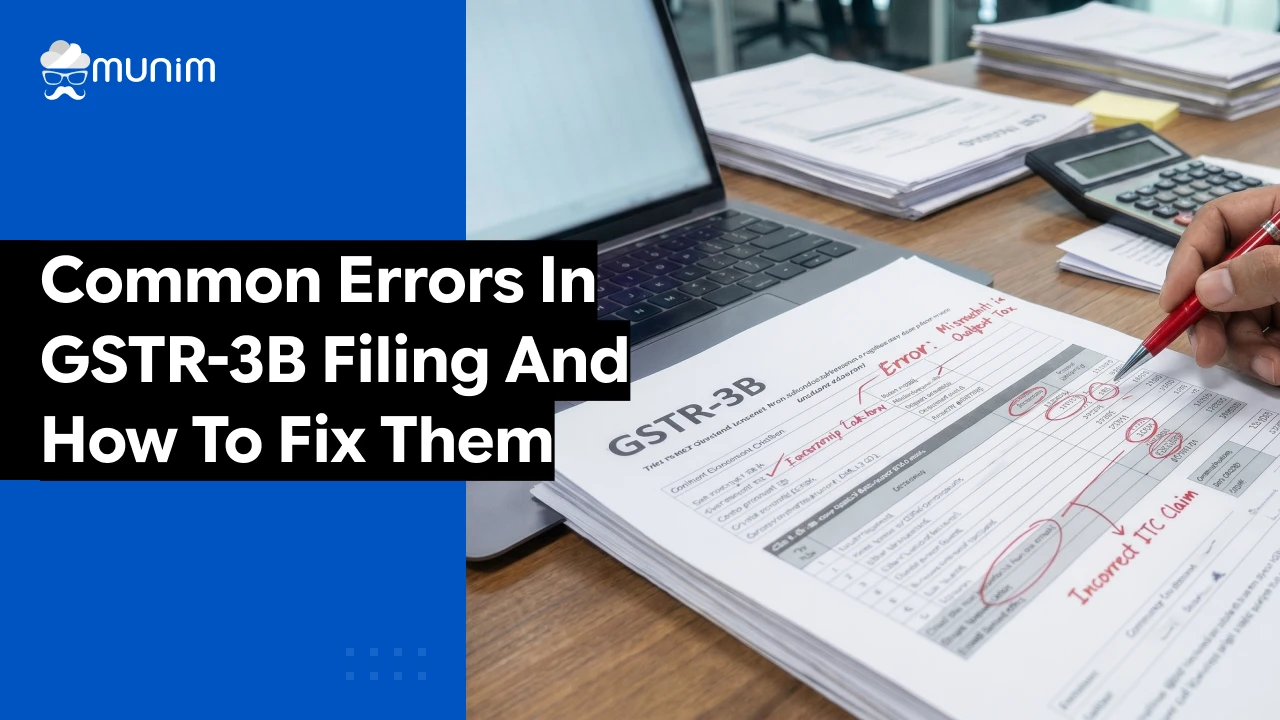
GSTR-3B errors are more common than most businesses realise, and even a small mistake can trigger notices, interest, or blocked ITC claims. This article covers the most frequently occurring errors in GSTR-3B filing, including data mismatches, incorrect ITC claims, reverse charge omissions, and portal-level technical glitches, along with clear, actionable solutions for each.
GSTR-3B is the monthly (or quarterly) summary return that every regular GST taxpayer must file. It covers outward supplies, input tax credit (ITC) claims, and the final tax payment for the period. Simple as it may look, GSTR-3B is where most GST compliance errors surface. And given that this return cannot be revised once filed, errors carry real consequences such as interest liability, mismatch notices, and blocked credit.
With the GST portal now auto-populating key fields from GSTR-1 and GSTR-2B, and certain fields becoming non-editable from July 2025 onwards, getting GSTR-3B right the first time is no longer optional. Here is a detailed look at the most common GSTR-3B errors businesses and tax professionals encounter, and exactly what needs to be done to fix them.
Error 1: Mismatch between GSTR-1 and GSTR-3B
What causes it: The outward tax liability reported in GSTR-3B does not match the taxable turnover and tax declared in GSTR-1. This often happens when invoices are added to GSTR-1 after GSTR-3B is already filed, or when the taxpayer enters figures manually in GSTR-3B without cross-checking GSTR-1.
Why it matters: This mismatch triggers notices under Rule 88C. The GST portal compares both returns and flags the difference. The taxpayer is required to either pay the differential tax or explain the variation within a stipulated time.
Solution: Reconcile GSTR-1 and GSTR-3B data before filing either return. If GSTR-3B has already been filed with a lower liability than what GSTR-1 shows, the differential amount must be reported and paid in the next GSTR-3B along with applicable interest at 18% per annum from the original due date.
From July 2025 onwards, Table 3.2 of GSTR-3B related to inter-state supplies to unregistered persons, composition taxpayers, and UIN holders is auto-populated from GSTR-1 and locked for editing. Any correction to these figures must now be made through GSTR-1A before GSTR-3B is filed for that period.
Error 2: Incorrect or excess ITC claims in GSTR-3B
What causes it: One of the most common GSTR-3B errors is claiming ITC on invoices that are not reflected in GSTR-2B, or claiming ITC on ineligible expenses such as personal use items, blocked credits under Section 17(5), or invoices from non-compliant suppliers.
Why it matters: Under the current GST framework, ITC can only be claimed to the extent it appears in GSTR-2B. Any excess claim triggers a notice under Rule 88D and may result in interest and reversal of credit.
Solution:
- If ITC has been over-claimed, the excess amount must be reversed in the next GSTR-3B by reducing the ITC figure in Table 4(B).
- If a refund was already utilised, the taxpayer must pay the equivalent amount in cash along with 24% interest (applicable for fraudulent or ineligible ITC claims under Section 50(3)).
- Reconcile GSTR-2B with the purchase register every month before filing. Any invoice not appearing in GSTR-2B should not be claimed as ITC unless the supplier has filed their GSTR-1 correctly.
Designed for Modern Tax Professionals
A premium filing solution for CAs and tax consultants who need speed, scale, and operational clarity.
 Handle multiple clients with ease
- Reconcile and validate with confidence
- Overcome the limitations of the GST portal
 Handle multiple clients with ease
Error 3: Under-reported or missed outward tax liability
What causes it: A taxpayer fails to include certain invoices in either GSTR-1 or GSTR-3B for a given month. This can happen due to last-minute invoices being missed, timing errors in accounting entries, or invoices raised at the very end of the month being inadvertently left out.
Solution: The missed liability must be added to the GSTR-3B of the subsequent month. The taxpayer must also pay interest at 18% per annum from the original due date of payment to the date of actual payment. The amount of interest is calculated only on the tax component, not on the total invoice value.
Additionally, the missed invoice must be reported in the next available GSTR-1 or through Table 9 of GSTR-1 (amendments to previously filed returns) for the correction to be visible in the recipient’s GSTR-2B.
Error 4: Over-reported tax liability in GSTR-3B
What causes it: An invoice is reported twice, or a higher tax rate is applied on a transaction that should attract a lower rate. This inflates the tax liability and results in excess payment.
Solution: The over-reported amount can be adjusted in the subsequent month’s GSTR-3B by reducing the outward tax liability in Table 3.1. However, this adjustment is subject to the condition that the corresponding GSTR-1 entry is also corrected. A credit note should be issued and reported in GSTR-1 if the over-reporting is linked to a specific invoice.
If the tax was already paid in cash and a credit note cannot be issued (for example, in a B2C transaction), the taxpayer may file a refund application under Section 54 of the CGST Act.
Error 5: ITC claimed under the wrong tax head
What causes it: IGST credit is adjusted against SGST or CGST liability in an incorrect sequence, or credit is applied against the wrong head entirely. Under GST rules, the order of ITC utilisation is prescribed: IGST credit is first used against IGST liability, then against CGST and SGST in that order.
Solution: Since the filed GSTR-3B cannot be edited, the taxpayer must self-correct in the next filing period by ensuring the credit utilisation follows the correct order. Maintaining a monthly electronic credit ledger reconciliation makes it easier to detect and correct such errors before they compound across quarters.
Closing Notes
GSTR-3B errors are not just an operational inconvenience. They can attract notices, block input credit, and result in interest outflows that could have been easily avoided. The best way to handle GSTR-3B errors is to prevent them in the first place through regular reconciliation, disciplined data entry, and timely filing.
If an error has already been made, the correction route is clear: report and pay the difference in the next return period with applicable interest, and ensure the source documents (GSTR-1 entries, purchase records) are aligned.
FAQs on GSTR-3B errors and corrections
What is Rule 88C in GSTR-3B?
Rule 88C deals with mismatch between tax liability reported in GSTR-3B and in GSTR-1. When the liability in GSTR-3B is less than what is declared in GSTR-1, the system issues an automated notice. The taxpayer must pay the difference or provide a valid explanation through Part A of GSTR-DRC-01B.
What is Rule 88D in GSTR-3B?
Rule 88D addresses discrepancies between ITC claimed in GSTR-3B and ITC available as per GSTR-2B. If the claimed amount exceeds the available credit, the portal generates a notice. The taxpayer must respond within the time specified.
What is Form DRC-03 used for in GSTR-3B corrections?
DRC-03 is used to make voluntary payment of tax, interest, or penalty discovered through self-assessment. If a taxpayer identifies excess liability after the return is filed and wants to discharge it without waiting for the next return period, DRC-03 can be used.
Disclaimer: "This blog post is for informational purposes only. For specific tax advice related to your business, please consult a qualified Chartered Accountant or GST practitioner."
About the author

Mehul is a seasoned content writer with a passion for simplifying complex accounting and GST topics. With a keen interest in entrepreneurship and business management, he specializes in creating informative and engaging content for themunim.com. His goal is to help businesses understand and implement accounting and GST software solutions effectively. When he's not crafting content, Mehul enjoys exploring new places and spending time with his Golden Retriever.
Related Articles
Explore the latest market news, useful resources for business, and Munim updates.