
GST Rate on Cars: HSN Code, Tax Slab and Applicability
 AuthorMehul Jagwani
 Reviewed ByMadhav Bhayani



Summary:
GST on hotel rooms in India is 5% without Input Tax Credit when the accommodation value is up to ₹7,500 per unit per day. If the value exceeds ₹7,500, GST is 18% with ITC, subject to applicable conditions. The 5% rate for rooms up to ₹7,500 has applied since 22 September 2025.
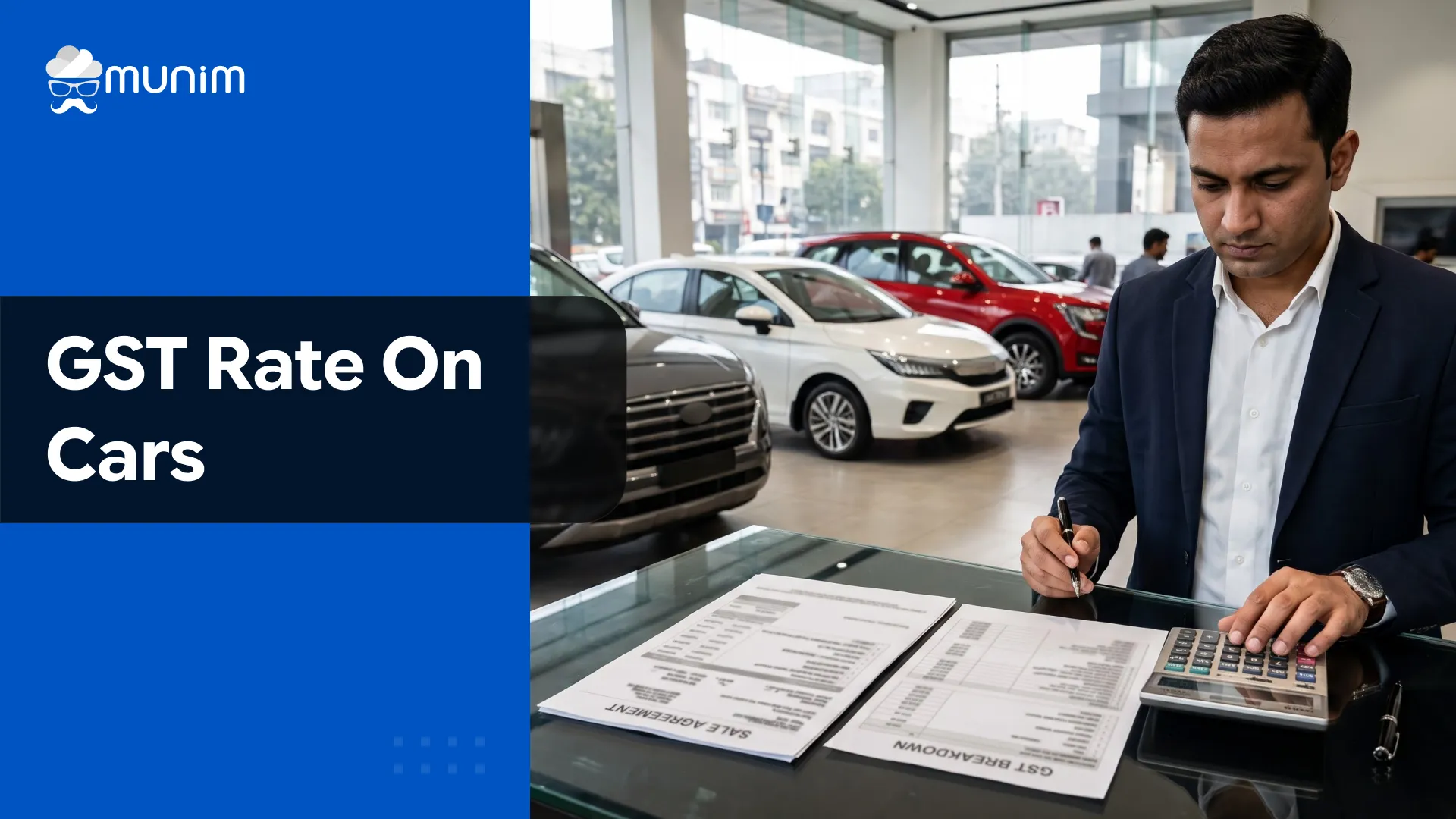
In India, the GST on car purchasing ranges from 5% to 40% depending on the vehicle’s fuel type, engine capacity and length. From 22 September 2025, small petrol, CNG, and diesel cars attract 18% GST, electric cars continue at 5%, while most of the luxury cars attract 40%, with no compensation cess.
Let’s discuss the details.
What Is the New Car GST Rate in India?
The new car GST rate is 5%, 18% or 40%, depending on the vehicle category. The following table shows car category and corresponding GST rate effective from 22 September 2025:
| Car category | Conditions | GST rate from 22 September 2025 |
| Electric car | Runs solely on electrical energy from an external source or electrical batteries | 5% |
| Small petrol, LPG or CNG car | Engine up to 1,200 cc and length up to 4,000 mm | 18% |
| Small diesel car | Engine up to 1,500 cc and length up to 4,000 mm | 18% |
| Small petrol hybrid car | Engine up to 1,200 cc and length up to 4,000 mm | 18% |
| Small diesel hybrid car | Engine up to 1,500 cc and length up to 4,000 mm | 18% |
| Other passenger cars | Cars not meeting the applicable small car conditions | 40% |
| Qualifying utility vehicles | Engine above 1,500 cc, length above 4,000 mm and ground clearance of at least 170 mm | 40% |
| Three wheelers under HSN 8703 | Passenger three wheelers | 18% |
| Ambulances cleared with required factory fittings | Subject to prescribed classification conditions | 18% |
Designed for Modern Tax Professionals
A premium filing solution for CAs and tax consultants who need speed, scale, and operational clarity.
 Handle multiple clients with ease
- Reconcile and validate with confidence
- Overcome the limitations of the GST portal
 Handle multiple clients with ease
What Is the HSN Code for Cars?
HSN stands for Harmonised System of Nomenclature. It is a standard system of classification of goods that helps in determining the applicable GST rate.
| HSN heading | General description |
| 8702 | Motor vehicles designed to carry ten or more persons, including the driver |
| 8703 | Cars and other motor vehicles principally designed to transport persons |
| 8704 | Motor vehicles used for transporting goods |
| 8705 | Special purpose motor vehicles, such as certain crane or fire fighting vehicles |
| 8706 | Chassis fitted with engines for motor vehicles |
| 8707 | Bodies, including cabs, for specified motor vehicles |
| 8708 | Parts and accessories of motor vehicles |
How Is GST Calculated on a New Car?
GST is calculated on the taxable value of the vehicle. Other charges such as road tax and insurance are applied separately.
Formula
GST amount = Taxable value × Applicable GST rate
Invoice value = Taxable value + GST
Example:
Suppose a qualifying small petrol car has a taxable value of ₹8,00,000.
| Particulars | Amount |
| Taxable value | ₹8,00,000 |
| GST at 18% | ₹1,44,000 |
| Value including GST | ₹9,44,000 |
What Is the GST Rate on a Second Hand Car?
The GST on 2nd hand car sales covered by the margin scheme is 18% on the positive margin, not on the entire sale value.
The treatment differs according to the seller.
| Seller and transaction | GST treatment |
| Individual sells a personal car to another individual/car dealer | Generally no GST |
| Registered used car dealer sells the vehicle without claiming ITC | 18% on positive margin, subject to conditions |
| Registered business sells a used car on which no ITC was claimed | Margin scheme may apply, subject to conditions |
| Registered business sells a vehicle on which ITC was claimed | Capital goods and normal valuation rules apply |
| Margin is negative | No GST on the negative margin under the margin scheme |
GST Rate on Old/Used Cars and their HSN Codes
| Vehicle Type | HSN Code | GST Rate |
| Used Petrol Cars | 8703 | 18% |
| Diesel cars (engine <1500cc) | 8703 | 18% |
| SUVs & Others | 8703 | 18% |
How is the margin calculated?
The calculation depends on whether the seller claimed depreciation under the Income Tax Act.
When depreciation was not claimed
Taxable margin = Selling price − Purchase price
When depreciation was claimed
Taxable margin = Selling price − Depreciated value on the date of sale
The depreciated value refers to the value determined under Section 32 of the Income Tax Act.
Example without depreciation
A used car dealer purchases a car for ₹5,00,000 and sells it for ₹5,80,000.
| Particulars | Amount |
| Selling price | ₹5,80,000 |
| Purchase price | ₹5,00,000 |
| Taxable margin | ₹80,000 |
| GST at 18% | ₹14,400 |
The GST is ₹14,400, not 18% of ₹5,80,000.
Example where depreciation was claimed
A registered business originally purchased a car and did not claim GST credit. Its depreciated value on the sale date is ₹4,00,000, and it sells the car for ₹4,75,000.
| Particulars | Amount |
| Selling price | ₹4,75,000 |
| Depreciated value | ₹4,00,000 |
| Taxable margin | ₹75,000 |
| GST at 18% | ₹13,500 |
Businesses should maintain a proper fixed asset register because the calculation of asset depreciation directly affects the taxable margin in such cases.
FAQs on GST on Cars
What is the GST rate on a new car in 2026?
The GST rate is 5% for electric cars, 18% for qualifying small cars and 40% for most other passenger and luxury cars.
What is the GST rate on an electric car?
An EV attracts 5% GST. State road tax, registration concessions and EV incentives are separate from GST and may vary by location.
Is GST applicable when an individual sells a personal car?
If an individual sells a personal car, then it is generally not subject to GST.
What is the GST rate on a second-hand car?
The applicable GST rate on a used car is either 18%, subject to other conditions.
Is GST payable if a used car is sold at a loss?
GST is not payable on a negative margin under the notified used vehicle margin scheme.
Is GST calculated on the car’s on-road price?
GST is primarily included in the ex-showroom value and taxable dealer supplies.
Disclaimer: "This blog post is for informational purposes only. For specific tax advice related to your business, please consult a qualified Chartered Accountant or GST practitioner."
Related Articles
Explore the latest market news, useful resources for business, and Munim updates.