GSTR 10 Final Return: Applicability, Due Date, Penalty & Format
 AuthorMehul Jagwani
 Reviewed ByMadhav Bhayani



- What Is GSTR-10? Understanding the Final Return Under GST
- GSTR 10 Applicability: Who Needs to File It?
- GSTR-10 Due Date: When Must You File?
- GSTR-10 Penalty: What Happens If You Miss the Due Date?
- Is CA Certificate Mandatory for GSTR-10?
- GSTR-10 Format: How to Fill and File the Return
- GSTR-10 vs GSTR-9: What's the Difference?
- Wrap Up
- Frequently Asked Questions on GSTR-10
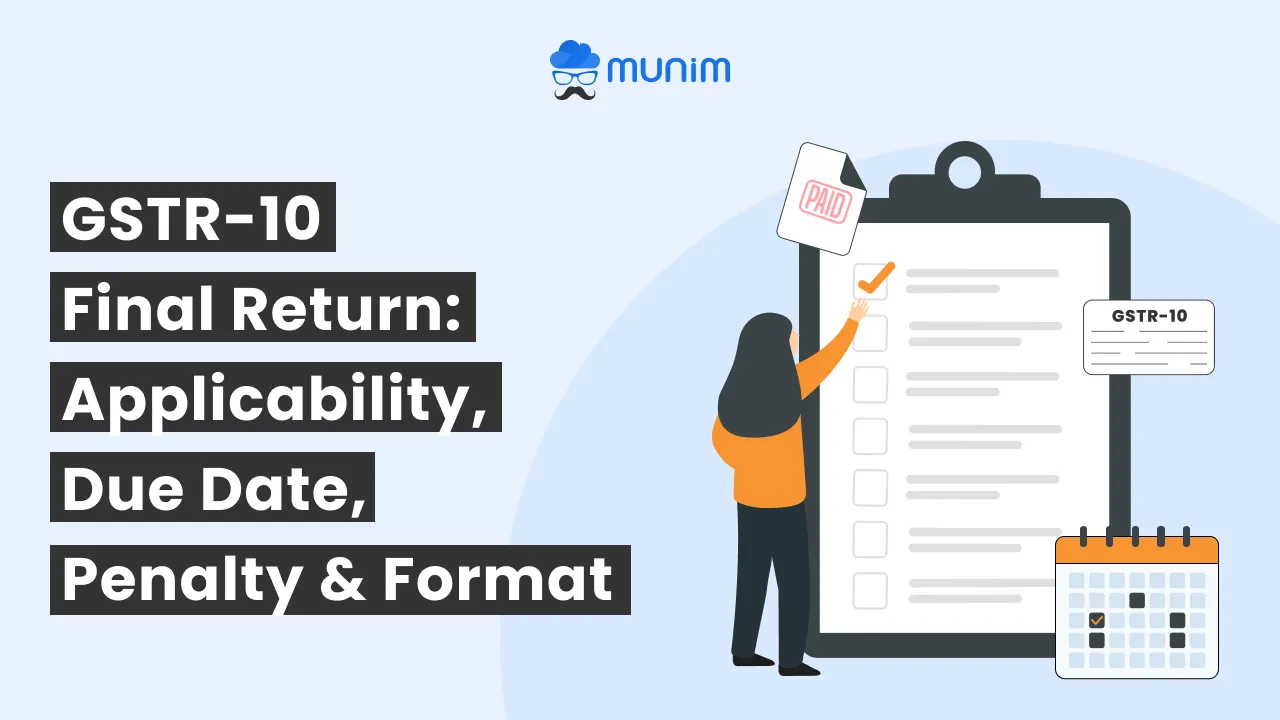
When a business cancels its GST registration, the compliance journey doesn’t end there. The last step before the registration is formally closed is filing the GSTR 10 final return — a one-time form that settles all remaining tax liabilities and Input Tax Credit (ITC) before the account shuts down.
Whether you’re a business owner, accountant, or CA guiding a client through cancellation, this guide covers everything — applicability, format, due date, CA certificate requirements, and the penalty for missing the deadline.
What Is GSTR-10? Understanding the Final Return Under GST
GSTR-10 is the final return under GST, filed only by taxpayers whose GST registration has been canceled — either voluntarily by the business or by the tax authorities.
The form exists to ensure nothing slips through the cracks. Before the registration closes permanently, any unsettled tax liability and ITC claimed on closing stock must be reported and reversed. Think of it as a closing balance sheet for your GST account.
This is also commonly called GST Form 10 or simply GSTR10.
GSTR 10 Applicability: Who Needs to File It?
Not every registered taxpayer files GSTR-10. GSTR 10 applicability is limited to businesses whose GST registration has been canceled or surrendered.
The following categories are exempt from filing GSTR-10:
- Taxpayers under the GST Composition Scheme
- Input Service Distributors (ISD)
- Non-Resident Taxable Persons (NRTP)
- Businesses required to deduct TDS under Section 51 of the CGST Act
- Businesses required to collect TCS under Section 52 of the CGST Act
If your business doesn’t fall into any of these categories and your registration has been canceled, filing GSTR-10 is mandatory.
GSTR-10 Due Date: When Must You File?
You must file the GSTR 10 final return within three months from whichever date is later — the date of GST registration cancellation or the date of the cancellation order.
Example: If the cancellation order is dated 31 January 2024 but you received it on 5 February 2024, the due date is 5 April 2024 — three months from the date of receipt.
Don’t miss this window. A late filing triggers a notice, and ignoring that notice leads to a final order with tax dues, interest, and penalties.
GSTR-10 Penalty: What Happens If You Miss the Due Date?
If you don’t file GSTR-10 by the due date, the GST department will issue a show cause notice. At this stage, you still have a chance to file and resolve the matter.
If you ignore the notice and still don’t file, the tax officer issues a final cancellation order — along with the full amount of tax payable, plus applicable interest and penalty. There is no fixed late fee for GSTR-10 (unlike GSTR-3B or GSTR-1), but the tax liability compounds with interest the longer you delay.
File on time. It’s genuinely not worth the trouble.
Is CA Certificate Mandatory for GSTR-10?
Here’s the straightforward answer:
- Yes, a CA certificate is required if your business holds closing stock and has tax invoices against which ITC was claimed.
- No, it is not required if there is no closing stock.
So GSTR 10 CA certificate is compulsory only when ITC on closing stock needs to be reversed and reported. In that case, the CA certifies the stock valuation and the ITC reversal amount.
CA Certificate Format for GSTR-10
The CBIC has not prescribed a single rigid format, but a standard CA certificate for GSTR-10 typically includes:
- Details of closing stock held
- ITC availed against that stock
- ITC amount to be reversed
- CA’s membership number and signature
If you’re searching for a CA certificate format for GSTR-10 PDF download, consult your CA directly — they’ll prepare it based on your specific stock position and the applicable ITC rules.
Designed for Modern Tax Professionals
A premium filing solution for CAs and tax consultants who need speed, scale, and operational clarity.
 Handle multiple clients with ease
- Reconcile and validate with confidence
- Overcome the limitations of the GST portal
 Handle multiple clients with ease
GSTR-10 Format: How to Fill and File the Return
Here’s a section-by-section breakdown of the GSTR-10 format. Some fields are auto-populated; others require manual input.
Auto-Populated Fields:
- GSTIN – Your unique GST Identification Number
- Legal Name – Registered taxpayer’s name
- Business Name – Your trade name
- Address – Registered business address
Fields You Fill In:
- ARN – The Application Reference Number from your approved cancellation request
- Effective Date of Surrender/Cancellation – As per the cancellation order
- Cancellation Order Status – Voluntary or authority-initiated
- Unique ID of Cancellation Order – If cancellation was forced by the tax department
- Date of Cancellation Order – The date the order was passed
- Particulars of Closing Stock – Stock on hand at the time of cancellation, with ITC details
- Tax on Closing Stock – Outstanding tax liability on that stock
- Verification – Sign using a Digital Signature Certificate (DSC) or Electronic Verification Code (EVC)
Steps to File GSTR-10 Online
- Log in to the GST portal
- Go to Services → Returns → Final Return
- Select the GSTR-10 form
- Fill in all applicable fields — closing stock, ITC reversal, cancellation details, and CA’s details if applicable
- Review everything carefully
- Submit using DSC or EVC
GSTR-10 vs GSTR-9: What’s the Difference?
These two returns often get confused. Here’s a quick comparison:
| GSTR-10 (Final Return) | GSTR-9 (Annual Return) | |
| Who files | Taxpayers whose registration is canceled | All registered taxpayers (except composition) |
| Frequency | One-time only | Every financial year |
| Purpose | Settle liabilities before closure | Report annual transactions |
| Due Date | 3 months from cancellation | 31 December of next FY |
Wrap Up
So this was all about the GSTR-10 final return. We hope that after reading this blog, you will have all your answers related to GSTR 10 filing. If you are looking for user-friendly GST return filing software, do consider signing up with Munim GST because it has everything you need to stay compliant with the latest GST regulations.
Frequently Asked Questions on GSTR-10
Can I file a NIL GSTR-10?
Yes. If your business has no closing stock and no outstanding ITC, you can file a NIL GSTR-10.
Is CA certificate mandatory for GSTR-10?
Only if your business holds stock against which ITC was claimed. No stock, no CA certificate needed.
What is the penalty for late GSTR-10 filing?
There is no fixed late fee, but ignoring the notice leads to a final order with tax dues plus interest. File as soon as possible to avoid this.
What is the due date for GSTR-10?
Three months from the date of cancellation order or the date of receipt of the order — whichever is later.
Where do I file GSTR-10?
On the GST portal under Services → Returns → Final Return.
Disclaimer: "This blog post is for informational purposes only. For specific tax advice related to your business, please consult a qualified Chartered Accountant or GST practitioner."
About the author

Mehul is a seasoned content writer with a passion for simplifying complex accounting and GST topics. With a keen interest in entrepreneurship and business management, he specializes in creating informative and engaging content for themunim.com. His goal is to help businesses understand and implement accounting and GST software solutions effectively. When he's not crafting content, Mehul enjoys exploring new places and spending time with his Golden Retriever.
Post Tags
Related Articles
Explore the latest market news, useful resources for business, and Munim updates.