ICAI CA GPT: Features, Benefits and How to Use It
 AuthorMehul Jagwani
 Reviewed ByCA Ajay Savani



- What Are the Different ICAI CA GPT Modules?
- How Can We Use ICAI CA GPT in Our CA Practice?
- How to Access ICAI CA GPT
- ICAI CA GPT vs ChatGPT: Key Differences
- What Are the Limitations of ICAI CA GPT?
- How Can We Use ICAI CA GPT and Munim Together?
- Making AI Useful in Our CA Practice
- Frequently Asked Questions About ICAI CA GPT
Summary:
ICAI CA GPT is a collection of specialised AI assistants for Chartered Accountants and CA students. It supports technical research, audit preparation, document drafting and financial analysis. Unlike GST filing or accounting software, CA GPT focuses on professional knowledge rather than executing compliance tasks.
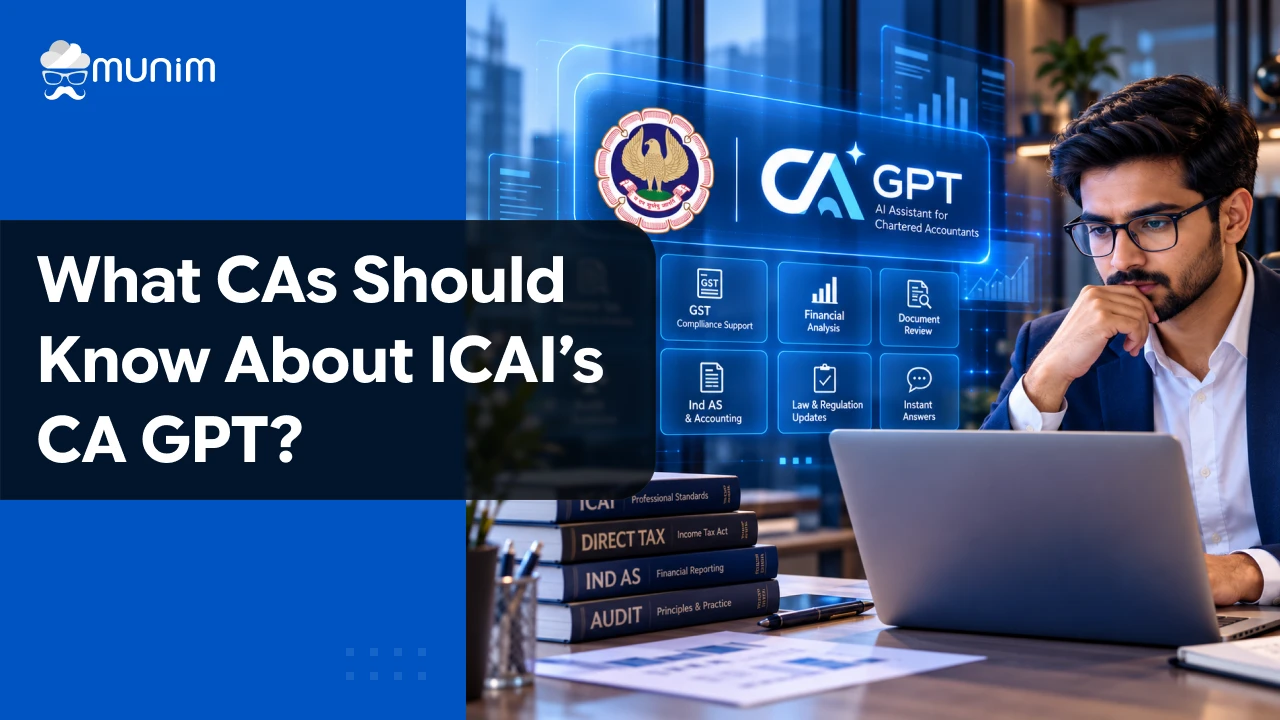
ICAI CA GPT is an AI-based platform developed by the Institute of Chartered Accountants of India (ICAI) to help Chartered Accountants research taxation, auditing, accounting standards and corporate laws. We can use it to ask professional questions and receive AI-generated explanations, summaries and guidance.
Launched on 1 July 2024, CA GPT helps us reduce time spent on research and routine documentation. However, we must verify its responses before using them for professional decisions.
What Are the Different ICAI CA GPT Modules?
ICAI provides subject-specific GPTs covering major areas of Chartered Accountancy.
| CA GPT Module | Primary Use |
| Accounting Standards | Research AS, Ind AS and accounting treatments |
| GST and Indirect Taxes | Understand GST provisions and compliance requirements |
| Direct Taxes | Research income tax laws and deductions |
| Auditing and Assurance | Review auditing standards and procedures |
| Corporate Laws | Understand Companies Act provisions |
| Ethical Standards | Research ICAI’s Code of Ethics |
| Internal Audit | Prepare audit checklists and risk assessments |
| Financial Reporting | Research disclosures and reporting requirements |
| Insolvency and Valuation | Understand valuation and insolvency matters |
| Sustainability Reporting | Research sustainability disclosures |
ICAI has also expanded its AI initiatives to include industry-specific GPTs and financial analysis resources.
How Can We Use ICAI CA GPT in Our CA Practice?
AI for CA practice is particularly useful for research, documentation and preliminary analysis.
1. GST and Income Tax Research
We can use CA GPT to understand tax provisions, identify relevant sections and prepare research checklists.
For example, if a client’s purchase invoice is missing from GSTR-2B, we can ask:
“What checks should we perform when a purchase invoice is missing from GSTR-2B before claiming ITC?”
The response can guide our research, while actual GST reconciliation helps us identify invoice-level differences.
2. Audit Planning and Documentation
We can use CA GPT to prepare:
- Audit planning checklists
- Risk assessment questionnaires
- Internal control review points
- Client information requests
- Draft working papers
We can then adapt these drafts to our client’s business and applicable auditing standards.
3. Accounting Standards Research
CA GPT helps us identify relevant AS or Ind AS provisions and understand accounting treatments.
For instance, we can ask which standard applies to revenue recognition for a service contract and what disclosure requirements we should consider.
4. Financial Analysis
ICAI AI initiatives also support industry research and financial reporting analysis.
We can use these resources to identify financial trends, compare disclosures and prepare management queries.
5. Professional Document Drafting
We can use CA GPT to prepare initial drafts of client questionnaires, SOPs, compliance checklists and internal reports.
This helps us reduce repetitive writing, although we must review the content before professional use.
How to Access ICAI CA GPT
We can access ICAI CA GPT through the official portal using valid ICAI membership credentials.
- Visit the ICAI CA GPT portal.
- Select Member Login.
- Enter our six-digit ICAI membership number.
- Verify the OTP sent to our SSP-registered mobile number.
- Choose the relevant CA GPT module.
- Enter our question and review the response.
Separate access options are available for students and foreign members.
ICAI CA GPT vs ChatGPT: Key Differences
| Feature | ICAI CA GPT | ChatGPT |
| Target audience | CAs and CA students | General and professional users |
| Primary focus | Chartered Accountancy | Multiple industries and subjects |
| GST and taxation | Specialised modules | General research assistance |
| Auditing | Dedicated professional GPTs | General audit-related assistance |
| Accounting standards | Subject-specific research | General explanations |
| Professional verification | Required | Required |
ICAI CA GPT’s main advantage is its focus on Chartered Accountancy. However, we should not treat either tool as an authoritative source of law or professional standards.
What Are the Limitations of ICAI CA GPT?
Although CA GPT can save us research time, we must understand its limitations.
| Limitation | What We Should Do |
| Incorrect or incomplete responses | Verify against official sources |
| Outdated tax information | Specify the applicable FY or AY |
| Missing transaction-specific details | Provide adequate context |
| Client data confidentiality risks | Avoid sharing sensitive information unnecessarily |
| No independent professional judgement | Review conclusions before relying on them |
| No replacement for filing software | Use dedicated compliance tools |
For better answers, we should include our client’s business context, relevant dates, specific questions and required output format.
Example prompt:
“For an Indian manufacturing company in FY 2026-27, explain the checks we should perform before claiming ITC on an invoice missing from GSTR-2B. Identify the relevant provisions that require verification.”
This gives us a more focused response than simply asking, “Explain ITC.”
How Can We Use ICAI CA GPT and Munim Together?
CA GPT and Munim serve different purposes.
We can use ICAI CA GPT to understand compliance requirements, while Munim GST helps us manage GST data, reconciliation and filing activities.
For instance, we can use CA GPT to research the treatment of an ITC discrepancy. With Munim GST, we can identify differences between purchase records and GSTR-2B.
At Munim, we support CAs with:
- GST Return Filing: GSTR-1, GSTR-1A, GSTR-3B, GSTR-4, GSTR-9 and GSTR-9C.
- GST Reconciliation: Compare purchase data with GSTR-2A and GSTR-2B.
- Invoice Management System: Review IMS-related information and exceptions.
- Bulk Filing: Manage returns across multiple clients.
- AI Validations: Identify potential errors before filing.
- GST Reporting: Access reconciliation and compliance reports.
These tools complement AI-assisted research without requiring a direct integration between the two platforms.
Making AI Useful in Our CA Practice
With ICAI CA GPT, we can research tax provisions, understand accounting standards and prepare professional documentation more efficiently. It helps us reduce repetitive work while keeping professional judgement and verification at the centre of our practice.
However, research is only one part of GST compliance. We also need accurate records, proper reconciliation and organised filing workflows.
At Munim, we help CAs manage GST returns, reconcile data and identify potential errors through a structured compliance process.
Explore Munim GST to see how we can simplify GST compliance management for our clients.
Frequently Asked Questions About ICAI CA GPT
When was ICAI CA GPT launched?
ICAI CA GPT was launched for members on 1 July 2024. ICAI has subsequently expanded its AI offerings to additional professional subjects and student resources.
Can CA students use ICAI CA GPT?
Yes. ICAI offers student-specific AI resources and a separate student login facility through its AI portal.
Can we use CA GPT for GST and income tax research?
Yes. We can use specialised GPTs for GST and direct tax research. However, we must verify the responses against applicable legislation, notifications and official guidance.
Is ICAI CA GPT more accurate than ChatGPT?
CA GPT is designed around Chartered Accountancy subjects, but neither platform guarantees complete accuracy. Important professional conclusions require independent verification.
Is it safe to upload client information to CA GPT?
Avoid uploading confidential client information unless it is authorised and appropriate security safeguards are in place. Use anonymised examples wherever possible.
Disclaimer: "This blog post is for informational purposes only. For specific tax advice related to your business, please consult a qualified Chartered Accountant or GST practitioner."
About the author

Mehul is a seasoned content writer with a passion for simplifying complex accounting and GST topics. With a keen interest in entrepreneurship and business management, he specializes in creating informative and engaging content for themunim.com. His goal is to help businesses understand and implement accounting and GST software solutions effectively. When he's not crafting content, Mehul enjoys exploring new places and spending time with his Golden Retriever.
Related Articles
Explore the latest market news, useful resources for business, and Munim updates.