
What is the Order of ITC Utilisation Under GST?
 AuthorMehul Jagwani
 Reviewed ByMadhav Bhayani



Summary:
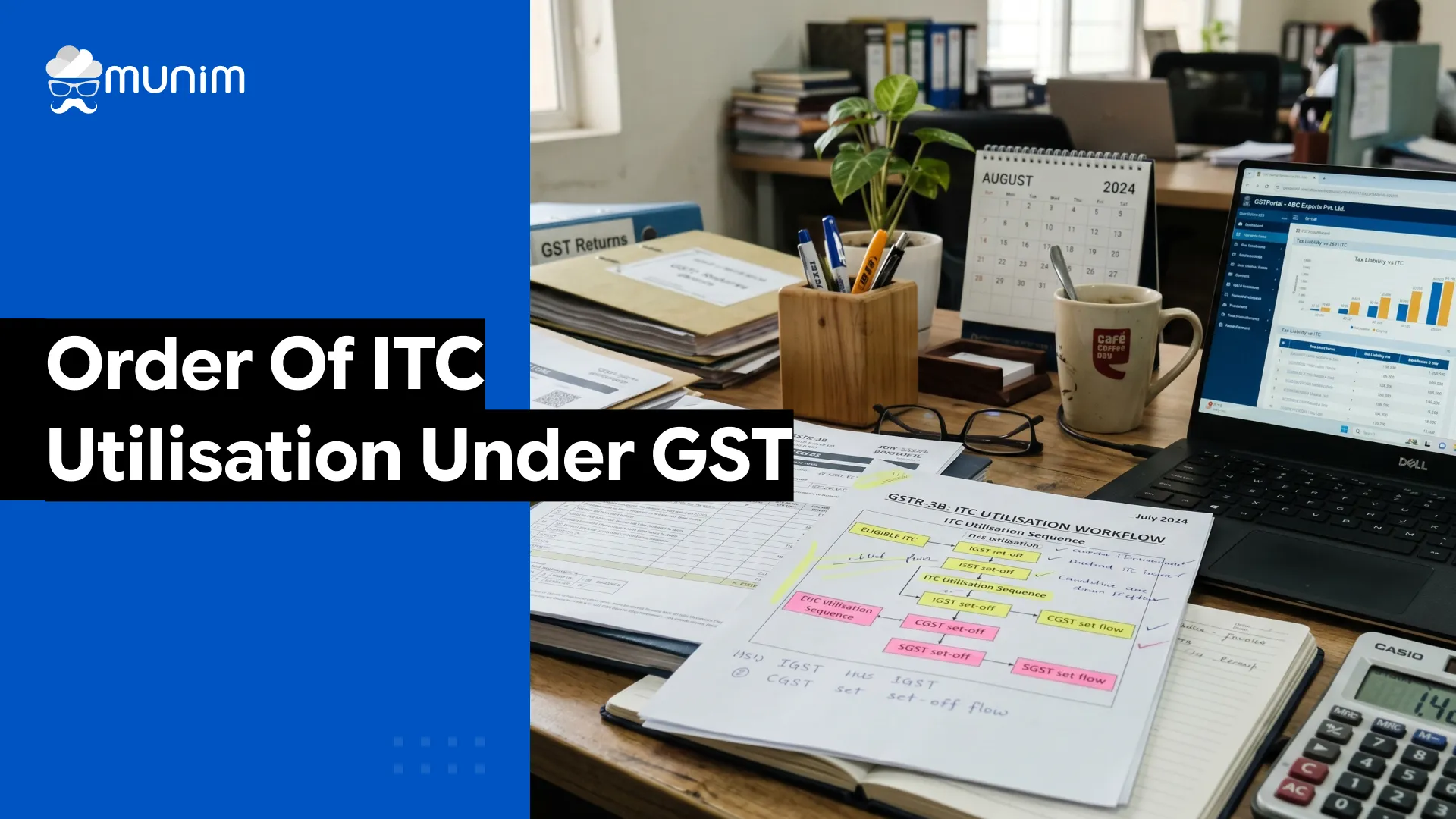
The order of ITC utilisation under GST follows a mandatory sequence prescribed under Section 49A, Section 49B, and Rule 88A of the CGST Act. As per the current ITC set off rules, IGST credit must be fully exhausted before CGST or SGST credit can be used.
Every GST-registered business needs to settle its output tax liability each month. Most businesses have Input Tax Credit sitting in their electronic credit ledger — but they cannot use it in any random order they choose. The law prescribes a specific order of ITC utilisation, and following the wrong sequence can result in unnecessary cash outflows, working capital blockage, or compliance issues.
This guide covers the manner of utilisation of ITC, the legal provisions that govern it, and real-world examples to help businesses and tax practitioners apply these rules correctly.
What Is Input Tax Credit (ITC) in GST?
Input Tax Credit is the credit a registered taxpayer earns on the GST paid for purchases of goods or services used in their business. When a business buys raw materials, pays GST on them, and later sells finished goods, it can use that earlier GST payment to reduce the output tax liability.
Under the dual GST structure in India, ITC can exist under three heads:
- IGST (Integrated GST) — applicable on inter-state transactions
- CGST (Central GST) — applicable on intra-state transactions
- SGST (State GST) — applicable on intra-state transactions
Each type of credit can only be used to pay specific tax liabilities. The rules governing this are what we refer to as the ITC set off rules.
Why Does the Order of ITC Utilisation Matter?
Before 2019, businesses had significant flexibility in how they used their ITC. A taxpayer could use CGST credit to first pay off IGST liability, or use SGST credit in any order that suited them. That flexibility, however, led to unintended accumulation of IGST credit in many cases.
To fix this, the government introduced Section 49A and Section 49B through the CGST (Amendment) Act, 2018, effective from 1 February 2019. These provisions brought in a strict sequence for ITC utilisation. Later, Rule 88A was inserted on 29 March 2019 (vide Notification No. 16/2019 Central Tax), effective from 1 April 2019, to address cash flow concerns that arose from the stricter rules.
The bottom line: the manner of utilisation of ITC is not optional. Businesses must follow the prescribed sequence when filing GSTR-3B.
Designed for Modern Tax Professionals
A premium filing solution for CAs and tax consultants who need speed, scale, and operational clarity.
 Handle multiple clients with ease
- Reconcile and validate with confidence
- Overcome the limitations of the GST portal
 Handle multiple clients with ease
Legal Framework: Section 49A, 49B, and Rule 88A
Understanding the law helps businesses avoid compliance errors. Here is a plain-language breakdown of the three key provisions.
Section 49A – IGST Credit Must Be Used First
Section 49A of the CGST Act states that the ITC available on account of CGST, SGST, or UTGST can be used for paying any GST liability only after the entire IGST credit has been fully exhausted.
In simple terms: finish your IGST credit first. Only then can you touch your CGST or SGST credit.
Section 49B – Government Has Power to Prescribe the Order
Section 49B gives the Central Government the authority to prescribe, on the recommendation of the GST Council, the specific order and manner in which ITC across different heads shall be utilised. This section is what enabled the government to introduce Rule 88A.
Rule 88A – Flexibility Within the IGST-First Rule
Rule 88A, inserted into the CGST Rules, 2017, added an important layer of flexibility. While Section 49A mandated that IGST credit be used first, Rule 88A clarified that once IGST credit is being applied to settle liabilities, the taxpayer can use the remaining IGST balance against CGST liability and SGST liability in any order and in any proportion.
This was a relief for businesses that were getting stuck paying cash under one head while having idle credit under another. Businesses should also be aware that another rule — Rule 86B of the CGST Rules — separately restricts the use of ITC to pay more than 99% of the output tax liability in certain cases.
CBIC Circular No. 98/17/2019-GST dated 23 April 2019 formally clarified how Rule 88A applies in practice.
The Complete Order of ITC Utilisation Under GST
After the introduction of Rule 88A, the ITC utilisation rules now work as follows:
Step 1 – Use IGST Credit First
The total available IGST credit must be applied to GST liabilities in this priority:
- First, against IGST output liability
- Then, any remaining IGST credit can be applied against CGST and SGST (or UTGST) liabilities — in any order and proportion
Step 2 – Use CGST Credit
Once the entire IGST credit is exhausted, CGST credit can be applied in this order:
- First, against CGST output liability
- Then, against IGST liability (if any remains)
Important: CGST credit cannot be used to pay SGST or UTGST liability. This is an absolute restriction.
Step 3 – Use SGST or UTGST Credit
Once IGST credit is fully used, SGST (or UTGST) credit can be applied:
- First, against SGST (or UTGST) output liability
- Then, against IGST liability (if any remains)
Important: SGST credit cannot be used to pay CGST liability. This restriction holds firmly.
ITC Set Off Rules: A Quick Reference Table
| ITC Available | Can Be Used to Pay | Cannot Be Used to Pay |
| IGST | IGST, CGST, SGST/UTGST (in any order) | — |
| CGST | IGST, CGST | SGST or UTGST |
| SGST | IGST, SGST | CGST or UTGST |
| UTGST | IGST, UTGST | CGST or SGST |
The mandatory condition: IGST credit must be fully used before any of the others.
Conclusion
The order of ITC utilisation under GST is one of those compliance fundamentals that every business needs to get right. The rules are clear: use IGST credit first, exhaust it fully, then use CGST and SGST credits in their respective order. Rule 88A adds helpful flexibility by allowing businesses to decide how surplus IGST credit is split between CGST and SGST liabilities — and smart use of this flexibility can meaningfully reduce cash outflow.
It is equally important to know which credits are outright blocked — Section 17(5) of the CGST Act lists specific categories of blocked credit that cannot be claimed as ITC at all, regardless of the set-off sequence.
For tax practitioners, the importance of reviewing the ITC position before finalising GSTR-3B each month cannot be overstated. A slightly different allocation of surplus IGST credit can make a real difference to how much cash a business needs to park.
Frequently Asked Questions (FAQs)
1. What is the order of ITC utilisation under GST?
The order is: first, use all IGST credit (against IGST, then CGST or SGST in any order). After IGST credit is fully exhausted, use CGST credit (against CGST first, then IGST). Similarly, use SGST credit against SGST first, then IGST. CGST and SGST credits cannot be used against each other.
2. Which ITC must be used first under GST?
IGST credit must always be used first, as mandated by Section 49A of the CGST Act. Only after the entire IGST credit balance is exhausted can CGST and SGST credits be applied.
3. Can CGST credit be used to pay SGST liability?
No. CGST credit cannot be used to pay SGST or UTGST liability. This is an absolute restriction under the ITC set off rules.
4. Can SGST credit be used to pay CGST liability?
No. SGST credit cannot be used to pay CGST liability. The cross-utilisation between CGST and SGST is not permitted.
5. How should UTGST credit be treated in ITC?
UTGST credit follows the same rules as SGST credit. It must first be used against UTGST liability, and any surplus can be used against IGST liability — but only after IGST credit is fully exhausted. UTGST credit cannot be used to pay CGST or SGST.
Disclaimer: "This blog post is for informational purposes only. For specific tax advice related to your business, please consult a qualified Chartered Accountant or GST practitioner."
About the author

Mehul is a seasoned content writer with a passion for simplifying complex accounting and GST topics. With a keen interest in entrepreneurship and business management, he specializes in creating informative and engaging content for themunim.com. His goal is to help businesses understand and implement accounting and GST software solutions effectively. When he's not crafting content, Mehul enjoys exploring new places and spending time with his Golden Retriever.
Related Articles
Explore the latest market news, useful resources for business, and Munim updates.