GST on Merchant Trade Transactions: Third-Country Sales Treatment
 AuthorJayant Surana
 Reviewed ByMadhav Bhayani


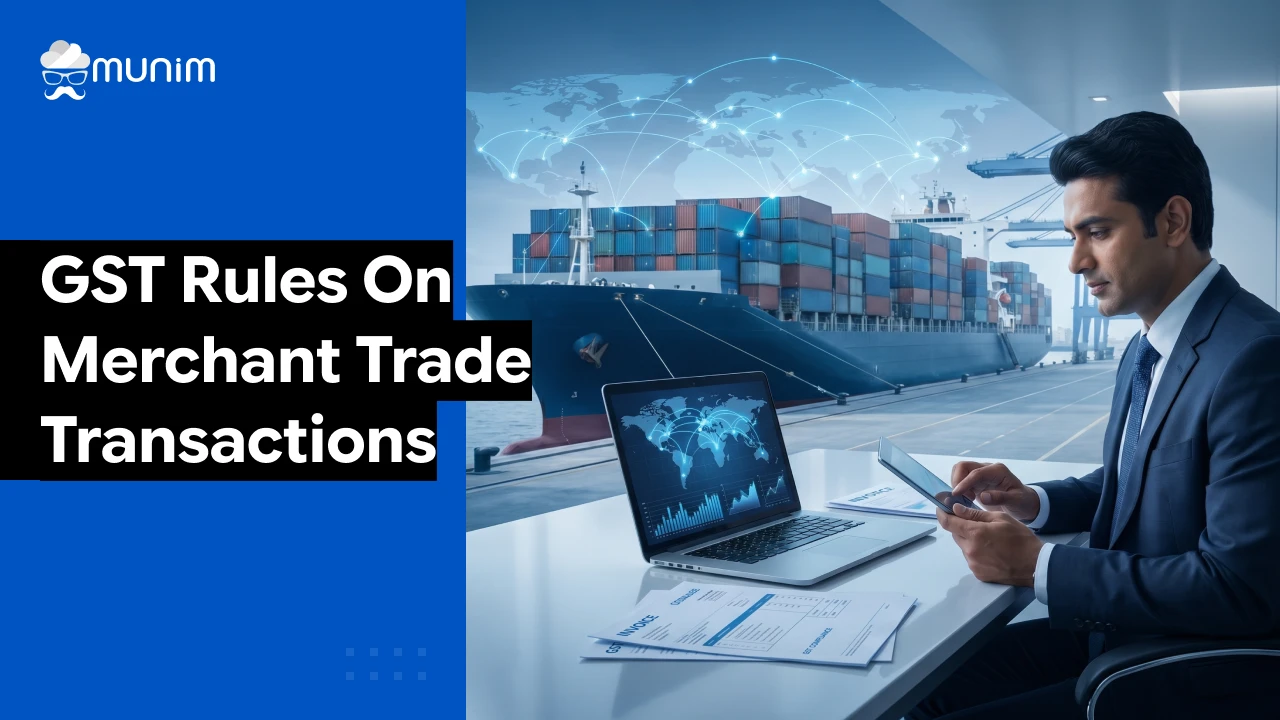
Indian businesses are engaging in more international trade than ever before. This raises common questions about how taxes work for a merchant trade transaction. This guide explains everything you need to know about these specific sales and their tax rules.
What Is a Merchant Trade Transaction? (Out-and-Out Sales)
A merchant trade transaction happens when you buy goods from one foreign country and sell them directly to another. The defining rule is that these goods never enter Indian territory at any point. This process is also commonly known as a third-country sale or an out-and-out sale.
For example, you might buy stock from China and ship it directly to Germany. Your business operates and is managed in India, but the physical products never cross Indian customs borders.
Is GST Applicable on Merchant Trade Transactions?
In India, the GST framework is strictly a location-based consumption tax. It only applies to goods supplied within India or formally imported into Indian territory. Because third-country sales never enter the country, they fall entirely outside these specific tax boundaries.
Legally, Paragraph 7 of Schedule III to the CGST Act (inserted via the 2018 amendment with retrospective effect from July 2017) declares that these trades are not considered a supply of goods. Therefore, GST on merchant trade transactions is simply not applicable. You do not have to pay any GST for these specific international sales.
Designed for Modern Tax Professionals
A premium filing solution for CAs and tax consultants who need speed, scale, and operational clarity.
 Handle multiple clients with ease
- Reconcile and validate with confidence
- Overcome the limitations of the GST portal
 Handle multiple clients with ease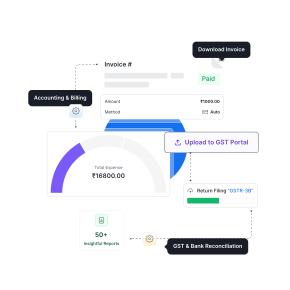
Can You Claim Zero-Rated GST or ITC on These Sales?
Many business owners wonder if they can claim zero-rated tax benefits for these international sales. Under Section 16 of the IGST Act, zero-rated GST exclusively applies to direct exports originating from India. It also applies to specific supplies made to special economic zones (SEZs).
A merchant trade transaction is neither an export from India nor an SEZ supply. Because of this, you cannot claim any zero-rated GST benefits or related refunds. The entire transaction remains completely outside the scope of the GST framework.
Documents Required for Merchant Trade Transactions
Even though no tax applies, you must still maintain strict business records. Section 35 of the CGST Act requires you to be able to prove the exact nature of these sales. Good documentation will keep your business safe during any future tax audits.
Make sure to collect and safely store the following documents:
- Purchase Invoices: Keep the original invoices from your foreign suppliers to prove the goods were bought outside India. Note that these are structurally different from export invoices raised when goods leave Indian territory.
- Sales Invoices: Save copies of the invoices sent to your foreign customers to prove the goods were sold outside India.
- Shipping Documents: Maintain transport records, such as a switch bill of lading or airway bills, to prove direct foreign-to-foreign delivery.
- Financial Receipts: Keep all foreign currency receipts and bank realisation certificates to track the flow of international payments.
Conclusion
Managing taxes for a merchant trade transaction does not have to be confusing once you know the rules. Since the goods never touch Indian soil, you do not owe any GST and the transactions sit entirely outside the scope of CGST, SGST, and IGST.
Just focus on adhering to the updated 6-month RBI outlay timelines and keep accurate shipping records to ensure full compliance.
Frequently Asked Questions (FAQs)
1. Is a merchant trade transaction allowed in India?
Yes, a merchant trade transaction is entirely legal and actively utilised by Indian businesses. You simply need to comply with the latest RBI and FEMA regulations regarding foreign exchange routing and banking procedures.
2. Is GST charged on international transactions?
GST is generally charged on international trades that involve goods entering or leaving Indian territory. However, since out-and-out sales never cross Indian borders, GST on merchant trade transactions does not apply.
3. Where to show third-country sales in GSTR 1?
These specific sales are excluded from the definition of supply under Schedule III of the CGST Act. Therefore, you are not required to report a third-country merchant trade transaction anywhere in your regular GSTR-1 filings.
4. What are the time limits for merchant trade transactions?
Under the RBI’s unified 2026 FEMA Regulations, the time gap between your outward payment to the supplier and the inward payment from the buyer must not exceed six months. The AD bank may grant extensions if reasonable grounds for a delay are provided.
5. Do I need to pay income tax on merchant trade profits?
Yes, any profit generated from a merchant trade transaction is considered regular business income in India. You must declare these earnings in your annual filings and pay the applicable corporate or individual income tax.
6. Can I claim Input Tax Credit (ITC) for third-country sales?
No, you cannot claim any Input Tax Credit (ITC) for expenses related to these specific sales. Since there is no GST on merchant trade transactions, the related input tax benefits simply do not apply.
7. Is an Import Export Code (IEC) required for these trades?
Yes, holding a valid Import Export Code (IEC) is absolutely mandatory for conducting a merchant trade transaction. Your authorised dealer bank will require this code to legally process your foreign currency payments.
Disclaimer: "This blog post is for informational purposes only. For specific tax advice related to your business, please consult a qualified Chartered Accountant or GST practitioner."
About the author

Jayant is a senior content writer and digital marketer, known for his extensive experience in commercial SEO writing, blog content, website copy, and B2B communication. Since 2019, he has worked on diverse freelance projects across industries. His portfolio includes articles, landing pages, social media content, and web development collaborations. Blending clarity, creativity, and strategic messaging, he specialises in crafting professional, audience-focused content for themunim.com.
Related Articles
Explore the latest market news, useful resources for business, and Munim updates.