
Best Small Business Subsidy Loans You Should Know About (2026)
 AuthorMehul Jagwani
 Reviewed ByMadhav Bhayani




Summary:
A government subsidy loan for business offers a smart alternative to traditional bank loans. It lowers your financial burden through direct subsidies, reduced interest rates, or collateral-free guarantees. This guide covers top MSME schemes like PMEGP, Mudra (PMMY), and CGTMSE. Discover the perfect fit for your startup / business. Know the maximum loan amounts, key benefits, and exact application steps.
Starting or expanding a business requires capital, and finding the right funding can be a major hurdle. For many entrepreneurs, securing a government subsidy loan for business is the most sustainable way to grow.
Unlike traditional bank loans, which come with high interest rates, a business subsidy loan offers financial relief. It offers subsidised interest rates, reduced principal amounts, or credit guarantees.
Understanding the right subsidy loan scheme for business can significantly reduce your financial burden. Choosing the best subsidy business loan is important when you are launching a new venture or scaling an existing one.
Let’s break down the best options available, how they work, and how you can secure one.
What is a Subsidy Business Loan?
A subsidy business loan is a financial assistance program where the government (or a government-backed institution) covers a portion of your loan costs. A subsidy is offered to encourage entrepreneurship and economic growth.
This financial support usually comes in three forms:
- Capital Subsidy: The government pays a percentage of the project cost upfront, directly reducing the principal amount you need to borrow.
- Interest Subsidy: The government covers a portion of the interest rate, lowering your monthly EMI burden.
- Credit Guarantee: The government acts as a guarantor, allowing you to secure a small scale business loan with subsidy without pledging physical assets like property.
Track business loans, expenses, and repayments easily with automated accounting tools.
Top Government Subsidy Loans for Business
If you are looking for a subsidy loan for a small business, several powerful government initiatives are designed to help entrepreneurs. Here are the most prominent government schemes for MSME in 2026 you need to know about:
1. Prime Minister’s Employment Generation Programme (PMEGP)
The PMEGP is one of the most popular choices for a government subsidy loan for new business. Administered by the Khadi and Village Industries Commission (KVIC), it aims to generate employment.
PMEGP does so by helping entrepreneurs set up micro-enterprises in the manufacturing and service sectors.
- Maximum Project Cost: Up to ₹50 lakh for manufacturing and ₹20 lakh for the service sector.
- Subsidy Amount: Varies by location and category. General category applicants get a 15% subsidy in urban areas and 25% in rural areas. Special categories (SC/ST/OBC/Women/Minorities) receive up to 25% in urban and 35% in rural areas.
- Best For: First-generation entrepreneurs looking for a substantial PMEGP loan subsidy.
- How to Apply: You can apply online through the PMEGP e-portal.
2. Pradhan Mantri Mudra Yojana (PMMY)
If you need a government subsidy loan for start up business with zero collateral requirements, Mudra loans are the go-to option. While MUDRA itself does not provide a direct capital subsidy, it offers highly accessible, collateral-free credit at favorable terms, often paired with other localised interest subsidies offered by state governments.
- Shishu: Loans up to ₹50,000 (Ideal for micro-startups).
- Kishore: Loans from ₹50,001 to ₹5 lakh.
- Tarun: Loans from ₹5,00,001 to ₹10 lakh.
- Tarun Plus: Expanded limits from ₹10,00,001 to ₹20 lakh for established businesses.
- Best For: Retailers, small manufacturers, and service providers seeking a Mudra loan for new business.
- How to Apply: Easily access this through commercial banks or apply online via the JanSamarth Portal.
3. Credit Guarantee Fund Trust for Micro and Small Enterprises (CGTMSE)
For established MSMEs and startups that lack physical assets, the CGTMSE provides a vital lifeline. It offers a credit guarantee to financial institutions, absorbing the risk and enabling banks to lend without demanding collateral.
- Loan Limit: Up to ₹5 crore.
- Guarantee Cover: Ranges from 75% to 85% of the sanctioned amount, with special 80% coverage for women-owned enterprises.
- Best For: Expanding businesses that need collateral free loans for MSME but lack property to pledge.
- How to Apply: Since CGTMSE is a guarantee scheme rather than a direct loan, you apply for a standard business loan. You can apply through a Member Lending Institution (like a bank or NBFC) and request them to cover it under the CGTMSE scheme.
4. Stand-Up India Scheme
This scheme is specifically tailored to empower marginalised groups and promote diversity in business. It facilitates bank loans to set up greenfield (brand new) enterprises in manufacturing, services, or the trading sector.
- Loan Amount: Between ₹10 lakh and ₹1 crore.
- Eligibility: At least one SC/ST borrower or one woman entrepreneur per bank branch.
- Best For: Those seeking a targeted subsidy loan for women entrepreneurs or support for SC/ST-led greenfield projects.
- How to Apply: Check eligibility and start the process through participating banks or the SBI Stand-Up India Page.
5. PM Formalisation of Micro Food Processing Enterprises (PM FME)
Targeting the unorganised food processing sector, this scheme provides financial, technical, and business support to micro food processing units.
- Subsidy: Offers a 35% credit-linked capital subsidy, capped at ₹10 lakh per unit.
- Best For: Small businesses in the food sector looking for a specialised subsidy loan for business.
- How to Apply: Applications can be submitted online via the official PMFME portal. It is maintained by the Ministry of Food Processing Industries.
Simplify Your Business Operations
Designed to give you speed, control, and accuracy in daily accounting tasks.
 Save time with automated accounting workflows
- Get 35+ detailed business reports easily
- Access your business anytime, anywhere
 Save time with automated accounting workflows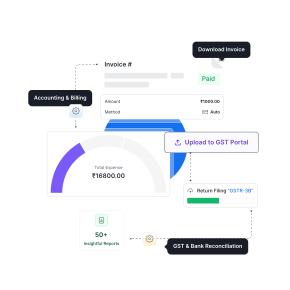
At a Glance: Comparing the Best Subsidy Loans
| Scheme Name | Max Loan/Project Amount | Key Benefit | Target Audience |
| PMEGP | ₹50 Lakh (Mfg) / ₹20 Lakh (Service) | 15% to 35% capital subsidy | New manufacturing/service micro-units |
| Mudra (PMMY) | Up to ₹10 Lakh | Collateral-free, accessible credit | Non-farm micro-enterprises |
| CGTMSE | Up to ₹5 Crore | Government guarantees up to 85% | MSMEs lacking physical collateral |
| Stand-Up India | ₹10 Lakh to ₹1 Crore | Capital for greenfield projects | Women and SC/ST entrepreneurs |
| PM FME | Up to ₹10 Lakh subsidy cap | 35% credit-linked subsidy | Micro food processing units |
How to Apply for a Subsidy Loan Scheme for Business?
Securing a subsidy loan for business requires preparation. While the exact portal varies by scheme (e.g., the Udyamimitra portal for Mudra, or the KVIC online portal for PMEGP), the general sequence of events remains consistent:
1. Draft a Robust Business Plan: Your project report is the most critical document. It must detail your revenue model, operational costs, machinery requirements, and exactly how the loan will be utilised.
2. Ensure Udyam Registration: To qualify for almost any MSME benefit today, your business must be registered on the government’s Udyam registration portal.
3. Gather Documentation: Prepare your KYC documents, proof of business address, caste/category certificates (if applying for special subsidies), and past financial statements (for existing businesses).
4. Apply Through the Nodal Agency/Bank: Submit your application through the specific scheme’s digital portal or directly to a Member Lending Institution (MLI) like a public or private sector bank.
5. Bank Appraisal: Even with a government mandate, the lending bank will rigorously appraise your project’s viability before sanctioning the funds.
Final Thoughts
Navigating the world of commercial finance can be intimidating, but leveraging a government subsidy loan for business can dramatically change your growth trajectory.
By reducing capital costs and removing the heavy barrier of collateral, schemes like PMEGP, Mudra, and CGTMSE empower you to focus on what matters most: building a sustainable, thriving enterprise.
Take the time to assess which subsidy loan scheme for business aligns with your industry, scale, and background, and take the next step toward funding your vision.
Frequently Asked Questions (FAQs)
Where can you check out the PGEGP loan subsidy details?
You can check the complete PGEGP loan subsidy details (officially known as PMEGP) on the KVIC online e-portal or the official Ministry of MSME website. The portal provides all guidelines, margin money details, and eligibility criteria.
Can I get a 100% government subsidy loan for new business?
No, there is no 100% subsidy business loan. The government provides a partial subsidy (usually ranging from 15% to 35%) on the total project cost. You are expected to contribute a small margin (typically 5% to 10%), while the bank finances the remaining amount.
Is collateral mandatory for a small scale business loan with subsidy?
No. Several government initiatives, specifically Mudra and CGTMSE, provide collateral free loans for MSME. The government or a trust takes on the guarantee for the loan, meaning you do not need to pledge personal property or assets.
What is the maximum amount I can get under a Mudra loan for new business?
Under the Pradhan Mantri Mudra Yojana (PMMY), you can get a collateral-free loan of up to ₹10 lakh across three categories (Shishu, Kishore, and Tarun). Recently, a Tarun Plus category was introduced for established businesses, allowing loans up to ₹20 lakh.
Are there specific subsidy loans for women entrepreneurs?
Yes! The Stand-Up India scheme specifically facilitates bank loans between ₹10 lakh and ₹1 crore for at least one woman entrepreneur per bank branch. Additionally, under the PMEGP scheme, women entrepreneurs fall under the “Special Category”. They are eligible for higher subsidy percentages (up to 35%).
What is the difference between an interest subsidy and a capital subsidy?
A capital subsidy directly reduces the principal loan amount you owe by covering a percentage of the total project cost upfront (e.g., PMEGP). An interest subsidy reduces the interest rate you pay on your monthly EMIs, making the loan cheaper to repay over time.
Disclaimer: "This blog post is for informational purposes only. For specific tax advice related to your business, please consult a qualified Chartered Accountant or GST practitioner."
About the author

Mehul is a seasoned content writer with a passion for simplifying complex accounting and GST topics. With a keen interest in entrepreneurship and business management, he specializes in creating informative and engaging content for themunim.com. His goal is to help businesses understand and implement accounting and GST software solutions effectively. When he's not crafting content, Mehul enjoys exploring new places and spending time with his Golden Retriever.
Related Articles
Explore the latest market news, useful resources for business, and Munim updates.