
New UPI MDR Rules: What They Mean for Your Business and Your Books
 AuthorMehul Jagwani
 Reviewed ByAjay Savani



- What Are the New UPI MDR Charges From 15 October 2026?
- Which Small Merchants Are Exempt From MDR?
- What MDR Applies to Fuel, Railways, Insurance and Utilities?
- What MDR Applies to Capital Market Transactions?
- How Should MDR Be Recorded in the Books?
- How Does Bank Reconciliation Work When MDR Is Deducted?
- What Is the GST Treatment of MDR?
- What Should Businesses Do Before 15 October 2026?
- Ajay’s View: What This Update Means for Munim Customers
- Frequently Asked Questions About MDR on UPI
Summary:
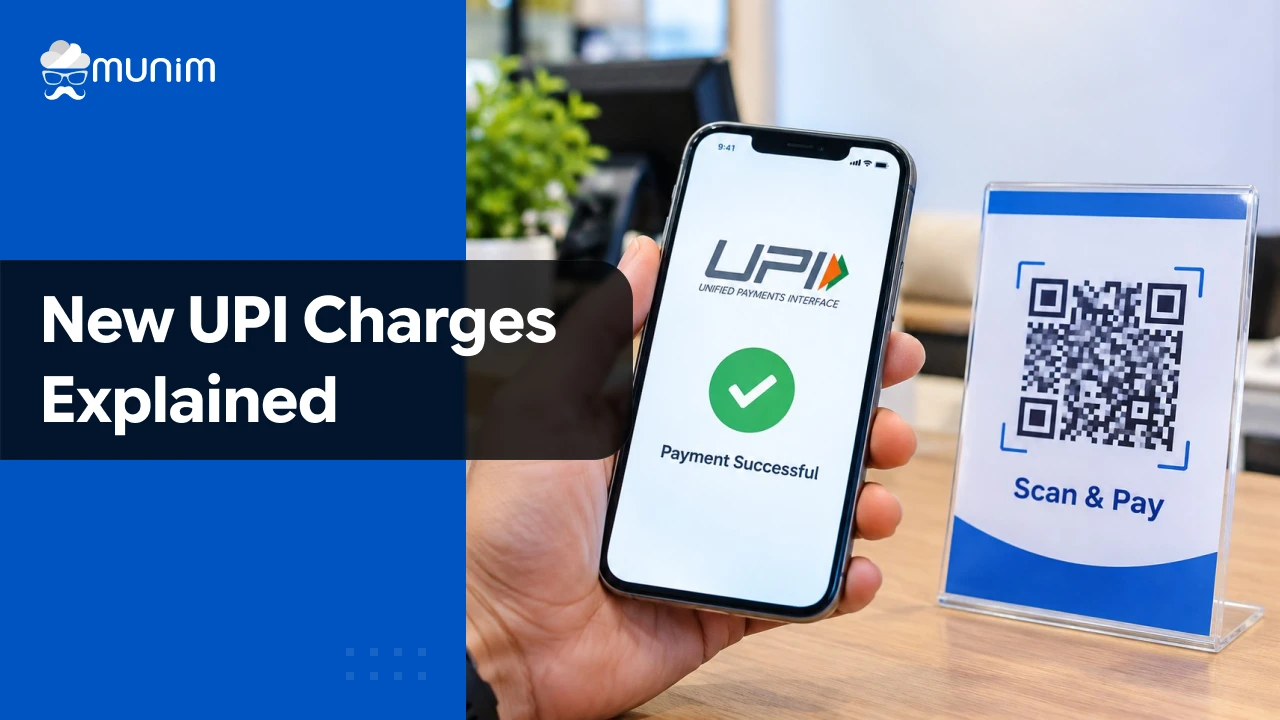
From 15 October 2026, specified UPI merchant payments above ₹2,000 will attract 0.4% MDR, capped at ₹300. Customers, personal transfers, payments up to ₹2,000 and eligible small merchants remain exempt. Businesses must record MDR separately, reconcile net settlements and account for GST correctly.
Accept UPI payments? From 15 October 2026, eligible merchant payments above ₹2,000 will attract 0.4% MDR, capped at ₹300, paid by merchants. Smaller payments, personal transfers and eligible small-merchant collections remain free of MDR. We explain what this means for your costs, settlements and books.
For a business owner, payment news becomes meaningful when it answers a practical question: What changes for my business tomorrow?
The new UPI Merchant Discount Rate, or MDR, deserves that kind of explanation.
From 15 October 2026, specified bank-account-to-merchant UPI payments above ₹2,000 will attract 0.4% MDR, capped at ₹300 per transaction. This framework is separate from the rules for credit cards and credit lines linked to UPI. Official MDR FAQs
If you already maintain your books in Munim, the practical question is how an affected payment should appear in your records: the customer’s full payment, the provider’s deduction and the amount credited to your bank.
In this article, I’ll explain the rules and the checks that can help you keep those figures connected.
Simplify Your Business Operations
Designed to give you speed, control, and accuracy in daily accounting tasks.
 Save time with automated accounting workflows
- Get 35+ detailed business reports easily
- Access your business anytime, anywhere
 Save time with automated accounting workflows
What Are the New UPI MDR Charges From 15 October 2026?
The official FAQs published on the Department of Financial Services website explain the standard MDR structure as follows. The amounts in this table exclude any applicable GST on the processing fee. Official MDR FAQs
| UPI payment amount | MDR rate | MDR payable by merchant |
| Up to ₹2,000 | Nil | ₹0 |
| ₹3,000 | 0.4% | ₹12 |
| ₹10,000 | 0.4% | ₹40 |
| ₹50,000 | 0.4% | ₹200 |
| ₹75,000 | 0.4% | ₹300 |
| ₹1,00,000 | Capped | ₹300 |
For transactions of ₹75,000 and above, the merchant will not pay more than ₹300 as MDR on a single transaction.
The basic formula is:
MDR = Transaction value × 0.4%
However:
Maximum MDR per transaction = ₹300
The standard rate does not apply to every UPI transfer. The nature of the transaction, merchant classification and industry category must be checked.
Which Small Merchants Are Exempt From MDR?
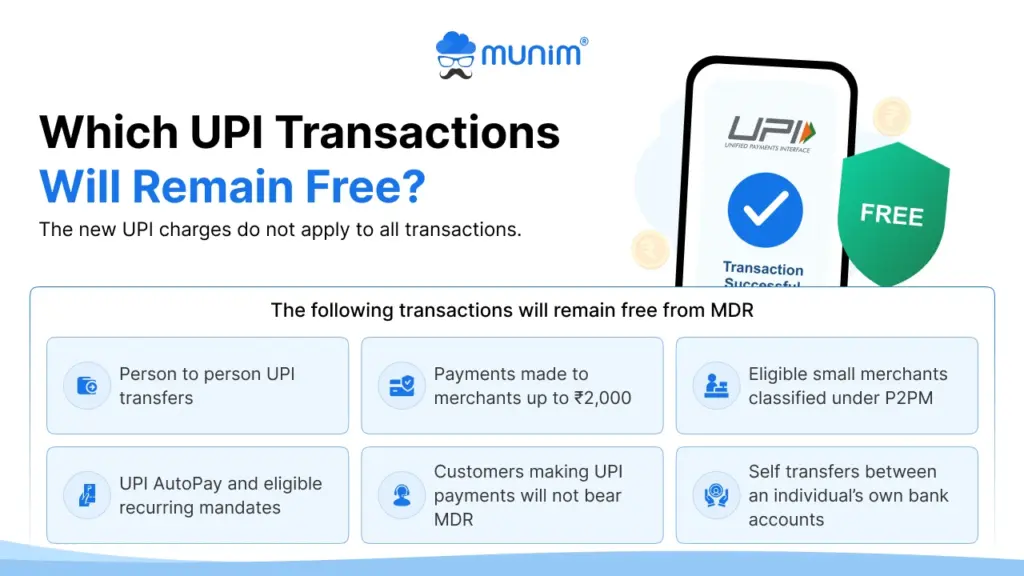
Eligible small merchants receiving up to ₹1 lakh per month through UPI QR codes under the Person to Person Merchant category will continue to enjoy zero MDR.
This category is commonly called P2PM. It is designed for small vendors who receive customer payments directly into their accounts through UPI QR codes.
Eligible businesses may include:
- Street vendors
- Local vegetable sellers
- Tea stalls
- Small neighbourhood shops
- Home based businesses
- Local service providers
- Other micro merchants classified under P2PM
An individual payment above ₹2,000 will not automatically make an eligible P2PM merchant liable for MDR. The merchant’s overall account classification determines whether MDR applies.
For example, if a P2PM classified merchant receives one QR payment of ₹3,500 but remains within the eligible monthly collection limit, that payment may continue to receive zero MDR treatment.
P2PM merchants whose inward UPI payments exceed ₹1 lakh per month for three consecutive months transition to P2M, according to the official FAQs.
Our advice is to confirm your merchant classification with your bank or payment provider. If you maintain your books in Munim, compare the relevant UPI receipts with your provider’s reports. This collection threshold should not be confused with your total business turnover.
What MDR Applies to Fuel, Railways, Insurance and Utilities?
A flat MDR of ₹5 will apply to specified transactions above ₹2,000 in selected essential and narrow margin sectors.
These sectors include:
- Railways
- Telecommunications
- Insurance
- Fuel
- Public utilities
- Agricultural inputs
- Other notified industry programme categories
The flat ₹5 charge applies instead of the standard 0.4% MDR.
For example:
| Transaction | Standard 0.4% MDR | Applicable sector MDR |
| Fuel purchase of ₹3,000 | ₹12 | ₹5 |
| Insurance premium of ₹10,000 | ₹40 | ₹5 |
| Railway payment of ₹20,000 | ₹80 | ₹5 |
| Utility payment of ₹25,000 | ₹100 | ₹5 |
Payments up to ₹2,000 in these categories will remain free from MDR.
These examples assume the transaction qualifies for the specified sector rate and exclude applicable GST on the fee. Confirm your merchant-category classification with your bank or payment provider.
What MDR Applies to Capital Market Transactions?
Payments connected with mutual funds, securities, stockbrokers and dealers will attract a lower MDR of 0.02%, subject to a maximum charge of ₹300 per transaction.
This rate is lower than the standard 0.4% MDR applicable to ordinary commercial transactions above ₹2,000.
For example:
| Capital market payment | MDR at 0.02% |
| ₹10,000 | ₹2 |
| ₹50,000 | ₹10 |
| ₹1,00,000 | ₹20 |
| ₹5,00,000 | ₹100 |
| ₹15,00,000 | ₹300 |
These are illustrative fee calculations, subject to the transaction limits applicable to the payment. Eligible UPI AutoPay mandates remain exempt from the prescribed MDR.
How Should MDR Be Recorded in the Books?
The merchant should record the complete customer payment against the invoice and show MDR separately as an expense.
MDR should not be deducted from sales revenue. The sale remains recorded at its full value because the customer has paid the complete invoice amount.
If you maintain the customer invoice in Munim, your records should show the customer’s full payment and the processing deduction separately. A lower bank settlement should not leave a fully paid invoice appearing outstanding.
Example of an MDR accounting entry
Assume:
- Customer invoice: ₹10,000
- UPI payment received: ₹10,000
- MDR at 0.4%: ₹40
- GST on MDR at 18%: ₹7.20
- Net bank settlement: ₹9,952.80
The settlement calculation is:
| Particulars | Amount |
| Gross UPI payment | ₹10,000.00 |
| Less: MDR | ₹40.00 |
| Less: GST on MDR | ₹7.20 |
| Net amount received | ₹9,952.80 |
If the merchant can claim input tax credit, the journal entry may be:
| Account | Debit | Credit |
| Bank account | ₹9,952.80 | |
| MDR or payment processing expense | ₹40.00 | |
| Input GST | ₹7.20 | |
| Customer account | ₹10,000.00 |
How Does Bank Reconciliation Work When MDR Is Deducted?
The business should match the gross UPI receipt, MDR, GST and net bank settlement as one connected transaction.
The reconciliation formula is:
Gross customer payment − MDR − GST on MDR − other adjustments = Net bank settlement
Using the ₹10,000 example:
₹10,000 − ₹40 − ₹7.20 = ₹9,952.80
Bank reconciliation process
- Identify the invoice paid by the customer.
- Confirm the gross amount paid through UPI.
- Download the provider’s settlement report.
- Identify the MDR deducted.
- Verify GST charged on the MDR.
- Check for refunds, reversals or other adjustments.
- Match the net settlement with the bank statement.
- Record the MDR expense and eligible input GST.
- Close the customer invoice for the full payment.
- Investigate any remaining difference.
For Munim customers, this is a useful check whenever a recorded customer payment differs from the bank credit. Review the settlement report before adjusting the customer’s outstanding balance.
If your workflow captures only the net bank amount, establish how the processing fee and GST will be recorded. Do not assume every difference is MDR; refunds, reversals and settlement timing can also cause mismatches.
What Is the GST Treatment of MDR?
GST does not apply to the complete UPI transaction amount merely because the payment exceeds ₹2,000.
GST applies to the MDR or payment processing service charged to the merchant. Such payment processing charges ordinarily attract 18% GST.
For example:
- UPI payment: ₹10,000
- MDR at 0.4%: ₹40
- GST on MDR at 18%: ₹7.20
The GST calculation is:
₹40 × 18% = ₹7.20
GST is not calculated as 18% of the ₹10,000 UPI payment.
GST on the processing fee is separate from any GST applicable to the underlying sale. Input tax credit is subject to eligibility and supporting documentation; it should not be assumed simply because GST appears in the deduction.
The Ministry of Finance has previously clarified that GST can apply to payment-processing charges such as MDR, rather than the amount transferred itself. Confirm the applicable rate and tax amount using your provider’s valid tax invoice.
What Should Businesses Do Before 15 October 2026?
Before the new framework takes effect, I encourage business owners to confirm whether their UPI collections will attract MDR and how those charges will appear in their accounts.
If you maintain your books in Munim, use this checklist with your accountant to connect your customer invoices, payment-provider reports and bank settlements.
Confirm the merchant category
Ask your bank or payment provider to confirm whether your account is classified as:
- P2PM
- Regular P2M
- Essential sector merchant
- Capital market merchant
- Another notified merchant category
Request written confirmation of your applicable rate, exemption status and when charges will begin. Your merchant classification determines which treatment applies.
Review your accounting ledgers
Check whether your existing accounts adequately cover:
- UPI clearing, where used
- MDR or payment-processing expenses
- Eligible input CGST, SGST and IGST
- Refunds, reversals or chargebacks
Add separate ledgers where your accounting process requires them. The aim is to distinguish customer payments from processing costs and taxes without creating duplicate accounts.
Check your settlement reports
Confirm whether your payment provider’s reports show:
- Gross collection
- MDR
- GST on MDR
- Refunds
- Reversals
- Settlement ID
- Net bank credit
Also confirm whether fees will be deducted from settlements or billed separately. This determines how your accounts team should record and reconcile them.
Review how customer payments are recorded
A customer who pays the full invoice should not appear to owe money because the provider deducted a processing fee.
For invoices maintained in Munim, ensure your accounting process records the full customer payment and accounts for deductions separately. If your workflow captures only the net bank credit, establish how the fee and tax details will be added from the settlement report.
Estimate the effect on your margins
Use your recent payment records to assess:
- The number and value of eligible UPI payments above ₹2,000
- Your merchant category and applicable rate
- Exemptions and per-transaction caps
- GST on processing fees and eligibility for input tax credit
Keep supporting records together
Retain the documents needed to explain each settlement:
- Customer invoice
- UPI reference number
- Settlement report
- Bank statement
- MDR invoice and applicable GST tax invoice
- Refund and adjustment reports
Ajay’s View: What This Update Means for Munim Customers
“When I share a regulatory or payment update with Munim customers, I want it to answer three questions: Does this affect your business? What changes in your accounts? What should you check next?
For this UPI update, those questions lead to specific actions: confirm your merchant classification, estimate the cost of affected transactions and make sure every settlement can be traced back to the customer’s payment.
If you already maintain your books in Munim, use those records together with your payment-provider reports to assess the impact. Your invoice tells you what the customer owed. The payment record establishes what they paid. The settlement report explains deductions. Your bank statement confirms what arrived.
Keeping those records connected helps you avoid showing a fully paid invoice as outstanding, overlooking processing costs or treating an unexplained deduction as an acceptable charge.
I support continued investment in reliable and secure digital payments. I also believe small businesses deserve clear classifications, understandable fee statements, proper tax invoices and a straightforward way to challenge incorrect deductions.
A 0.4% charge deserves attention when margins are thin. As an illustration, ₹40 MDR on a ₹10,000 sale would consume 8% of a ₹500 gross profit, before considering tax treatment.
That is why this news matters beyond the headline. My aim in sharing it is to help you understand the effect on your business and know what to check before the first deduction reaches your books.” – Ajay, Founder, Munim
Frequently Asked Questions About MDR on UPI
Is MDR charged on a payment of exactly ₹2,000?
No. UPI merchant payments up to and including ₹2,000 remain free from MDR. The standard charge applies to eligible transactions above ₹2,000.
Will customers pay the new UPI charge?
No. MDR is payable by the merchant receiving the payment. Customers can continue making valid UPI payments without paying a transaction or platform fee.
Are personal UPI transfers chargeable?
No. Person to person transfers to friends, family members or an individual’s own bank accounts remain free, irrespective of the permitted transfer amount.
What happens if a small merchant receives more than ₹1 lakh per month?
The official FAQs state that P2PM merchants whose inward UPI payments exceed ₹1 lakh per month for three consecutive months transition to P2M. Confirm the classification change and applicable charges with your bank or payment provider.
Should the customer invoice remain partly unpaid after MDR deduction?
No. The customer invoice should be closed for the full amount paid. MDR and GST are merchant side deductions and should be recorded separately.
Do these MDR rules also apply to credit cards or credit lines linked to UPI?
The framework discussed here applies to direct bank-account-to-merchant UPI payments. Credit-linked UPI payments, including RuPay credit cards and bank credit lines linked to UPI, follow separate product rules. Confirm their applicable charges with your provider. Official MDR FAQs, question 36
Disclaimer: "This blog post is for informational purposes only. For specific tax advice related to your business, please consult a qualified Chartered Accountant or GST practitioner."
Related Articles
Explore the latest market news, useful resources for business, and Munim updates.