What is Electronic Cash Ledger in GST & How Does it Work?
 AuthorMehul Jagwani
 Reviewed ByCA Ajay Savani


- What is an Electronic Cash Ledger?
- How to Deposit Money into the GST Cash Ledger
- Who Maintains the Electronic Cash Ledger?
- What Can the Electronic Cash Ledger Be Used For?
- How to View the Electronic Cash Ledger Balance
- Refund of Balance in Electronic Cash Ledger
- The Three GST Ledgers at a Glance
- Closing Notes
- FAQs on Electronic Cash Ledger in GST
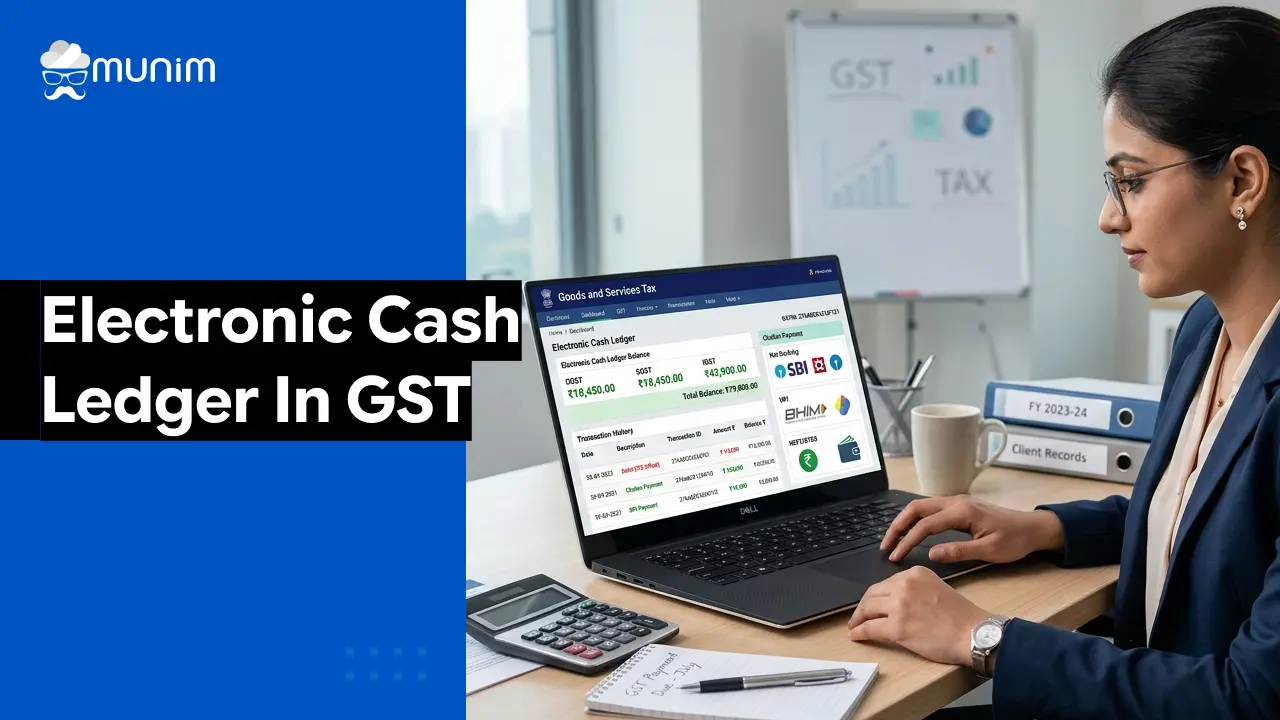
Every GST-registered business has three ledgers on the GSTN portal. One of them, the electronic cash ledger, is perhaps the simplest, yet it confuses many taxpayers because of how GST payment rules work. Simply put, this is where your real money sits. You deposit funds here, and those funds are then used to pay your actual GST liability.
What is an Electronic Cash Ledger?
The electronic cash ledger (ECL) is a ledger maintained on the GST portal for each registered taxpayer. It functions as a digital wallet. Any cash payment a taxpayer makes toward GST, whether through net banking, UPI, NEFT, RTGS, or over-the-counter at an authorized bank, gets credited here first.
Once the money is in the ledger, it can be used to discharge GST liabilities. This includes CGST, SGST, IGST, and UTGST, as well as interest, penalties, late fees, and any other dues under the GST law.
How to Deposit Money into the GST Cash Ledger
Depositing money into the electronic cash ledger is done through Form GST PMT-06. Here is how it works in practice, step by step, when a taxpayer needs to add funds to meet their GST liability.
Step 1: Log in to the GST Portal
Visit gstin.gov.in and log in with your credentials.
Step 2: Go to Services > Payments > Create Challan
Choose the tax period and enter the amount you want to deposit under each head (CGST, SGST, IGST, Cess) and sub-head (tax, interest, penalty, fee, others).
Step 3: Choose a Payment Mode
Available payment modes include:
- Net banking (immediate credit, most commonly used)
- UPI (for smaller amounts)
- NEFT/RTGS (for large amounts, takes a few hours)
- Over the counter at authorized banks (for amounts up to Rs. 10,000 per challan)
- Credit/Debit card (subject to availability)
Step 4: Complete the Payment
After payment, the amount is reflected in the electronic cash ledger under the respective head. The challan reference number (CRN) is generated, and the GSTN sends a confirmation.
Who Maintains the Electronic Cash Ledger?
Every person registered under GST has an electronic cash ledger. This includes:
- Regular taxpayers
- Composition scheme dealers
- Input service distributors
- Non-resident taxable persons
- Casual taxable persons
- TDS and TCS deductors and collectors
Even if a taxpayer has sufficient ITC to cover all tax dues, they still need a cash ledger balance to pay interest or penalties if any arise.
What Can the Electronic Cash Ledger Be Used For?
The balance in the GST cash ledger can be used to pay:
- GST output tax liability (to the extent ITC is not available or insufficient)
- Interest on late payment of tax
- Late fees for delayed filing of returns
- Penalties levied under GST
- Reverse charge mechanism (RCM) tax liability (ITC cannot be used for RCM payment in certain cases)
- Pre-deposit for appeals
It cannot be used to pay dues for another GSTIN, even if both GSTINs belong to the same business entity.
How to View the Electronic Cash Ledger Balance
Checking the balance is simple.
Log in to the GST portal. Go to Services > Ledgers > Electronic Cash Ledger. The portal displays the available balance under each head and sub-head. You can also download a statement for a specific date range.
The ledger shows:
- Opening balance
- Credits (deposits made)
- Debits (liabilities discharged)
- Closing balance
This is useful for reconciliation, especially before filing monthly or quarterly returns.
Refund of Balance in Electronic Cash Ledger
One of the useful features of the GST’s electronic cash ledger is that excess balance can be claimed as a refund. This is governed by Section 54 of the CGST Act.
If a taxpayer has deposited excess cash and there is no pending liability, they can apply for a refund through Form GST RFD-01. The application must be filed within two years from the relevant date.
Common reasons for excess cash balance include:
- Payment made under the wrong head
- Overpayment due to miscalculation
- Business closure with remaining balance
- Advance payment in anticipation of liability that did not arise
The Three GST Ledgers at a Glance
To understand the cash ledger better, it helps to see all three ledgers together.
| Ledger | What It Holds | Used For |
| Electronic Cash Ledger | Actual cash deposits | Paying tax, interest, penalty, late fee |
| Electronic Credit Ledger | Input Tax Credit (ITC) | Paying output tax liability only |
| Electronic Liability Ledger | Outstanding dues | Tracks what is owed to the government |
The electronic cash ledger is the only one that holds real money. ITC in the credit ledger cannot be used to pay interest, penalties, or late fees. For those, only the cash ledger balance works.
Closing Notes
The electronic cash ledger is not just a technical feature of the GST system. It is the actual payment account a taxpayer holds with the government. Understanding how it works, when to use it, and how to manage it properly saves businesses from avoidable interest, penalties, and compliance headaches.
Whether you are a small business owner filing monthly returns or a finance professional managing multiple GSTINs, knowing the mechanics of the GST cash ledger gives you better control over your compliance process.
FAQs on Electronic Cash Ledger in GST
1. What is the difference between the electronic cash ledger and the electronic credit ledger?
The cash ledger holds actual money deposited by the taxpayer. The credit ledger holds input tax credit. The credit ledger can only be used to pay output tax, while the cash ledger can be used for all dues including interest and penalties.
2. Can I transfer my electronic cash ledger balance to another GSTIN?
Yes, after the Finance Act 2022 amendment, a taxpayer can transfer the cash ledger balance from one GSTIN to another GSTIN registered under the same PAN using Form GST PMT-09.
3. How do I check my electronic cash ledger balance?
Log in to the GST portal. Go to Services > Ledgers > Electronic Cash Ledger. You will see your available balance under each head and sub-head.
4. Can I get a refund of excess balance in the electronic cash ledger?
Yes. If there is an excess balance with no pending liability, you can apply for a refund using Form GST RFD-01. The application must be filed within two years from the relevant date.
5. Can composition dealers use the electronic cash ledger?
Yes. Composition dealers must pay all their GST dues entirely through the electronic cash ledger since they cannot claim input tax credit.
6. Is the electronic cash ledger balance shown in real time?
Generally, net banking and UPI payments reflect within a few minutes. NEFT and RTGS payments may take a few hours to reflect. Over-the-counter payments can take up to one working day.
Disclaimer: "This blog post is for informational purposes only. For specific tax advice related to your business, please consult a qualified Chartered Accountant or GST practitioner."
About the author
Related Articles
Explore the latest market news, useful resources for business, and Munim updates.