
GST on Clothes: Tax Rates, HSN Codes & Applicability (2026 Guide)
 AuthorPriyanka Chaudhari
 Reviewed ByCA Ajay Savani



- New GST Rates on Apparels, Garments, and Textiles
- GST on Clothes After 22 September 2025: GST 2.0 Changes
- How to Calculate GST on Clothes
- 2024 Budget Meeting Updates: GST on Clothes
- HSN Code and GST on Textiles: A Complete Breakdown
- How GST on Clothes Drives Strategic Business Decisions
- Conclusion
- FAQs on GST on Clothes
Ever wondered why a ₹999 T-shirt feels like a steal compared to one priced at ₹1,001? That pricing psychology is directly tied to how GST on clothes works in India.
The Goods and Services Tax has reshaped how garments are priced, sold, and invoiced across the country. Whether you run a clothing store, manage a textile business, or simply want to know what you're actually paying at checkout, understanding GST on clothes, the applicable HSN codes, and rate thresholds keeps you ahead on both compliance and cost.
This guide walks you through the current GST rates on readymade garments, HSN codes for textiles, and what the latest GST 2.0 changes mean for apparel businesses.
New GST Rates on Apparels, Garments, and Textiles
Knowing the right GST slab helps customers shop smarter and enables sellers to raise invoices that meet GST and HSN standards. The rates depend primarily on the sale price per piece, not the total invoice amount.
| Type of Apparel | HSN Code | Sale Price | GST Rate |
| Knitted or crocheted garments (e.g., T-shirts, sweaters) | 61 | Up to ₹2500 | 5% |
| Above ₹2500 | 18% | ||
| Not knitted or crocheted (e.g., trousers, shirts, dresses) | 62 | Up to ₹2500 | 5% |
| Above ₹2500 | 18% | ||
| Worn clothing and used textiles | 6309/6310 | Any price | 5% |
| Handmade/hand embroidered shawls | 6117, 6214 | Up to ₹2500 | 5% |
| Above ₹2500 | 18% | ||
| Worn clothing and other worn articles | 6309 or 6310 | Any Price | 5% |
| Other textile articles (excluding worn clothing) | 63 | Above ₹2500 | 18% |
Important: GST rates apply per item. A single bill with multiple garments does not aggregate the value — each piece is taxed independently.
GST on Clothes After 22 September 2025: GST 2.0 Changes
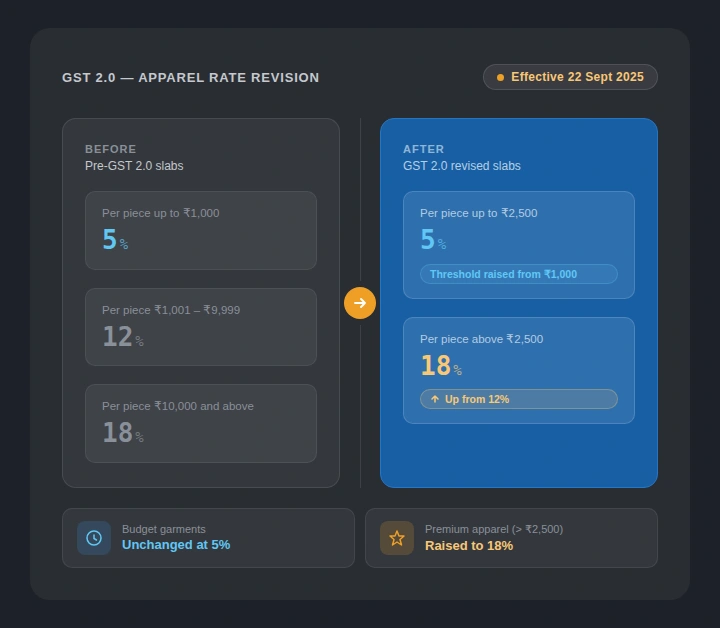
The GST Council rolled out a revised tax structure under what is being referred to as GST 2.0. Two key changes apply to apparel after 22 September 2025:
- Garments priced up to ₹2,500 per piece — taxed at 5% GST (previously, the 5% slab applied only to garments below ₹1,000).
- Garments priced above ₹2,500 per piece — taxed at 18% GST, up from the earlier 12% rate.
This means everyday and budget clothing has become relatively more affordable, while premium and branded apparel now attracts a higher GST burden. For retailers managing invoicing and tax compliance across price segments, tools like Munim's GST return filing software help you stay updated and file returns accurately without manual errors.
How to Calculate GST on Clothes
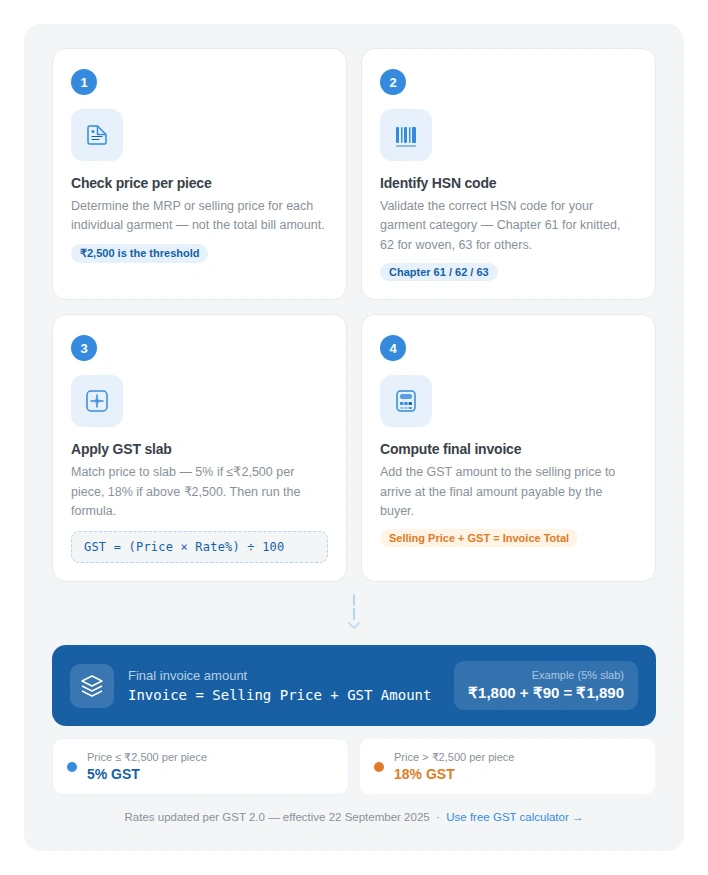
Calculating GST on apparel is straightforward once you know the applicable slab. Follow these steps:
Step 1 - Determine the sale price per piece
- Apparel priced at ₹2,500 or below → 5% GST
- Apparel priced above ₹2,500 → 18% GST
Step 2 - Identify the correct HSN code Use the HSN/SAC code finder to validate the right code for your product category before raising an invoice.
Step 3 - Apply the formula
GST Amount = (Selling Price × GST Rate) / 100
Step 4 - Add GST to arrive at the final amount
Invoice Amount = Selling Price + GST Amount
Example: A shirt priced at ₹1,800 attracts 5% GST. GST = (1,800 × 5) / 100 = ₹90 Final invoice value = ₹1,800 + ₹90 = ₹1,890. You can also use a free GST calculator to get instant, accurate results without manual calculation.
2024 Budget Meeting Updates: GST on Clothes
- During the 2024 budget meeting, the Apparel Export Promotion Council (AEPC) presented a structured format for Goods and Services Tax in the textile industry. It proposed tax incentives, uniformity in GST rates, and improved subsidies to support vendors and local manufacturers.
- AEPC requested to allow tax concessions for the textile manufacturers who follow the global quality standards and Environmental, Social, and Corporate Governance (ESG) rules. They also presented budget allocation for marketing and advertising the Indian brands.
- Also, earlier, the equalization rates were reduced from 3% to 2% for non-MSMEs, for which AEPC requested to make it 5% for apparel traders.
HSN Code and GST on Textiles: A Complete Breakdown
The GST rate on textiles depends on the fabric type, garment category, and sale value. Every textile product is mapped to a unique HSN code that defines its applicable GST slab. This classification ensures uniformity across the apparel supply chain - from raw material suppliers to retailers.
| Sr. No | ITEMS | HSN Code | GST Rate |
| 1 | Silk yarn | 5004 to 5006 | 5% |
| 2 | Woven fabrics of silk or of silk waste | 5007 | 5% |
| 3 | Supply of garneted wool, various grades of animal hair, and recycled wool. | 5104 | 5% |
| 4 | Carded or combed varieties of wool and animal hair. | 5105 | 5% |
| 5 | Yarn of wool or animal hair | 5106 to 5110 | 5% |
| 6 | Woven fabrics of wool or animal hair | 5111 to 5113 | 5% |
| 7 | Cotton and Cotton waste | 5201 to 5203 | 5% |
| 8 | Cotton sewing thread (whether or not put up for retail sale) | 5204 | 5% |
| 9 | Cotton yarn [other than khadi yarn] | 5205 to 5207 | 5% |
| 10 | Woven fabrics of cotton | 5208 to 5212 | 5% |
| 11 | Raw or treated flax that is not spun, plus flax tow, yarn waste, and garneted stock. | 5301 | 5% |
| 12 | Non-jute textile bast fibres in raw or treated form, not yet spun.Waste and tow from these fibres, covering yarn waste and garneted material. | 5303 | 5% |
| 13 | Complete range of goods, including flax yarn, jute yarn, yarn from other textile bast fibres, vegetable textile fibres, and paper yarn. (other than coconut coir fibre) | 5305 to 5308 | 5% |
| 14 | Woven fabrics of vegetable textile fibres, paper yarn | 5309 to 5311 | 5% |
| 15 | Woven fabrics of manmade textile materials | 5407, 5408 | 5% |
| 16 | Woven fabrics of manmade staple fibres | 5512 to 5516 | 5% |
| 17 | Real zari thread (gold) and silver thread | 5605, 5600, 5610 | 5% |
| 18 | Jute twine, coir cordage or ropes | 5607 | 5% |
| 19 | Knotted netting of twine, cordage or rope | 5608 | 5% |
| 20 | Products of coir | 5609 | 5% |
| 21 | Coir mats, matting, floor covering, and handloom durries | 5702, 5703, 5705 | 5% |
| 22 | Narrow textile strips consisting solely of warp yarns, held together with adhesive (bolducs). | 5806 | 5% |
| 23 | All goods of Knitted or crocheted fabrics | 60 | 5 |
For apparel businesses managing multiple SKUs and fabric types, Munim's billing software lets you map HSN codes to each product, automatically applying the correct GST rate at the point of invoicing.
How GST on Clothes Drives Strategic Business Decisions
GST on clothes isn't just a compliance matter — it actively shapes how apparel businesses operate. Here's how:
- Pricing strategy: Brands often position key products just below ₹2,500 to retain the 5% GST advantage and attract price-sensitive buyers.
- Product mix decisions: Businesses restructure their clothing range to offer affordable categories that qualify for the lower slab.
- Inventory management: HSN codes and GST slab mapping help sort and track stock efficiently. Munim's inventory management module automates this across product categories.
- Vendor and supplier decisions: GST applicability on input materials affects procurement costs, making it an important factor when evaluating supply chain partners.
- Discounting strategy: Knowing the GST slab on each product helps structure offers and seasonal discounts without eroding margins.
For clothing retailers managing GSTR-1 or GSTR-3B filings every month, having a platform that auto-populates GST data from invoices saves hours. Explore Munim pricing plans to find the right fit for your apparel business.
Conclusion
GST on clothes in India touches every stage, from raw textile procurement to the final invoice at your store counter. GST 2.0 has made garments below ₹2,500 more accessible for consumers, while apparel above that threshold now carries an 18% burden that demands accurate pricing and invoicing discipline.
Whether you're a retailer, textile manufacturer, or CA advising SME clients, staying current on GST rates, HSN codes, and filing obligations directly affects your profitability and compliance standing.
FAQs on GST on Clothes
1. What GST rate applies to sarees in India?
Silk and handloom sarees attract 5% GST.
2. Can I claim GST on clothes as a business?
Yes. If you are a GST-registered business purchasing garments for resale or business use, you can claim input tax credit on the GST paid.
3. Does GST apply to baby clothing?
Yes. The cloth GST rate on baby garments is 5%.
4. Which apparel categories retain the same GST rates after GST 2.0?
Several categories remain unchanged:
- Knitted or crocheted articles below ₹2,500 → 5%
- Cotton quilts below ₹2,500 → 5%
- Non-knitted, non-crocheted accessories and articles up to ₹2,500 → 5%
- All manmade textiles below ₹2,500 → 5%
5. Can garments be sold without applying GST?
Only if the item is genuinely tax-exempt. Raw jute and raw silk are currently exempt from GST.
6. Is GST included in the MRP printed on garments?
Yes. Under the GST regime, MRP must be inclusive of all applicable taxes, including GST.
7. What GST rate applies to man-made fibers and yarns?
Manmade fibres and yarns attract an 18% GST rate.
8. Are there penalties for non-compliance with garment GST?
Yes. Generating an invalid tax invoice or failing to issue a required e-invoice can attract a penalty of up to ₹10,000 per instance.
9. How does GST affect the final price of clothes?
GST replaced multiple cascading taxes — central excise, VAT, and octroi — with a single unified tax. This brings pricing transparency, though the overall tax incidence on premium garments has increased under GST 2.0.
10. What GST rate applies to cotton fabric?
Cotton fabric attracts 5% GST.
11. What is the GST rate on tailoring services?
The GST rate on tailoring services has been reduced from 18% to 5%.
12. What GST applies to garments above ₹2,500 after 22 September 2025?
Garments priced above ₹2,500 per piece are taxed at 18% GST following the GST 2.0 revision.
Disclaimer: "This blog post is for informational purposes only. For specific tax advice related to your business, please consult a qualified Chartered Accountant or GST practitioner."
About the author
Related Articles
Explore the latest market news, useful resources for business, and Munim updates.