GST Refund on Export in India (2026 Guide): How Much You Get & How to Claim
 AuthorMehul Jagwani
 Reviewed ByCA Ajay Savani
- What is the meaning of a GST refund on export?
- Types of GST Refund on Export & How Much You Get
- Step-by-step Process to Claim GST Refund On Exports
- Documents Required for GST Refund on Export
- GST Refund Timeline
- What is the time limit to claim a GST Refund?
- Practical Scenarios for Better Clarity
- GST Refund Process for Exporters – Which Option is Better?
- Frequently Asked Questions on GST Refund on Exports
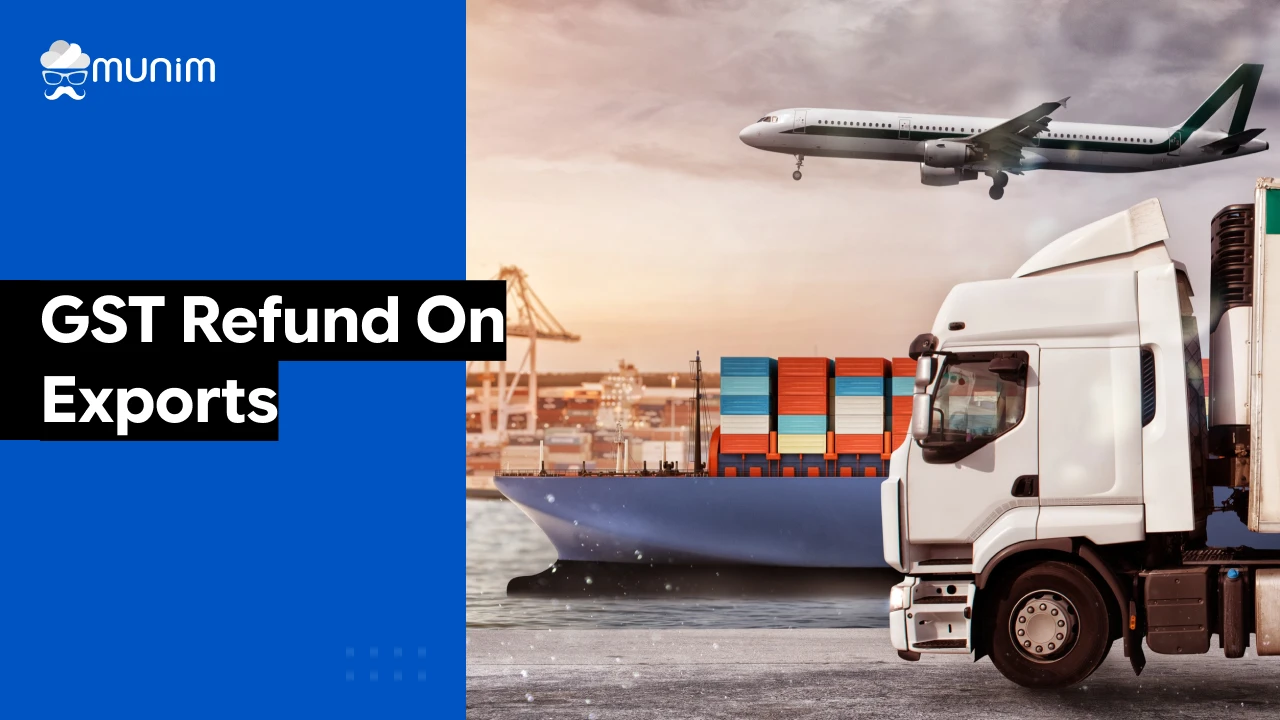
If you are into an export business, one of the biggest advantages you can get under GST is claiming a refund on the exports. Since exports in India are treated as zero-rated supplies, as an exporter you should not bear the tax cost.
But still many exporters feel confused about how much refund they will get and how they can claim it correctly without any mental fuss.
In this blog, we will explore:
- What GST refund on export means
- How much refund you can claim
- The difference between IGST refund and ITC refund
- Step-by-step process to file a claim
- Time limits, documents required, and refund timeline
And as you completely read this article, you will clearly understand the end-to-end GST refund process for exporters.
Let’s get started…
What is the meaning of a GST refund on export?
Under GST law, exports are classified as zero-rated supplies under Section 16 of the IGST Act. This means:
- GST is not meant to be a cost for exporters
- You can claim a refund of taxes paid
The concepts behind GST refunds on exports are really simple. The government wants exports to remain competitive in global markets. So, any GST paid during production or supply can be refunded.
Let's understand this in depth.
Types of GST Refund on Export & How Much You Get
Exporters can claim a GST refund on exported goods and services through two different methods. Here is a brief explanation of both.
1. Refund of IGST Paid on Exports
If you have exported goods on which you have paid IGST, then you can recover the IGST that you had paid.
The process works as follows:
- When you create the export invoice, you will charge IGST;
- When you generate the GSTR-3B, you will pay IGST;
- The refunds are automatically processed after the shipping bill is filed and the goods are exported.
Refund Amount: You will recoup 100% of the IGST that you paid on your export invoice.
Example:
Export Invoice: ₹10,00,000
IGST @18%: ₹1,80,000
Refund Amount: ₹1,80,000
This refund process is very easy to use because the shipping bill is a refund application (as per Rule 96).
2. Refund of Unutilised ITC (Export under LUT/Bond)
If you export goods without paying IGST (under LUT or bond), you can claim a refund through accumulated input tax credits (ITC). This is known as an export ITC refund in GST.
This is known as an export ITC refund in GST.
Refund Formula (as per Rule 89):
Refund Amount = (Turnover of zero-rated supply × Net ITC) ÷ Adjusted Total Turnover
Where:
- Net ITC = Input tax credit on inputs & input services
- Adjusted turnover = Total turnover excluding exempt supplies
Example:
If Your Total Sales Amount for Exports is ₹20,00,000
Your Net ITC Amount is ₹3,00,000
Your Total Sales Amount is ₹25,00,000x
Thus the Calculation
Refund = (20,00,000 x 3,00,000) / 25,00,000 = ₹2,40,000
This method requires filing Form RFD-01 manually.
Check the complete list of documents required and the step-by-step procedure for filing Form RFD-01.
Step-by-step Process to Claim GST Refund On Exports
The refund process depends on how you exported the goods. There are two ways you can claim a GST refund on exports. Let’s explain it in detail.
If You Exported with an IGST Payment:
Step 1: First, file Table 6A in GSTR-1 with the correct export invoice details. Make sure the details match your shipping bill exactly. This includes the shipping bill number, shipping bill date, and port code.
Step 2: Next, file GSTR-3B correctly for the same tax period. Also check that the IGST and cess reported in Table 3.1 of GSTR-3B match the values reported in Table 6A and Table 6B of GSTR-1.
Under GST rules, the shipping bill itself is treated as the refund application. After you file GSTR-1, the GST portal shares your export details with ICEGATE. It also sends confirmation that you have filed GSTR-3B for the relevant period.
Then, the Customs system compares the details filed in GSTR-1 with the shipping bill and Export General Manifest (EGM). If everything matches, the refund is processed and credited to your registered bank account.
Once the refund amount is credited, ICEGATE shares the payment details with the GST portal. After that, the GST portal informs the taxpayer through SMS and email.
If there is any mismatch between the shipping bill data and GSTR-1 details, the refund will not move forward until the error is corrected.
If You Exported under LUT Without IGST Payment (Unutilized Input Tax Credit):
Step 1: Log in to the GST portal
Step 2: Go to Services → Refunds → Application for Refund.
Step 3: Select the refund type for exports without payment of tax and file Form GST RFD-01. You can file for one or multiple tax periods in a single application.
Step 4: Generate ARN Number. After ARN is generated, the application goes to the refund officer for processing.
Step 5: Now you can track it through Services → Refunds → Track Application Status.
Usually, the refund is processed within 60 days. If the refund is delayed beyond this period, the exporter is entitled to 6% interest per annum.
While filing the refund claim through Goods and Services Tax Network, make sure all required documents are ready to avoid delays.
Documents Required for GST Refund on Export
The following documents are necessary for the processing of GST refunds on export services:
- Form GST RFD-01
- Export invoices
- Copy of shipping bill
- Export General Manifest (EGM) to confirm that goods have physically left the country
- Bank Realisation Certificate - BRC (for services) & Foreign Inward Remittance Certificate (FIRC)
- Statement of Exports
- Letter of Undertaking LUT or Bond copy (if supplies made without payment of ITC)
- GSTR-1 and GSTR-3B filed returns for the relevant time period
- CA certificate (if refund exceeds ₹2 lakh)
Incomplete documentation is one of the main reasons refunds get delayed.
GST Refund Timeline
- 90% of the provisional refund is usually credited within 7 days for eligible claims and all amounts within 60 days for ITC.
- For IGST paid on exports, refunds are processed after filing GSTR-1 and GSTR-3B correctly.
- For ITC refund claims, the department generally processes the refund within 60 days.
- If the refund is delayed beyond 60 days, the exporter may receive 6% interest per year.
- Recent GST reforms have reduced the average refund processing time from 120 days to around 45 days in many cases.
What is the time limit to claim a GST Refund?
According to Section 54 of the CGST Act, you must submit your refund claim within two (2) years from the respective date of the refund request.
Relevant date means:
- For goods: Date of shipment
- For services: Date of receipt of payment
If you miss the deadline, a refund may not be allowed.
Practical Scenarios for Better Clarity
Scenario 1: Exporter Paying IGST
If you prefer faster refund processing, paying IGST and claiming automatic refund may be easier.
Scenario 2: Exporter Using LUT
If your ITC accumulation is high and working capital is limited, LUT method helps avoid upfront IGST payment.
Choose a method based on your cash flow and compliance comfort.
GST Refund Process for Exporters – Which Option is Better?
| Factor | IGST Refund | ITC Refund (LUT) |
| Refund Speed | Faster | Slightly slower |
| Filing Effort | Automatic | Manual RFD-01 |
| Cash Flow Impact | IGST paid upfront | No IGST payment |
| Complexity | Lower | Moderate |
There is no “one best option.” It depends on your working capital and filing capacity.
Frequently Asked Questions on GST Refund on Exports
1. What is zero-rated GST for export?
Exports under GST are treated as zero-rated supplies. This means exporters do not charge GST on export sales, but they can still claim a refund of the GST paid on inputs or input services used for exports. This helps exporters avoid the tax burden on international trade.
2. Who is eligible for a GST refund?
Any GST-registered taxpayer is eligible to claim a GST refund. If they have paid excess tax or tax credit remains unutilized. Exporters of goods or services are also eligible because exports are treated as zero-rated supplies. Taxpayers can claim refunds on IGST paid on exports or unutilized input tax credit (ITC).
3. What is the time limit for export refund under GST?
Exporters can claim GST refunds on exports, which must generally be filed within 2 years from the relevant date. The relevant date usually means the date of export or the date when payment is received for export services. This rule is defined under Section 54 of the CGST Act.
4. What is the formula for a GST refund in the case of an export?
For exports made without payment of IGST under LUT, the refund of unutilized ITC is calculated using this formula:
Refund Amount = (Turnover of Zero-Rated Supply × Net ITC) ÷ Adjusted Total Turnover
This formula is prescribed under Rule 89(4) of the CGST Rules for refund of accumulated input tax credit.
5. How to check export GST refunds?
You can check the GST refund status through the GST portal. Log in to gst.gov.in, go to Services → Refunds → Track Application Status, and enter your ARN (Application Reference Number). The portal will show whether the refund is processed, pending, or approved.
6. Can a merchant exporter claim a GST refund?
Yes. A merchant exporter can claim a GST refund when exporting goods. They have two options:
- Pay IGST while exporting and later claim a refund of the tax paid.
- Export under LUT (Letter of Undertaking) without paying IGST and claim a refund of unutilized ITC.
7. How is GST refund calculated for exports?
GST refund for exports depends on the method used:
- With payment of IGST: The exporter pays IGST at the time of export and later claims the full IGST amount as a refund.
- Without payment of IGST (LUT): The exporter claims a refund of the accumulated input tax credit used for export supplies.
8. How is GST refund calculated for exports?
The GST refund is calculated based on either IGST paid on exported goods/services or unutilized ITC used for zero-rated supplies. The final amount depends on export turnover, eligible ITC, and compliance with GST return filings.
Disclaimer: "This blog post is for informational purposes only. For specific tax advice related to your business, please consult a qualified Chartered Accountant or GST practitioner."
About the author

Related Articles
Explore the latest market news, useful resources for business, and Munim updates.