Step-by-Step Guide to Integrating Payment Gateway with Billing Software
 AuthorMehul Jagwani
 Reviewed ByCA Ajay Savani



Summary:
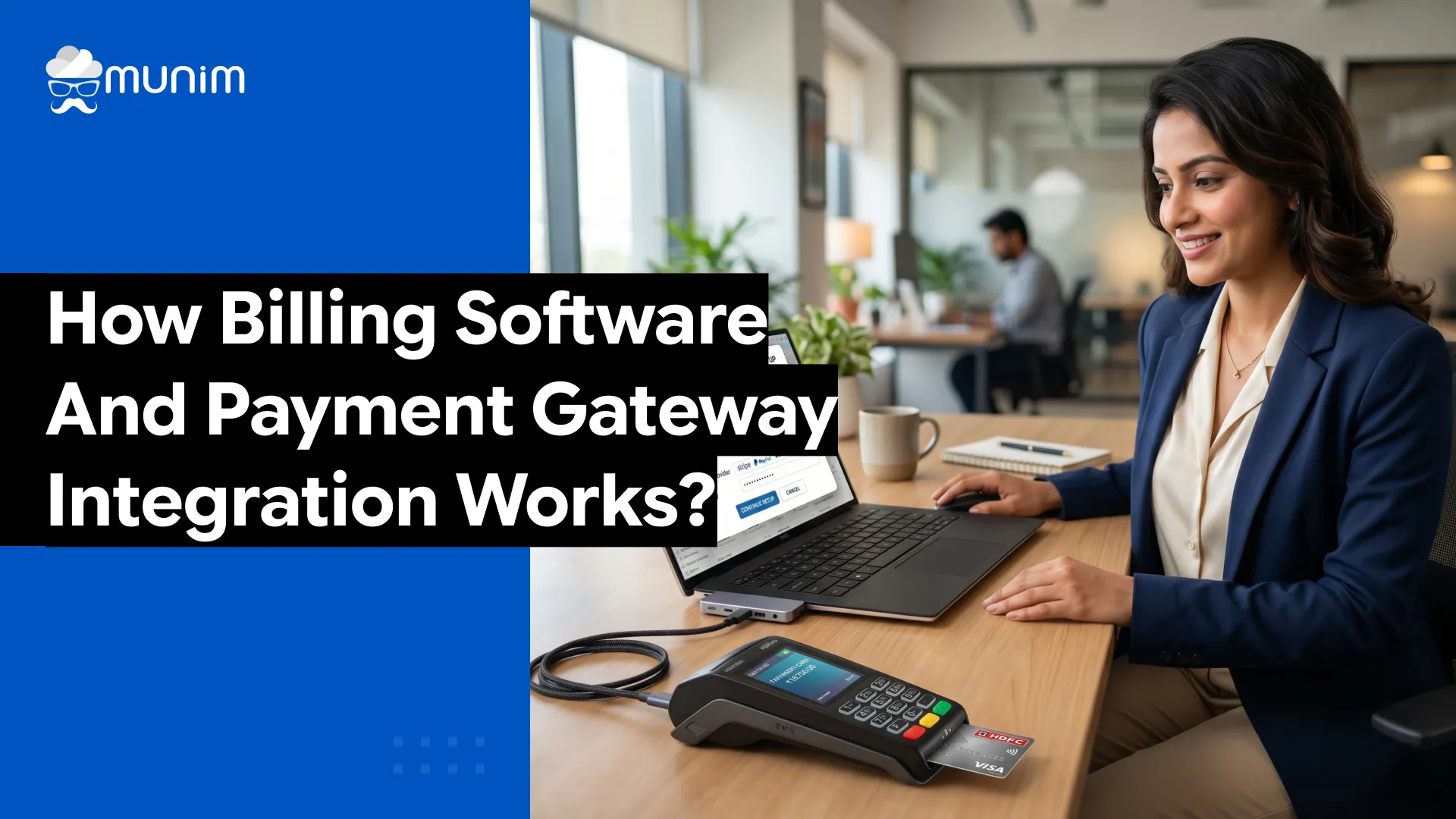
Payment gateway integration connects your online payment system with your billing software. This helps record, track, and manage transactions automatically. In this guide, you will learn how to set up payment gateway integration in India and which platforms you can consider.
If your business accepts online payments but still records them manually in billing software, you are wasting time and increasing the chance of errors. Payment gateway integration fixes this by automatically linking payments with your billing system.
This is no longer limited to large businesses. Small and medium businesses across India now use it every day. The setup is also easier than many people think.
This guide explains the full process step by step in simple language.
Stop manual billing errors and streamline your payment-to-invoice process with Munim Billing Software.
Which are the Best Payment Gateways in India?
The Indian market has several well-established online payment platforms. Choosing the right one depends on transaction volume, the type of business, and the features needed.
Here is a quick overview of the best payment gateway India:
Razorpay: It is widely considered among the best payment gateways in India for small and medium businesses. It supports UPI, net banking, credit and debit cards, and EMI options. Its API documentation is developer-friendly, and it integrates easily with most billing and e-commerce platforms.
PayU: It is another strong option, particularly for businesses with high transaction volumes. It offers good uptime, multiple payment modes, and direct integrations with several accounting tools.
Instamojo: It is popular among freelancers, small retailers, and D2C brands. It offers payment links, a simple dashboard, and basic integration features without requiring heavy technical setup.
Cashfree Payments: It has gained traction for its fast settlement times and strong API support. It is a solid choice for businesses that need instant or same-day settlements.
Businesses with a strong UPI-first customer base widely use PhonePe Payment Gateway and Paytm Payment Gateway.
Understand UPI limits and transaction rules in India. Read More
Payment Gateways Comparison Table
| Feature | Razorpay | PayU | Instamojo | Cashfree Payments | Payment Gateway | Paytm Payment Gateway |
| Best for | Startups, SMEs, SaaS, growing businesses | High-volume businesses, enterprises | Freelancers, small sellers, beginners | Fast-growing online businesses | UPI-first businesses, mobile commerce | D2C brands, Paytm ecosystem users |
| Settlement | T+1 / T+2 (fast, flexible options) | T+2 (stable, predictable) | T+3 (slower but simple) | T+1 / instant options available | T+1 to T+2 | T+1 (fastest in many cases) |
| Setup Complexity | Medium | Medium | Low | Low to Medium | Low | Low to Medium |
| Integration Type | API + Plugins | API + Plugins | Plugin + Payment Links | API + Plugins | Plug-and-play | API + Plugins |
| Payment Methods | UPI, Cards, Netbanking, EMI, Wallets | UPI, Cards, EMI, BNPL | UPI, Cards, Bank Transfer | UPI, Cards, International options | UPI-heavy, Cards, Wallets | UPI, Cards, Wallet, EMI |
| Ease of Use | ★★★★☆ | ★★★★ | ★★★★ | ★★★★ | ★★★★ | ★★★★ |
| Developer Friendliness | Very High | High | Medium | High | Medium | Medium |
| Key Strength | Balanced + best | Enterprise stability | Simplicity | Fast settlements | UPI dominance | Strong brand + T+1 payout |
Note: Settlement timelines can vary based on merchant onboarding status, bank holidays, risk checks, and the settlement plan selected with the gateway.
How to Integrate a Payment Gateway with Your Billing Software: Step by Step
Here is a practical walkthrough of the full payment gateway integration process. The steps broadly apply across most platforms and billing tools.
Step 1: Create a Gateway Account and Complete KYC
Visit the website of the chosen gateway. Razorpay, for example, allows businesses to sign up for free, create a test account, and begin exploring the dashboard before going live.
During onboarding, the following documents are typically required:
- PAN card of the business or proprietor
- GSTIN (if registered under GST)
- Business registration proof (GST certificate, Udyam certificate, or incorporation document)
- Cancelled cheque or bank statement for the settlement account
- Address proof
Once KYC is verified, the gateway provides a live API Key and a Secret Key. These are unique identifiers that will be used to connect the gateway to the billing software.
Step 2: Choose the Integration Method
There are two main ways to integrate a payment gateway with billing software:
- Plugin or Native Integration
- API Integration
For most Indian SMEs using cloud-based billing software, the plugin or native integration method is sufficient and much faster to set up.
Step 3: Configure the Integration Settings
Once connected, a few configuration decisions need to be made:
Webhook Setup: A webhook is an automatic notification that the gateway sends to the billing software when a payment is completed, failed, or refunded. Setting up webhooks ensures that the billing software updates invoice statuses in real time. Without this, the integration will not be fully automatic.
Currency and Payment Modes: Confirm which payment modes are enabled. For India, at minimum, UPI, net banking, and cards should be active. If the business has international customers, multi-currency support may be needed.
Settlement Cycle: Configure how often the gateway settles funds to the bank account. Most gateways offer T+1 or T+2 settlement (meaning funds arrive one or two business days after the transaction).
Step 4: Test the Integration Thoroughly
Before going live, every gateway provides a sandbox or test mode. In this mode, dummy transactions can be run without real money being involved. This step is critical.
Test for the following scenarios:
- A successful payment: Does the invoice in the billing software update automatically?
- A failed payment: Does the billing software reflect the failure?
- A refund: Is the ledger entry reversed correctly?
Important: Running at least 8 to 10 test transactions across different payment modes before going live is a good practice.
Step 5: Go Live and Monitor Closely
Once testing is complete, switch the settings from sandbox to live mode by replacing the test API keys with the live API keys. The integration is now active.
For the first few weeks, manually verify a sample of completed transactions against the billing software records. This helps catch any edge cases that the test phase may have missed.
How to Choose Billing Software for Payment Gateway Integration India
When choosing or evaluating billing software for payment gateway compatibility, these are the features that matter most:
Native gateway connectors: The software should have pre-built integrations with popular Indian payment gateways. This reduces setup time and eliminates the need for custom development.
Automatic invoice status updates: When a payment is received, the corresponding invoice should automatically move from “Unpaid” to “Paid.” This is a basic requirement.
Webhook support: The software must support incoming webhook events from the payment gateway. Without this, real-time updates are not possible.
Transaction fee accounting: The software should allow the business to record gateway fees separately so that the settlement amount and the invoice amount can be reconciled without confusion.
GST-compliant invoicing: Every payment received should be tied to a GST-compliant invoice, with the correct tax components reflected automatically.
Closing Notes
Payment gateway integration improves billing, reduces reconciliation work, and helps businesses avoid payment mismatches. For Indian businesses, it has also become easier to set up because of widespread UPI usage, GST compliance needs, and affordable billing software. The process is simpler than before and saves both time and effort.
Manage billing, payments, and GST compliance in one unified system with Munim. Request a Demo Today!
Frequently Asked Questions
What is payment gateway integration?
Payment gateway integration is the process of connecting a payment gateway to a software platform such as a billing tool, website, or e-commerce platform, so that transactions are processed and recorded automatically without manual intervention.
How much does it cost to integrate a payment gateway in India?
Most payment gateways in India do not charge a setup fee. They charge a per-transaction fee, typically ranging from 1.5% to 2.5% depending on the payment method and the gateway chosen. Some gateways offer volume discounts for high-transaction businesses.
Is GST applicable on payment gateway charges?
Yes. Payment gateway services attract 18% GST under the financial services category. The gateway deducts its fees including GST from each settlement, and businesses can claim this as an input tax credit if they are GST-registered.
What is the difference between a payment gateway and a payment aggregator?
A payment gateway is the technology layer that processes transactions. A payment aggregator is a company that allows multiple businesses to accept online payments under a single merchant account without each needing a separate payment gateway contract.
Disclaimer: "This blog post is for informational purposes only. For specific tax advice related to your business, please consult a qualified Chartered Accountant or GST practitioner."
About the author
Related Articles
Explore the latest market news, useful resources for business, and Munim updates.