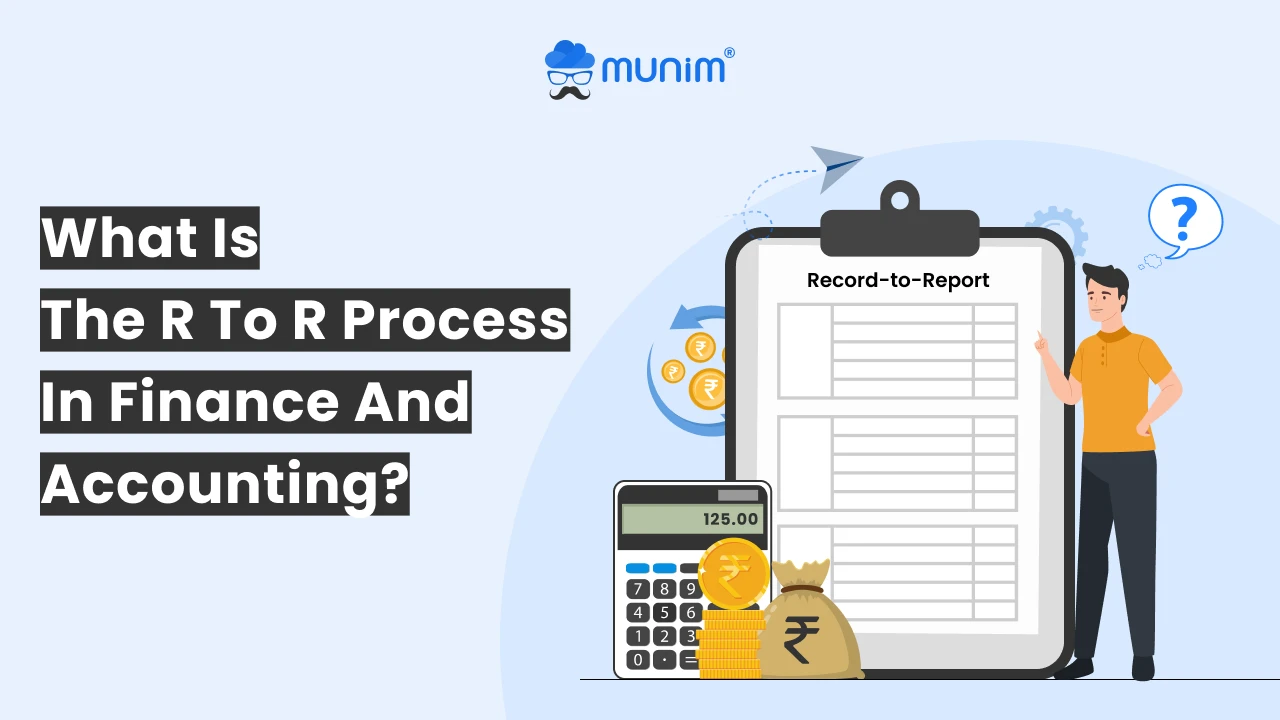
What is the R to R Process in Finance and Accounting?
 AuthorMehul Jagwani
 Reviewed ByCA Ajay Savani
Key Takeaways:
- R2R (Record to Report) is the process of turning daily transactions (sales, expenses, bank, payroll) into final financial reports like P&L and Balance Sheet.
- It follows a clear flow: record entries → validate → pass adjustments (accruals, provisions, depreciation) → reconcile key accounts → close books.
- It also improves audit readiness and compliance for MCA, SEBI, RBI, GST, and TDS.
Ever wondered how the finance department manages the end-of-the-month deadline? Do you know what exactly the R to R process is? If you have worked in a finance team, you might have experienced that in one moment, everything feels under control.
There is an inflow of sales, payment is transferred, and all is well. Then suddenly it is the end of the day. Week-end. Month-end. Quarter end. And finance department executives begin to get messages such as "Please send the final numbers" and "Is the report ready? You have experienced this kind of feeling, right?
This kind of job requires precision and accuracy; there is no room to make serious mistakes. Because based on these reports, leaders make decisions.
Inaccurate data = wrong decision-making
This is exactly where R to R comes in. Let’s explore the R to R full form, R2R meaning, the full R2R process, and how the record to report process works in this blog.
R to R Full Form And Meaning
The full form of R2R is Record to Report.
The terminology R2R refers to the entire process of managing financial data: from the moment a transaction happens (such as a sale, expense, bank entry, etc.) and ending with its inclusion in a corresponding financial statement, such as a profit and loss statement or balance sheet.
In the case of Indian companies, particularly listed companies and large privately owned firms, a good record to report process keeps them in line with the provisions of MCA, SEBI, RBI, GST, and TDS, as well as provides the management a real-time view of the performance.
The R to R process: Step-by-Step
Let us break the R2R process into simple steps you can actually picture.
1) Record transactions
This is where entries come in from:
• Sales invoices
• Purchase invoices
• Bank entries
• Payroll entries
• Expense claims
• Asset purchases
Some of it is automatic through ERP systems. Some of it still needs manual intervention.
Your job is to ensure the records reflect accurately.
2) Review and validate
This is where you ask:
• Are all entries posted in the right period
• Are the amounts correct
• Are the accounts correct
• Are there duplicates or missing entries
This step may seem unimportant, but it is needed for double-checking.
3) Post adjusting entries
Adjusting entries are done to match reality.
Examples:
• Accruals for expenses not yet booked
• Provisions for expected costs
• Prepaid expenses adjustments
• Depreciation entries
It is basically fixing timing and matching rules so reports look accurate.
4) Perform reconciliations
Reconciliation means matching two sets of records and explaining differences.
Common reconciliations:
• Vendor reconciliation
• Customer reconciliation
• Intercompany reconciliation
• Balance sheet schedules
If reconciliation feels like detective work, you are not imagining it. It really is.
5) Close activities
This is the most important part.
It includes:
• Ensure all invoices are captured
• Ensure provisions are booked
• Ensure recurring entries are posted
• Run depreciation and amortisation
• Review trial balance
• Validate key balance sheet accounts
6) Reporting
Now you prepare reports like:
• Profit and loss statement
• Balance sheet
• Cash flow (depending on scope)
• Segment reporting
• Cost centre reporting
• Management packs
This is where leaders finally see the story behind the numbers.
7) Analysis and explanations
This is where finance becomes valuable, not just accurate.
You answer:
• Why did expenses rise
• Why did revenue change
• Why is the margin different
• What moved in working capital
And you provide clear explanations, not vague ones.
8) Audit and compliance support
You support internal and external audits by providing:
• Schedules
• Backup documents
• Reconciliation proofs
• Entry explanations
Clean work here saves you so much stress later.
Importance of R to R
Accurate financial statements: R2R assists in converting raw transactions data to verified P&L, Balance Sheet, and Cash flow reports to ensure that the business is not running on guesswork.
Faster month-end close: A clean R2R process minimizes the effort of chasing invoices, corrections and approvals at the end of the month, making it easy to close books.
Better compliance and audit preparedness: R2R creates a transparent trail (vouchers, approvals, reconciliations), making both statutory reporting and audit easier.
Better controls and fewer mistakes: Periodic checks and balances during the review of entries catch wrong postings, duplicates, missing entries, and leakage early.
Actual decision-making data: Management reporting (profitability, expenses, cash position, receivables/payables ageing) is reliable in cases when R2R process works well.
Branch-branch consistency: Standard rules of coding, ledgers and reporting ensure that numbers remain similar across locations and periods.
The R2R Process Flow Chart
The following are the segments of a process flow chart arranged in chronological order:
- Source systems (billing, ERP, HR, banking) feed transactions
- Journal entry creation and posting
- Reconciliations (bank, intercompany, sub-ledger, balance sheet)
- Adjustments and closing activities
- Consolidation
- Final reporting and analytics
R to R Cycle: What Happens Each Month
The R to R cycle is simply the repetition of activities in each accounting period, which is normally in every month. Consider it more or less like a monthly check-up of the finance team:
Before month-end (pre-close)
You finish the pending queries, chase missing bills, and finish routine tasks so that the actual close is smoother.
During the month-end (close)
This is the period of a real test. Teams work on reconciliations, pass closing entries, resolve mismatches, and freeze ledgers by internal deadlines.
After the month-end (post-close)
When numbers are locked, the report is forwarded to the management. Teams also examine variances, write commentary and design better improvements in the following cycle.
Over to You
We hope that after reading this blog on the R2R process in finance and accounting, you now understand its full form, meaning, process flow chart and whole R2R cycle. If you are an accountant or CA, we encourage you to sign up with Munim, an all-in-one solution for accounting, billing and GST return filing. For more information about the product, feel free to reach out to our sales team.
Frequently Asked Questions on R2R Process
1. Does payroll processing come under the R to R domain?
Yes, the accounting side of payroll does fall under R2R, like posting payroll journal entries, booking provisions, and reconciling payroll liabilities.
2. What are the activities of the R to R process?
The following are the activities that come under the R2R process:
- Record transactions
- Validate entries
- Post adjustments
- Reconcile key accounts.
- Closing the books
- Preparing reports like profit and loss, balance sheet, and management summaries.
3. What is the A2R and R2R process?
Account to Report and Record to Report are the terms that are often used interchangeably, having the same meaning.
4. What is reconciliation in the R2R process?
Reconciliation in the R2R process means matching two different sets of records and explaining any differences to make your numbers reliable.
5. Why is the R2R process important in finance?
R2R ensures accurate financial statements, faster month-end close, and better compliance. It helps leadership make decisions using reliable numbers instead of assumptions.
6. What are the key steps in the R2R process?
The following are the important steps in R to R process:
Transaction recording
Journal entries and accruals,
Reconciliations,
Fixed asset accounting
Month-end close
Consolidation (if required)
Financial reporting.
7. What is the difference between R2R and P2P or O2C?
R2R focuses on recording and reporting financial results. P2P covers purchases to vendor payments, while O2C covers sales to customer collections.
About the author

Related Articles
Explore the latest market news, useful resources for business, and Munim updates.