
Savings Bank Account Limit as Per New Income Tax Rules 2026: Complete Guide
 AuthorMehul Jagwani
 Reviewed ByCA Ajay Savani



- What Changed Under the New Income Tax Rules 2026?
- The Updated Savings Account Cash Deposit Limit at a Glance
- Designed for Modern Tax Professionals
- PAN Quoting Rules: Old vs New (Draft Income Tax Rules, 2026)
- What is the Savings Account Cash Deposit Limit Per Year?
- Is There a Savings Account Deposit Limit Per Month?
- What is the Cash Deposit Limit in a Savings Account Per Day?
- TDS on Cash Withdrawals: Section 194N Explained
- Cash Transaction Rules Beyond Deposits: Sections 269SS, 269T, and 269ST
- Closing Notes
- Frequently Asked Questions (FAQs)

Starting from April 2026, there are new rules under the new Income Tax Act, 2025, regarding savings bank accounts and the limits on the amount you can deposit. These changes are important for everyone, whether you’re saving money for future needs or just managing your daily expenses.
In this guide, we will explain how these new rules affect savings accounts, what the new limits are, and how it can impact you.
What Changed Under the New Income Tax Rules 2026?
The Income Tax Act, 2025 replaces the Income Tax Act, 1961. The Draft Rules, 2026 that accompany it overhaul how PAN quoting thresholds are applied to bank transactions.
The old rule asked depositors to quote PAN every time a single cash deposit crossed Rs. 50,000 in a day. This created friction even for routine, legitimate transactions. The new cash deposit limit rules income tax framework shifts to an annual aggregate view: PAN must now be quoted only when total cash deposits or withdrawals across all bank accounts cross Rs. 10 lakh in a financial year.
The Updated Savings Account Cash Deposit Limit at a Glance
Here are the six key thresholds every account holder should know under the new framework:
| Threshold | Applicable Limit |
| Savings account SFT reporting trigger (annual cash deposits) | Rs. 10 lakh |
| Current account SFT reporting trigger (annual cash deposits) | Rs. 50 lakh |
| PAN mandatory: annual aggregate cash deposits or withdrawals | Rs. 10 lakh per year (replaces old Rs. 50,000/day rule) |
| TDS for non-ITR filers (Section 194N) on cash withdrawals | 2% above Rs. 20 lakh |
| TDS for non-ITR filers on cash withdrawals above Rs. 1 crore | 5% |
| Section 269ST cash receipt penalty trigger | Rs. 2 lakh in single transaction |
Designed for Modern Tax Professionals
A premium filing solution for CAs and tax consultants who need speed, scale, and operational clarity.
 Handle multiple clients with ease
- Reconcile and validate with confidence
- Overcome the limitations of the GST portal
 Handle multiple clients with ease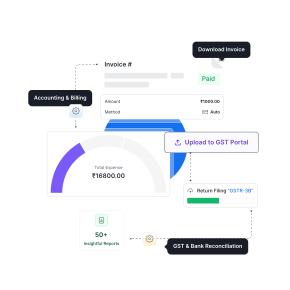
PAN Quoting Rules: Old vs New (Draft Income Tax Rules, 2026)
This is the most practical update for individual account holders. The shift from a per-transaction view to an annual aggregate view changes how banks track the cash deposit limit savings account holders are subject to.
| Transaction Type | Old Threshold | New Threshold (2026) |
| Cash deposit or withdrawal in any bank account | Rs. 50,000 per day | Rs. 10 lakh per year |
| Immovable property purchase or sale | Rs. 10 lakh | Rs. 20 lakh |
| Vehicle purchase (including two-wheelers) | Any motor vehicle (two-wheelers exempt) | Rs. 5 lakh (two-wheelers now included) |
| Hotel, travel, or event payments | Rs. 50,000 | Rs. 1 lakh |
What is the Savings Account Cash Deposit Limit Per Year?
The important savings account transaction limit for income tax is Rs. 10 lakh in cash. If cash deposits exceed this amount, the bank reports it to the Income Tax Department
Is There a Savings Account Deposit Limit Per Month?
There is no specific savings account deposit limit per month defined in the Income Tax Act or the new Draft Rules. The annual aggregate is the relevant metric. However, individual banks set their own internal daily and monthly cash deposit limits based on internal policy and RBI guidelines. These may vary from bank to bank and account type to account type.
What is the Cash Deposit Limit in a Savings Account Per Day?
Under the old rules, the per-day threshold for PAN was Rs. 50,000 per single transaction. The Draft Rules, 2026 remove this per-day per-transaction rule entirely and replace it with the annual aggregate approach. So there is no longer a specific daily cash deposit limit as per income tax rules. However, your bank may still have its own daily cash deposit limit, typically in the range of Rs. 1 lakh to Rs. 2 lakh per day, which is a banking operations rule rather than a tax rule.
TDS on Cash Withdrawals: Section 194N Explained
Section 194N governs Tax Deducted at Source on cash withdrawals from bank accounts. The thresholds here remain unchanged from the previous framework. Here is the complete picture for FY 2026-27:
For regular ITR filers: A 2% TDS applies on cash withdrawals exceeding Rs. 1 crore in a financial year. No TDS is applicable below this level.
For non-filers (no ITR filed for the prior three years): A 2% TDS applies on cash withdrawals exceeding Rs. 20 lakh in the financial year. A 5% TDS applies on the portion exceeding Rs. 1 crore in the same year.
If your bank has deducted TDS under Section 194N, you’ll need to account for it properly while filing your returns — this guide on how to file a TDS return online walks you through the entire process step by step.
Cash Transaction Rules Beyond Deposits: Sections 269SS, 269T, and 269ST
These provisions catch high-value cash flows that happen outside of bank deposits. They apply equally under the new framework.
| Provision | Rule | Penalty |
| Section 269SS | No loan or deposit of Rs. 20,000 or more may be accepted in cash | Penalty equal to the loan amount |
| Section 269T | No repayment of a loan or deposit of Rs. 20,000 or more in cash | Penalty equal to the repayment amount |
| Section 269ST | No receipt of Rs. 2 lakh or more in cash from a single person in one day, one transaction, or the same event | 100% of the amount received |
Section 269ST is particularly relevant for traders, event businesses, and professionals who sometimes collect large payments in cash. The penalty is steep: 100% of the amount received. There is no room for error here.
Closing Notes
The key takeaway is simple: deposit legitimately earned funds, document their source, and file your ITR every year. If you manage cash regularly as a business owner or professional, keeping your books updated and aligned with your AIS data is the best protection against unwanted notices.
Frequently Asked Questions (FAQs)
1. What is the saving account limit as per the new Income Tax Act 2025?
The cash deposit limit in savings accounts as per income tax rules is Rs. 10 lakh per financial year. This threshold is retained under the Income Tax Act, 2025 and the Draft Rules, 2026.
2. What has changed in the new Income Tax Rules 2026 for savings account holders?
The biggest change is in PAN quoting. The old cash deposit limit rules income tax framework required PAN for any single cash deposit above Rs. 50,000 per day. The new Draft Rules, 2026, shift this to an annual aggregate of Rs. 10 lakh across all bank accounts.
3. Does splitting deposits help avoid the savings account deposit limit?
No. Deliberately splitting cash deposits into smaller amounts to stay below the savings account deposit limit threshold is considered structuring. Banks identify such patterns and can file a Suspicious Transaction Report (STR).
4. Are UPI, NEFT, and salary credits counted toward the Rs. 10 lakh cash deposit limit?
No. The cash deposit limit savings account rule applies only to physical cash deposits. Digital credits do not count.
5. Does the cash deposit limit apply to post office savings accounts?
Yes. The Rs. 10 lakh annual SFT reporting threshold applies to post office savings accounts as well.
Disclaimer: "This blog post is for informational purposes only. For specific tax advice related to your business, please consult a qualified Chartered Accountant or GST practitioner."
About the author
Related Articles
Explore the latest market news, useful resources for business, and Munim updates.