GSTR-3B Form Details Explained: What Information You Must Fill (2026 Guide)
 AuthorMehul Jagwani
 Reviewed ByMadhav Bhayani


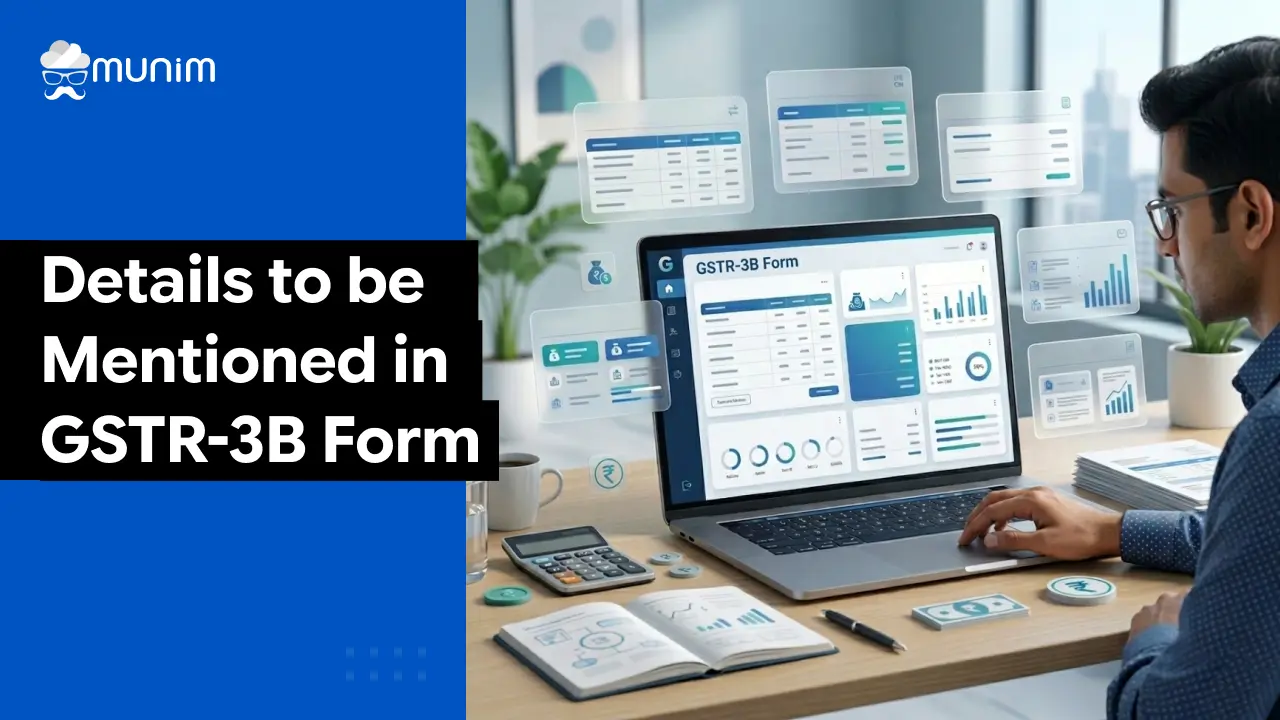
Have you ever sat down to fill the GSTR-3B form and felt completely lost? Like, where does this number go? Is this the right table? Am I filling this correctly? If yes, it is totally fine. Most business owners and even some accountants feel the same way the first few times. The form looks small, but the details it asks for are anything but simple.
This blog will walk through every single detail that needs to be mentioned in the GSTR-3B form. Clearly. Simply. Without all the complicated tax language that nobody enjoys reading.
Who Needs to File GSTR-3B?
Every regular GST registered taxpayer in India who is not covered under any special scheme has to file GSTR-3B. This includes:
- Regular registered taxpayers filing monthly returns
- Taxpayers under the Quarterly Return Monthly Payment (QRMP) scheme, who file GSTR-3B quarterly
- New registrants
The following categories are not required to file GSTR-3B:
- Composition dealers (they file CMP-08 and GSTR-4)
- Input Service Distributors (ISD)
- Non-resident taxable persons (they file GSTR-5)
- Online Information and Database Access or Retrieval (OIDAR) service providers
Details to be Mentioned in GSTR-3B Form
This is the heart of the blog. Let us go through each section of the GSTR-3B form, one table at a time, with simple examples wherever needed.
Table 3.1: Details of Outward Supplies and Inward Supplies Liable to Reverse Charge
This is the first major table in GSTR-3B. It captures the summary of all outward supplies (sales made by the taxpayer) and also certain inward supplies under reverse charge (where the buyer has to pay the tax instead of the seller).
The table is divided into the following rows:
3.1(a): Outward taxable supplies (other than zero rated, nil rated and exempted)
This is where all regular taxable sales go. Any sale made on which GST is applicable at 5%, 12%, 18%, or 28% is reported here. The taxpayer has to enter the total taxable value and the applicable IGST, CGST, and SGST/UTGST separately.
Example: A textile dealer in Surat sold goods worth ₹10,00,000 within Gujarat at 12% GST. They would report ₹10,00,000 in taxable value here, with ₹60,000 CGST and ₹60,000 SGST.
3.1(b): Outward taxable supplies (zero rated)
This row is for supplies made to SEZ units or SEZ developers, and for exports. Zero-rated does not mean the supply is exempt. It means GST is charged at 0%, but the taxpayer can still claim a refund on the input tax credit used for those supplies.
3.1(c): Other outward supplies (nil rated, exempted)
Nil-rated supplies are those on which GST is 0% (like certain food items). Exempted supplies are those that are specifically listed as exempt under the GST law (like healthcare and education services in most cases). Both go in this row.
3.1(d): Inward supplies (liable to reverse charge)
This is slightly different. Under reverse charge mechanism (RCM), the buyer pays the GST instead of the seller. Common examples include services from a goods transport agency (GTA), legal services from an advocate, and import of services. The total value of such purchases where the taxpayer is liable to pay GST has to be reported here.
3.1(e): Non-GST outward supplies
These are supplies that are outside the scope of GST altogether, like alcohol for human consumption, petroleum products (crude oil, petrol, diesel, aviation turbine fuel, and natural gas), and a few others. If the business makes such supplies, they go here.
Table 3.2: Details of Inter-State Supplies Made to Unregistered Persons, Composition Taxable Persons and UIN Holders
Does a business sell goods or services to customers in another state? This table captures a breakup of those inter-state supplies, specifically for:
- Unregistered persons (B2C customers in other states)
- Composition scheme dealers
- UIN holders (like embassies or UN bodies who have a unique identification number)
This table asks for a state-wise breakup. The taxpayer has to mention the state name, the total taxable value, and the IGST applicable for each category.
This is often overlooked or filled incorrectly, which creates mismatches. So paying attention to this table is important.
Table 4: Eligible Input Tax Credit (ITC)
This is probably the most critical table in GSTR-3B. And also the most confusing one for many businesses.
4(A): ITC Available
This row has sub-rows for different types of ITC:
- (1) Import of Goods: IGST paid at the time of importing goods into India. This is eligible as ITC.
- (2) Import of Services: IGST paid under reverse charge on import of services.
- (3) Inward supplies liable to reverse charge (other than 1 and 2): ITC on RCM purchases like GTA services, advocate fees, etc.
- (4) Inward supplies from ISD: Credit received from an Input Service Distributor. ISD is a concept where a company distributes credit to its branches.
- (5) All other ITC: This is where most regular purchases go. ITC on goods and services received from registered suppliers, as reflected in GSTR-2B.
4(B): ITC Reversed
Not all ITC that is available can be fully claimed. Some has to be reversed. This section captures:
- (1) As per Rule 42 and 43: These rules deal with reversals on inputs used for both taxable and exempt supplies. A proportionate reversal is required.
- (2) Others: Any other reversals, like ITC on goods or services used for personal purposes, or where the supplier has not paid the tax to the government.
4(C): Net ITC Available
Simple math: 4(A) minus 4(B) equals 4(C). This is the actual ITC that the taxpayer can use to offset the GST liability.
4(D): Ineligible ITC
This row reports ITC that cannot be claimed at all. For example:
- GST paid on motor vehicles (in most cases)
- GST on food, health club memberships, beauty treatment, and similar expenses
- GST on works contracts for construction of immovable property
- Any other ITC that is blocked under Section 17(5) of the CGST Act
Note: Ineligible ITC is reported here for information purposes, not for availing.
Table 5: Values of Exempt, Nil-Rated and Non-GST Inward Supplies
This table asks about the taxpayer’s purchases, not sales. Specifically, it asks about inward supplies that are exempt, nil-rated, or outside GST altogether.
- From registered supplier (exempt): Purchases from a registered supplier that are exempt from GST.
- From registered supplier (nil rated): Purchases on which GST rate is 0%.
- From unregistered supplier (exempt and nil rated): Same categories but from an unregistered supplier.
- Non-GST supply: Purchases outside the scope of GST.
Why does GSTR-3B ask for this? Because these purchases directly affect ITC calculation. If a business makes both taxable and exempt supplies, it cannot claim full ITC. This table provides the data needed for that proportionate reversal mentioned in Table 4B.
Table 5.1: Interest and Late Fee Details
This table is straightforward. If the taxpayer is filing the return late or has underpaid tax in a previous period, the interest and late fee details go here.
- Interest: Calculated at 18% per annum on the unpaid tax amount, from the due date to the date of payment. For wrongfully availed ITC, the rate is 24% per annum.
- Late Fee: As mentioned earlier, ₹50 per day for returns with liability and ₹20 per day for NIL returns, subject to a maximum cap introduced by various GST notifications.
These amounts have to be paid through the Electronic Cash Ledger. ITC cannot be used to pay interest or late fees.
Table 6: Payment of Tax
Table 6 is where everything comes together. It shows how the tax liability from Table 3.1 will be settled.
The payment options are:
- Through ITC: The taxpayer can use the available ITC balance (IGST, CGST, SGST/UTGST) to pay the tax.
- Through Cash: Any remaining liability after applying ITC has to be paid in cash through the Electronic Cash Ledger.
The table shows the tax liability split across IGST, CGST, SGST/UTGST, and Cess. There is a specific order in which ITC can be used:
- IGST credit must first be used to pay IGST liability. Any remaining IGST credit can be used to pay CGST or SGST.
- CGST credit can only be used to pay CGST and IGST (not SGST).
- SGST credit can only be used to pay SGST and IGST (not CGST).
Getting this order wrong can cause mismatches and tax notices. So being careful here matters.
Example: A business has IGST liability of ₹1,00,000, CGST liability of ₹50,000, and SGST liability of ₹50,000. Its ITC balance is: IGST ₹80,000, CGST ₹30,000, SGST ₹20,000.
- IGST credit of ₹80,000 goes toward IGST liability. Remaining IGST liability = ₹20,000.
- Since IGST ITC is exhausted, the remaining IGST liability of ₹20,000 must be paid in cash.
- CGST credit of ₹30,000 goes toward CGST liability. Remaining CGST liability = ₹20,000, paid in cash.
- SGST credit of ₹20,000 goes toward SGST liability. Remaining SGST liability = ₹30,000, paid in cash.
Table 6.1: TDS and TCS Credit
This is a smaller table but important for certain categories of taxpayers.
TDS under GST: Certain entities like government departments, public sector units, and local bodies deduct 2% GST (1% CGST + 1% SGST or 2% IGST) from the payment made to the supplier. The supplier can view this deduction in their GSTR-2B and utilize it as TDS credit.
TCS under GST: E-commerce operators collect 1% GST (0.5% CGST + 0.5% SGST or 1% IGST) from suppliers who sell through their platforms. Sellers on Amazon or Flipkart, for instance, will have TCS deducted, which reflects in GSTR-2B.
Both TDS and TCS credits can be used in Table 6.1 to reduce the cash outflow.
Explore Further: How to Calculate and Claim Input Tax Credit (ITC) Step-by-Step
Common Mistakes to Avoid While Filling GSTR-3B
Knowing the details is half the job. Avoiding errors is the other half. Here are some of the most common mistakes that lead to notices and mismatches:
1. Not reconciling with GSTR-2B before filing: GSTR-2B is a system-generated statement of available ITC based on suppliers’ GSTR-1 filings. Many taxpayers claim ITC that is not reflected in GSTR-2B, which leads to scrutiny.
2. Showing wrong figures in Table 3.1: If the sales numbers in GSTR-3B do not match with GSTR-1, the department will send a notice. Both returns should be consistent.
3. Claiming ineligible ITC: Some taxpayers accidentally claim ITC on items blocked under Section 17(5), like motor vehicles or club memberships. This is a violation.
4. Reversals not done: If a business has used inputs for both taxable and exempt supplies, it must reverse a proportionate part of ITC. Many skip this step.
5. Not paying RCM liability: Some businesses forget that they owe GST under reverse charge. That liability must be paid in cash, not through ITC.
6. Leaving fields blank: Even if a row does not apply, entering zero is better than leaving it blank. Blank fields sometimes cause system errors.
How Munim Makes GSTR-3B Filing Simpler
Filing GSTR-3B manually, while maintaining books and cross-checking GSTR-2B and GSTR-1, is genuinely a lot of work. For small and medium businesses in India, this can take hours every month.
Munim GST is built exactly for this. It auto-populates the GSTR-3B details from the sales and purchase data already entered in the system. The software makes sure the figures are consistent across GSTR-1 and GSTR-3B, reducing the chance of mismatches. ITC reconciliation with GSTR-2B is also made easy, so businesses know exactly what they can claim and what they cannot.
More than 50,000 businesses across India trust Munim for their GST compliance. The software supports GSTR-3B, GSTR-1, GSTR-9, GSTR-9C, and much more, all from a single platform.
If filing GSTR-3B feels like a burden every month, maybe it is time to try a simpler way.
Check how to file GSTR-3B using Munim GST.
Closing Notes
The details mentioned in GSTR-3B are not just numbers. They represent the business’s entire tax position for that period. So understanding each table and what goes where is not optional; it is essential for anyone running a business under GST in India.
If filing GSTR-3B every month feels like a task, sign up with Munim GST and experience a smoother compliance journey
Frequently Asked Questions on GSTR-3B Details
1. What is the full form of GSTR-3B?
GSTR-3B stands for Goods and Services Tax Return 3B. It is a monthly or quarterly self-declared summary return filed by regular GST registered taxpayers in India.
2. Is GSTR-3B mandatory for all GST taxpayers?
No. Composition dealers, ISDs, and certain other categories are exempt. However, for regular taxpayers, filing GSTR-3B is mandatory.
3. Can GSTR-3B be revised after filing?
No, GSTR-3B cannot be revised once filed. Any corrections have to be made in the next month’s return.
4. What happens if GSTR-3B is filed with wrong details?
Wrong details can lead to tax demand notices, interest, and penalties. It can also lead to ITC mismatches with the supplier’s filings.
5. What is the difference between GSTR-1 and GSTR-3B?
GSTR-1 is a detailed return with invoice-level data of outward supplies. GSTR-3B is a summary return with aggregate figures of sales, ITC, and tax payable.
6. Can ITC be used to pay interest and late fee?
No. Interest and late fee under GST can only be paid through the Electronic Cash Ledger. ITC cannot be used for this purpose.
Disclaimer: "This blog post is for informational purposes only. For specific tax advice related to your business, please consult a qualified Chartered Accountant or GST practitioner."
About the author

Mehul is a seasoned content writer with a passion for simplifying complex accounting and GST topics. With a keen interest in entrepreneurship and business management, he specializes in creating informative and engaging content for themunim.com. His goal is to help businesses understand and implement accounting and GST software solutions effectively. When he's not crafting content, Mehul enjoys exploring new places and spending time with his Golden Retriever.
Related Articles
Explore the latest market news, useful resources for business, and Munim updates.