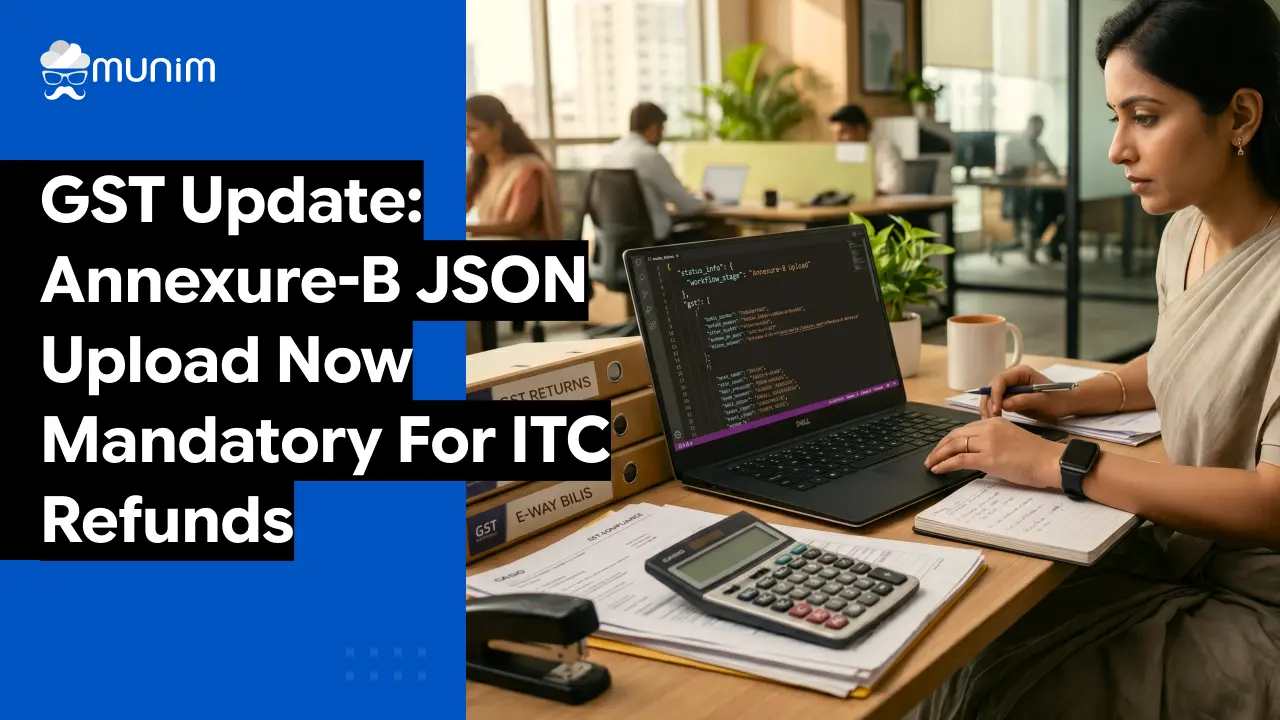
GST Refund Rules Tightened: Annexure-B Must Now Be Uploaded in JSON Format for Unused ITC Claims
 AuthorMehul Jagwani
 Reviewed ByCA Madhav Bhayani



- What Is Annexure-B and Why Does it Matter in GST Refund Filing?
- What Has Changed: The New GST Update Explained
- What Additional Details Does the New Offline Utility Require?
- Who Is Affected by This GST Update?
- How Should Taxpayers Prepare: A Step-by-Step Approach
- Tips for CA Firms and Tax Consultants Handling ITC Refund Claims
- Conclusion
- Frequently Asked Questions
Summary:
The GST portal has rolled out a significant GST update for taxpayers claiming refunds on accumulated Input Tax Credit. Businesses filing FORM GST RFD-01 for unused ITC must now prepare Annexure-B using the offline utility and upload it strictly in JSON format. The revised utility also collects detailed invoice-level data, signalling a clear shift toward automated, system-driven refund verification.
Refund claims under GST just got a lot more structured. The GST portal has issued a new mandate: Annexure-B, which forms a core part of the ITC refund application under FORM GST RFD-01, must now be prepared through the official offline utility and uploaded exclusively in JSON format. This GST update affects exporters, SEZ suppliers, and any registered taxpayer sitting on accumulated ITC that remains unutilised.
What Is Annexure-B and Why Does it Matter in GST Refund Filing?
- Annexure-B is an invoice-level statement submitted as part of the GST refund application under FORM GST RFD-01
- It is used when a business claims a refund of accumulated Input Tax Credit that it cannot utilise against output tax
- It tells the GST authorities which invoices form the basis of the refund claim, how much ITC was taken, and how much is eligible to be refunded
- Until recently, taxpayers had flexibility in how they prepared and submitted this statement
- That flexibility has now been removed with the new mandatory JSON upload requirement
Advisory on Filing of Annexure-B for Refund Applications involving Accumulated ITC using the offline utility in GST portal pic.twitter.com/QZMws5DaOR
— CA Akhil Pachori (@akhilpachori) May 19, 2026
What Has Changed: The New GST Update Explained
- Refund applicants filing FORM GST RFD-01 must now prepare Annexure-B through the offline utility
- The completed Annexure-B must be uploaded to the GST portal strictly in JSON format
- JSON (JavaScript Object Notation) is a structured digital file format that the GSTN system can read and process automatically
- Taxpayers are already familiar with JSON in GST from filing GSTR-1, where invoice data is uploaded in the same format
- The revised offline utility captures additional invoice-level details that were not required earlier
Designed for Modern Tax Professionals
A premium filing solution for CAs and tax consultants who need speed, scale, and operational clarity.
 Handle multiple clients with ease
- Reconcile and validate with confidence
- Overcome the limitations of the GST portal
 Handle multiple clients with ease
What Additional Details Does the New Offline Utility Require?
The revised utility now captures the following fields for every invoice included in the refund claim:
- Type of inward supply – whether the purchase is from a regular supplier, an unregistered dealer, under reverse charge, or an import
- Document type – whether the document is a tax invoice, debit note, credit note, or bill of entry for imports
- Total ITC – the full amount of GST paid on purchases before any deductions or restrictions
- Eligible ITC – the portion of ITC that the taxpayer is actually allowed to claim under GST law
- Blocked ITC under Section 17(5) – ITC that is specifically barred by law, such as on motor vehicles for personal use, food and beverages, club memberships, and certain construction services
- Ineligible ITC – credits that have been reversed or cannot be claimed for procedural or legal reasons
- GSTR-2B period – the specific return period in which the supplier’s invoice appeared in the taxpayer’s auto-drafted GSTR-2B
Who Is Affected by This GST Update?
This update applies to any taxpayer filing FORM GST RFD-01 for accumulated ITC refunds. That includes:
- Exporters of goods and services – They make zero-rated supplies with no output GST, so input tax paid on purchases builds up and cannot be offset
- Suppliers to SEZ units and SEZ developers – Their supplies are also zero-rated, and accumulated ITC qualifies for a refund
- Manufacturers with an inverted duty structure – Where the GST rate on inputs is higher than on the final product, ITC accumulates structurally and cannot be consumed against output tax
Businesses in these categories may face increased reconciliation and documentation work as a result of this GST update.
How Should Taxpayers Prepare: A Step-by-Step Approach
The GST portal recommends reconciling in this order before uploading Annexure-B:
Purchase Register → GSTR-2B → ITC Eligibility → Refund Claim
Here is how that plays out in practice:
Step 1: Download the latest offline utility
- Get the updated version of the FORM GST RFD-01 offline utility from the GST portal
- Older versions will not capture all the new required fields
Step 2: Reconcile the purchase register with GSTR-2B
- Every invoice included in the refund claim must appear in GSTR-2B for the relevant period
- If an invoice is not reflected in GSTR-2B, do not include it in the claim until it is
Step 3: Classify ITC correctly for each invoice
- Determine the total ITC, eligible ITC, blocked ITC under Section 17(5), and ineligible ITC for every entry
- This is often where errors occur, especially when processing is done in bulk
Step 4: Fill in Annexure-B in the offline utility
- Enter all invoice-level details in the utility
- Ensure the GSTR-2B period is correctly noted for each invoice
- Verify that document types are accurately classified
Step 5: Generate and upload the JSON file
- The utility will generate a JSON file once all entries are complete
- This file must be uploaded on the GST portal while filing FORM GST RFD-01
Step 6: Review for mismatches before final submission
- Cross-check Annexure-B details against GSTR-2B and the purchase register
- Any discrepancy caught at this stage is far easier to correct than one flagged by the department after filing
Tips for CA Firms and Tax Consultants Handling ITC Refund Claims
- Maintain a running reconciliation tracker that maps purchase register entries to their GSTR-2B reflections — do not wait until refund time to do this
- Keep separate records of blocked ITC under Section 17(5) for every client, as errors in this field are common when processing is done in bulk
- Advise clients to retain original documents for every invoice included in the claim — the JSON upload is the data layer, but the underlying invoice remains the primary support
- Always update the offline utility before every filing cycle — GSTN releases updated versions periodically, and using an outdated utility can lead to missing fields or errors
- Build internal checklists that mirror the new utility’s fields:
- Inward supply type
- Document type
- Eligible ITC
- Blocked ITC (Section 17(5))
- Ineligible ITC
- GSTR-2B period
- A consistent internal process reduces errors across all clients
Conclusion
The mandatory JSON upload of Annexure-B is one of those updates that looks procedural on the surface but requires a real operational change underneath. Businesses and their tax advisors need to reconcile purchase data carefully before filing, use the latest offline utility, and ensure every invoice in the claim is reflected in GSTR-2B.
The direction is clear: GST refund processing is becoming more automated, more data-driven, and less dependent on manual review. For taxpayers who maintain clean books and reconcile regularly, this change should not be disruptive. For those who have relied on loose documentation, it is a strong signal to tighten the process.
Frequently Asked Questions
What is Annexure-B in GST?
Annexure-B is an invoice-level statement that taxpayers must submit along with FORM GST RFD-01 when claiming a refund of accumulated Input Tax Credit. It details the invoices supporting the refund claim, along with ITC classification for each entry.
Who needs to upload Annexure-B in JSON format?
Any registered taxpayer filing FORM GST RFD-01 for refund of accumulated ITC needs to prepare and upload Annexure-B in JSON format using the revised offline utility available on the GST portal.
What is FORM GST RFD-01?
FORM GST RFD-01 is the application form used to claim a GST refund. It covers multiple refund categories including export refunds, SEZ supplier refunds, refunds due to excess payment, and refunds on account of inverted duty structure.
Is this change relevant for businesses claiming refund under inverted duty structure?
Yes. Businesses that accumulate ITC because the GST rate on their inputs is higher than on their outputs (inverted duty structure) typically file FORM GST RFD-01. This update directly affects how they prepare and submit Annexure-B.
Disclaimer: "This blog post is for informational purposes only. For specific tax advice related to your business, please consult a qualified Chartered Accountant or GST practitioner."
About the author

Mehul is a seasoned content writer with a passion for simplifying complex accounting and GST topics. With a keen interest in entrepreneurship and business management, he specializes in creating informative and engaging content for themunim.com. His goal is to help businesses understand and implement accounting and GST software solutions effectively. When he's not crafting content, Mehul enjoys exploring new places and spending time with his Golden Retriever.
Related Articles
Explore the latest market news, useful resources for business, and Munim updates.