General Ledger Explained: Definition, and How It Works
 AuthorMehul Jagwani
 Reviewed ByAjay Savani




Summary:
A general ledger is the central record of every financial transaction in a business. It organises all accounts including assets, liabilities, income, and expenses, into one structured document. From preparing financial statements to passing a statutory audit, the general ledger sits at the core of any sound accounting system.
The general ledger is the master record of every financial transaction in a business. From sales and purchases to salaries and tax payments, everything gets classified and stored here. For Indian businesses, it is the document that underpins GST filings, income tax returns, and statutory audits. This guide covers the definition, format, preparation steps, and reconciliation process in a straightforward, practical way.
What Is General Ledger Accounting?
General ledger accounting refers to the complete process of recording, classifying, and summarising all financial transactions of a business within the ledger system. It follows the double-entry accounting method, which means every transaction affects at least two accounts, one debit and one credit, and the total of debits must always equal the total of credits.
Here is how the process flows:
- A financial transaction takes place, say a business sells goods worth ₹50,000.
- A journal entry is created recording the debit and credit sides.
- The entry is posted to the relevant ledger accounts (in this case, Cash or Accounts Receivable, and Sales).
- At the end of the period, all accounts are summarised to prepare trial balances and financial statements.
This systematic process is what general ledger accounting means in practice. It keeps accounts clean, traceable, and audit-ready.
Types of Accounts in a General Ledger
A general ledger organises accounts into five broad categories:
1. Assets Everything the business owns. This includes cash, bank balances, trade receivables, inventory, fixed assets, and prepaid expenses.
2. Liabilities Everything the business owes. This includes trade payables, loans, outstanding expenses, and GST payable.
3. Capital or Equity The owner’s or shareholders’ stake in the business. This includes share capital, retained earnings, and reserves.
4. Income or Revenue All money earned by the business. This includes sales revenue, interest income, commission received, and other operating income.
5. Expenses All money spent by the business. This includes salaries, rent, electricity, purchase of raw materials, depreciation, and professional fees.
Each of these categories has multiple individual accounts. Together, they form the complete structure of the general ledger.
Easily manage assets, liabilities, expenses, GST ledgers, and financial reports with Munim Accounting Software.
General Ledger Format: What Does It Look Like?
The general ledger format in India typically follows the T-account style or a tabular format. Here is what a standard ledger account looks like:
T-Account Format
Account Name: Sales Account
| Dr. Side (Debit) | Cr. Side (Credit) | ||
| Date | Particulars | Amount (₹) | Date |
| 31 Mar 2025 | Balance c/d | 5,00,000 | 01 Apr 2024 |
| 15 Apr 2024 |
The left side of every ledger account records debits. The right side records credits. The closing balance is carried forward to the next accounting period.
Tabular or Running Balance Format
Modern accounting software, including cloud-based platforms, typically displays the general ledger in a running balance format, which is easier to read and reconcile. It looks like this:
| Date | Particulars | Debit (₹) | Credit (₹) | Balance (₹) |
| 01 Apr 2024 | Opening Balance | 10,000 | ||
| 05 Apr 2024 | Cash Sales | 50,000 | 60,000 | |
| 10 Apr 2024 | Rent Paid | 15,000 | 45,000 | |
| 30 Apr 2024 | Closing Balance | 45,000 |
This running balance format is used by most accounting software today and makes it far easier to track the movement of each account in real time.
General Ledger Example: A Practical Scenario for Indian SMEs
Here is a simple general ledger example relevant to a small Indian trading business.
Business: Rajesh Traders, Ahmedabad Month: April 2025
Transactions:
- 2 Apr: Purchased goods worth ₹1,00,000 from supplier on credit.
- 5 Apr: Sold goods for ₹1,40,000 in cash.
- 10 Apr: Paid rent of ₹12,000 by bank transfer.
- 15 Apr: Paid ₹1,00,000 to supplier via NEFT.
- 28 Apr: Received electricity bill of ₹3,500, not yet paid.
General Ledger Entries:
Purchase Account
| Date | Particulars | Dr (₹) | Cr (₹) |
| 2 Apr | Creditors (Supplier) | 1,00,000 |
Sales Account
| Date | Particulars | Dr (₹) | Cr (₹) |
| 5 Apr | Cash | 1,40,000 |
Cash Account
| Date | Particulars | Dr (₹) | Cr (₹) |
| 5 Apr | Sales | 1,40,000 |
Bank Account
| Date | Particulars | Dr (₹) | Cr (₹) |
| 10 Apr | Rent | 12,000 | |
| 15 Apr | Creditor | 1,00,000 |
Rent Account
| Date | Particulars | Dr (₹) | Cr (₹) |
| 10 Apr | Bank | 12,000 |
Electricity Expense Account
| Date | Particulars | Dr (₹) | Cr (₹) |
| 28 Apr | Outstanding Expenses | 3,500 |
This is a simplified but realistic picture of how ledger accounts are maintained for a trading business. Each account tells its own story, and together they narrate the complete financial activity of the month.
Simplify Your Business Operations
Designed to give you speed, control, and accuracy in daily accounting tasks.
 Save time with automated accounting workflows
- Get 35+ detailed business reports easily
- Access your business anytime, anywhere
 Save time with automated accounting workflows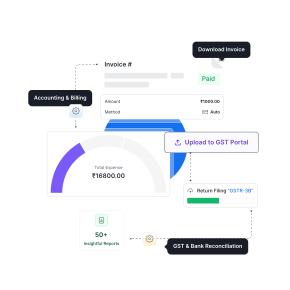
How to Prepare a Ledger Account
Knowing how to prepare a ledger account is essential for any business owner, accountant, or CA dealing with Indian SME accounts. Here is a step-by-step breakdown.
Step 1: Record Transactions in the Journal
Before anything enters the ledger, it starts as a journal entry. Every transaction is recorded with a date, description, debit account, credit account, and amount. This is the book of the original entry.
Step 2: Open Individual Ledger Accounts
For each account that appears in the journal (Sales, Cash, Bank, Rent, Creditors, etc.), open a separate ledger account. Follow either the T-account or tabular format depending on what your system supports.
Step 3: Post Journal Entries to the Ledger
Take each journal entry and post the debit side to the debit column of the relevant account, and the credit side to the credit column of the relevant account.
For example, if the journal entry is:
- Debit: Cash ₹50,000
- Credit: Sales ₹50,000
Then ₹50,000 goes to the debit side of the Cash Ledger Account, and ₹50,000 goes to the credit side of the Sales Ledger Account.
Step 4: Balance Each Ledger Account
At the end of the accounting period, add up both sides of each ledger account. The difference between the total debits and total credits is the closing balance. This is carried forward (c/f) to the next period and brought forward (b/f) as the opening balance.
Step 5: Prepare a Trial Balance
Once all accounts are balanced, extract the closing balance of each account and list them in a trial balance. The total of all debit balances must equal the total of all credit balances. If they match, the posting is arithmetically correct.
Step 6: Use the Ledger to Prepare Financial Statements
The trial balance is the starting point for preparing the Profit and Loss Account and the Balance Sheet. Revenue and expense accounts form the P&L. Asset, liability, and equity accounts form the Balance Sheet.
Create & Manage Ledger Accounts Easily with Munim – Know More!
What Is General Ledger Reconciliation?
General ledger reconciliation is the process of verifying that the balances in the general ledger are accurate and match supporting records. It involves comparing ledger balances against external documents like bank statements, GST returns, vendor invoices, customer statements, or subsidiary ledgers.
Why Is Reconciliation Important?
Errors in the general ledger, if left undetected, can lead to incorrect financial statements, wrong tax filings, and gst compliance issues. For Indian businesses, inaccuracies in ledger accounts can directly affect GSTR-1, GSTR-3B, and income tax computations.
Types of Reconciliation in General Ledger Accounting
Bank Reconciliation This is the most common form. The bank account balance in the general ledger is compared against the bank statement. Any mismatches, such as outstanding cheques, deposits in transit, or bank charges, are identified and resolved.
Vendor Reconciliation The creditor ledger balance is compared with the vendor’s statement of accounts. This is especially important for businesses with high-volume purchases who need accurate accounts payable figures.
Customer Reconciliation The debtor ledger balance is matched against customer statements to ensure no dues are overstated or understated.
GST Reconciliation In an Indian context, the GST ledger in the general ledger is reconciled with the GSTR-1, GSTR-3B, and GSTR-2A/2B records. This is a critical step before filing GST returns.
Intercompany Reconciliation For businesses with multiple entities or branches, transactions between group companies must be matched and eliminated from consolidated accounts.
How Often Should Reconciliation Be Done?
Ideally, bank reconciliation should be done monthly. GST ledger reconciliation should be done before every return filing deadline. For large businesses, a full general ledger reconciliation is done quarterly or annually.
Final Thoughts
The general ledger is not just an accounting book. It is the financial backbone of every business. Whether it is a small trader in Surat, a manufacturing unit in Pune, or a services firm in Bengaluru, accurate ledger accounting keeps the business compliant, audit-ready, and well-informed.
Understanding what a general ledger is, how it is structured, and how to reconcile it regularly helps business owners and accountants avoid costly errors. It also ensures that tax filings, financial statements, and business decisions all rest on solid, reliable data.
Frequently Asked Questions (FAQs)
What is a general ledger in simple terms? A general ledger is the complete record of all financial transactions of a business, organised by account type. It includes every debit and credit posted in the accounting period and forms the basis for financial statements.
What is general ledger accounting? General ledger accounting is the process of recording all business transactions using the double-entry system, classifying them into relevant accounts, and summarising them to prepare financial reports.
What are the five types of accounts in a general ledger? The five account types in a general ledger are assets, liabilities, equity or capital, income or revenue, and expenses.
Can I view my general ledger in accounting software?
Yes. Most modern accounting software, including cloud-based platforms designed for Indian businesses, provides a general ledger report that shows all transactions account-wise with running balances. This makes it easy to review, filter, and export ledger data.
Disclaimer: "This blog post is for informational purposes only. For specific tax advice related to your business, please consult a qualified Chartered Accountant or GST practitioner."
About the author

Mehul is a seasoned content writer with a passion for simplifying complex accounting and GST topics. With a keen interest in entrepreneurship and business management, he specializes in creating informative and engaging content for themunim.com. His goal is to help businesses understand and implement accounting and GST software solutions effectively. When he's not crafting content, Mehul enjoys exploring new places and spending time with his Golden Retriever.
Related Articles
Explore the latest market news, useful resources for business, and Munim updates.