10 Steps To Start a Travel Agency in India (Complete Guide 2026)
 AuthorJayant Surana
 Reviewed ByMadhav Bhayani



- Why Does Starting a Travel Agency in India Make Sense in 2026?
- Step 1: Decide Your Business Structure
- Step 2: Choose Your Agency Type and Niche
- Step 3: Register Your Business
- Step 4: Get Ministry of Tourism (MoT) Recognition
- Step 5: Choose Your Flight Booking and Ticketing Model
- Step 6: Set Up Your Office and Technology Stack
- Step 7: Plan Your Finances and Startup Costs
- Step 8: Build Supplier Partnerships
- Step 9: Set Up Your Marketing Channels
- Step 10: Hire the Right Team
- How to Start a Travel Agency Online?
- Conclusion
- Frequently Asked Questions (FAQs)

Summary:
Starting a travel agency in India is more accessible than most people realise. Whether you want to start a travel agency from home, launch completely online, or open a premium commercial shopfront, this guide breaks down the entire process into 10 actionable steps.
We map out a clear, cost-aware blueprint. It helps with navigating everything from your initial business registration and GST compliance to setting up your tech stack. Further, it helps secure highly profitable supplier partnerships.
India’s travel industry is growing at an annual rate of 14%, even after weathering one of the toughest periods in global tourism history. That’s a remarkable signal and a real business opportunity.
Yet, most aspiring entrepreneurs who want to start a travel agency don’t know where to begin. Which licence comes first? How much does it actually cost? Do you need an office, or can you start a travel agency from home? This guide answers all of that, step by step.
Why Does Starting a Travel Agency in India Make Sense in 2026?
India’s outbound and domestic travel segments are expanding rapidly. Tier-2 and Tier-3 cities are generating strong demand for customised travel packages. However, organised agencies remain scarce in these markets. That gap is your opportunity.
Many aspiring entrepreneurs in 2026 ask how to start a travel agency, and for good reason. The barrier to entry is relatively low, and commission structures are established. Further, by selecting the right niche, even a small travel agency can become highly profitable within its first year of operations.
Let’s get into the exact steps.
Turn your travel business into profit — track every booking and commission accurately. Know More!
Step 1: Decide Your Business Structure
Before anything else, decide how you want to legally exist. Are you going solo, or do you have a co-founder?
Your options are:
- Sole Proprietorship: easiest to set up, ideal for home-based beginnings.
- Limited Liability Partnership (LLP): preferred if you plan to scale or apply for IATA.
- Private Limited Company: best for accessing formal credit and corporate clients.
The Ministry of Tourism recognises different types of travel entities. Your registration structure determines the categories you qualify for, including eligibility for subsidies and business loans.
Choose based on your long-term vision, not just immediate convenience.
Step 2: Choose Your Agency Type and Niche
Not every travel agency does the same thing. The Ministry of Tourism recognises four primary categories:
| Agency Type | Focus | Typical Margin |
| Travel Agent | Domestic tickets & hotels | 1-5% |
| Inbound Tour Operator | Foreign tourists visiting India | 10-15% |
| Outbound Tour Operator | Indians travelling abroad | 8-15% |
| Domestic Tour Operator | Indians travelling within India | 8-12% |
For a first-time entrepreneur, the least expensive entry point is registering as a Domestic Travel Agent. However, for higher-ticket clients, registering as an Outbound Tour Operator is recommended.
Pick a niche early. Honeymoon packages, spiritual circuits, adventure travel, or corporate trips – specificity builds trust and referrals faster than being a generalist.
Step 3: Register Your Business
Once you know your structure and niche, complete your formal registrations. These are non-negotiable if you want to operate legally and professionally.
The key registrations include:
- PAN and TAN: for tax compliance.
- GST Registration (GSTIN): mandatory for collecting Goods and Services Tax on travel services.
- MSME Udyam Registration: free registration that helps with MSME-linked financial products.
- Shops & Establishment License: issued by your local municipal body.
While the government sets a legal turnover threshold of ₹20 Lakhs for GST, it is practically mandatory from day one for a travel agency to handle inter-state bookings. Further, you need GST registration to partner with B2B inventory portals.
Business registrations done? Now automate your accounting from day one. Read Now!
Step 4: Get Ministry of Tourism (MoT) Recognition
Registering with the Ministry of Tourism is not legally mandatory. However, it is strongly recommended that your agency meet government-defined standards. Airlines, hotel chains, and tour operators take it seriously when evaluating credit terms and partnership eligibility.
What you need for MoT registration:
- Non-refundable application fee: ₹10,000 (renewed every 2 years for ₹5,000).
- A physical office with a minimum area of 150 sq. ft.
- A minimum of four qualified staff members, with at least one staff member with a Tourism diploma or degree.
- Latest audited balance sheet, PAN copy, and GST registration copy.
- Signed Pledge of Commitment to “Safe & Honourable Tourism”.
MoT recognition is a prerequisite for IATA applications and eligibility for international trade fairs – making it a valuable step even though it isn’t legally compulsory.
Simplify Your Business Operations
Designed to give you speed, control, and accuracy in daily accounting tasks.
 Save time with automated accounting workflows
- Get 35+ detailed business reports easily
- Access your business anytime, anywhere
 Save time with automated accounting workflows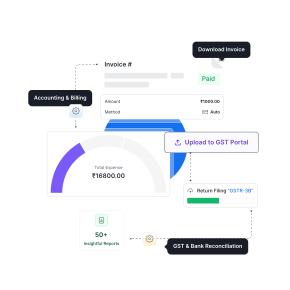
Step 5: Choose Your Flight Booking and Ticketing Model
If you plan to book air tickets (especially international ones), your system needs access to airline inventory. You have two realistic paths:
Option A – IATA Accreditation
This is the gold standard. A travel agency that earns IATA approval gains worldwide credibility, can issue tickets directly, and gets access to global platforms like Amadeus, Sabre, and Galileo.
However, it requires a bank guarantee of ₹3-10 lakh plus at least two IATA-certified staff members.
Option B – GDS Sub-Agent via a Consolidator
New agencies often begin as sub-agents to manage initial costs. You may later pursue IATA accreditation once operational scale and compliance readiness improve.
Monthly GDS access typically costs ₹2,000-₹8,000. It is far more manageable when starting a small travel agency. The practical advice is to start as a sub-agent. You can build volume and pursue IATA later.
Option C – Direct Airline Agent Portals (Best for Absolute Beginners)
If you have zero budget for GDS fees or IATA bank guarantees, you can bypass them entirely by registering directly on individual airline partner portals (such as IndiGo Partner, Air India Express Agent Connect, etc.).
Step 6: Set Up Your Office and Technology Stack
You can start a travel agency from home with a modest setup. Many successful agencies began this way. A home-based setup brings startup costs down to roughly ₹1.5-₹2.5 lakh.
However, if you plan to serve corporate clients, it is advisable to have a physical office. A commercial office of ~200 sq. ft. (slightly larger than the legal minimum of 150 sq. ft.) adds credibility during client visits and audit checks.
Regardless of location, your technology stack is your engine:
- B2B Travel Portal: Yatra for Business, SOTC Trade, or similar aggregators for hotel and holiday inventory.
- GDS Terminal: ₹2,000-₹8,000/month for Amadeus, Galileo, or Sabre access.
- CRM Software: to manage leads, preferences, and repeat bookings.
- GST-compliant Accounting Tool: for invoicing and financial reporting.
- Booking Website: a white-label engine (₹15,000-₹50,000) gives you a professional booking interface.
A well-designed website isn’t optional anymore. It’s the first impression for most customers searching for how to start a travel agency online.
Step 7: Plan Your Finances and Startup Costs
One of the most common questions is: how much does it cost to start a travel agency in India?
Startup costs vary significantly based on your setup level. A minimal home-based agency can begin with ₹1.5-₹2.5 lakh, a standard commercial setup runs ₹3.5-₹5 lakh, while a fully accredited agency with IATA, a CRM, and staff can require ₹7-₹12 lakh.
Here’s a quick breakdown for a standard setup:
| Expense Head | Estimated Cost |
| Business registration & GST | ₹5,000-₹10,000 |
| MoT recognition fee | ₹10,000 |
| Office setup (basic) | ₹50,000-₹1,50,000 |
| GDS/B2B portal access | ₹2,000-₹8,000/month |
| Website & booking engine | ₹15,000-₹50,000 |
| Marketing (initial) | ₹20,000-₹50,000 |
| Working capital buffer | ₹50,000-₹1,00,000 |
Always plan for a working capital buffer. The travel industry often sees a timing gap between advance supplier payments and client collections. It is especially important in peak seasons.
Track expenses, commissions, and profits in real time — no spreadsheets needed. Learn More!
Step 8: Build Supplier Partnerships
Your agency is only as strong as the network behind it. Invest early in building supplier relationships.
Key partnerships to establish:
- Hotels: negotiate room blocks and discounted rates for repeat bookings.
- Airlines: register for ticketing commissions through your GDS or IATA setup.
- Local Tour Operators: collaborate for destination-specific activities, transport, and guides.
- Visa Consultants: especially valuable for outbound packages.
Real-world example:
Priya, a former HR manager from Pune, launched a home-based travel agency focused on women-only group tours. Within eight months, she had partnerships with three boutique resorts in Rajasthan and a local operator in Spiti Valley.
She achieved this by consistently offering what online aggregators couldn’t: curated and personal experiences. Her client base grew entirely through WhatsApp referrals.
The lesson: niche + strong supplier network = a defensible business.
Step 9: Set Up Your Marketing Channels
A travel agency lives and dies by its visibility. Here’s how to build yours from day one:
- Google My Business: essential for local discovery in Tier-2 and Tier-3 cities.
- Instagram & Facebook: share destination reels, client testimonials, and itinerary previews.
- WhatsApp Business: most Indian travel bookings are still initiated through WhatsApp.
- SEO Content: blog posts targeting queries like how to start a travel agency in India and destination-specific searches drive long-term traffic.
- Referral Program: offer booking discounts for successful client referrals.
Don’t wait until your office is “ready” to start marketing. Begin building your audience and your reputation from day one.
Step 10: Hire the Right Team
Even a small travel agency needs the right people. The Ministry of Tourism requires at least four qualified staff members for MoT recognition. It should include at least one person with a Tourism diploma / degree.
For a smooth launch, prioritise these roles:
- Travel Consultant: handles bookings, client communication, and itinerary design.
- Accounts Executive: manages GST invoicing, reconciliation, and supplier payments.
- Marketing/Social Media: builds your digital presence.
As you scale, add destination specialists and a corporate travel manager.
How to Start a Travel Agency Online?
If a physical office isn’t feasible yet, how to start a travel agency online is a completely valid question. You can operate with:
- A registered business entity (proprietorship is fine to start).
- GST registration.
- A B2B portal subscription.
- A professional website with inquiry forms.
Many successful agencies in India began as online-only operations before eventually setting up offices. Learning how to start a travel agency from home has become an incredibly popular route for women entrepreneurs and career-switchers alike. It offers a way to build a highly credible, profitable business with total lifestyle flexibility.
Conclusion
Starting a travel agency in India is one of the most accessible service businesses you can launch. In 2026, domestic and outbound travel demand is stronger than it has been in years.
The steps aren’t complicated, but they do require discipline. Register correctly, pick your niche, build your supplier network, and market consistently from day one.
You don’t need a fancy office to start a travel agency. You need the right licenses, the right tools, and a clear value proposition for the customers you want to serve. Start small, learn fast, and scale with confidence.
Ready to turn your travel passion into a full-time income? Now that you know exactly how to start a travel agency business, take the first step and register your entity today. Your very first client is just one itinerary away.
Frequently Asked Questions (FAQs)
How much does it cost to start a travel agency in India?
Startup costs range from ₹1.5 lakh for a small home-based setup to ₹12 lakh for a fully accredited agency. The cost includes office rent, IATA registration, and staff salary. A standard mid-level setup typically costs ₹3.5-₹5 lakh.
Can I start a travel agency from home in India?
Yes, absolutely. A home-based setup is entirely viable, especially at the start. You’ll need a registered business entity, GST registration, and access to a B2B travel portal. MoT recognition requires a dedicated physical office address of at least 150 sq. ft.. It must be a private, locked cabin in a co-working space. Remember that open hot-desks or virtual offices will not qualify.
Is IATA accreditation mandatory to start a travel agency in India?
No, IATA accreditation is not legally mandatory. Most new agencies start by operating as GDS sub-agents through a consolidator, which is much more affordable. IATA accreditation becomes valuable once you scale and want to issue airline tickets directly.
What is the first step to start a travel agency in India?
The very first step is deciding your legal structure. You can choose from sole proprietorship, LLP, or private limited company. This determines your eligibility for registrations, bank accounts, and eventually, IATA accreditation.
How do I start an online travel agency in India with minimal investment?
Start by registering a sole proprietorship and getting your GST number. Subscribe to a B2B travel portal, build a basic website, and start marketing on WhatsApp and Instagram. Many successful agencies started this way with under ₹2 lakh in total investment.
Disclaimer: "This blog post is for informational purposes only. For specific tax advice related to your business, please consult a qualified Chartered Accountant or GST practitioner."
About the author

Jayant is a senior content writer and digital marketer, known for his extensive experience in commercial SEO writing, blog content, website copy, and B2B communication. Since 2019, he has worked on diverse freelance projects across industries. His portfolio includes articles, landing pages, social media content, and web development collaborations. Blending clarity, creativity, and strategic messaging, he specialises in crafting professional, audience-focused content for themunim.com.
Related Articles
Explore the latest market news, useful resources for business, and Munim updates.