
ITR 4 Sugam for AY 2026 27: New Changes, Who Can File, and Filing Deadline Explained
 AuthorMehul Jagwani
 Reviewed ByMadhav Bhayani



- What Is ITR 4?
- ITR 4 for Whom: Understanding Eligibility
- Key Changes in ITR 4 Sugam for AY 2026 27
- ITR 3 vs ITR 4: When to Use Which Form
- ITR4 Filing Last Date for AY 2026 27
- Documents Needed Before Filing ITR 4
- Step by Step: How to File ITR 4 Online for AY 2026 27
- Common Mistakes to Avoid When Filing ITR 4
- Closing Notes
- Frequently Asked Questions
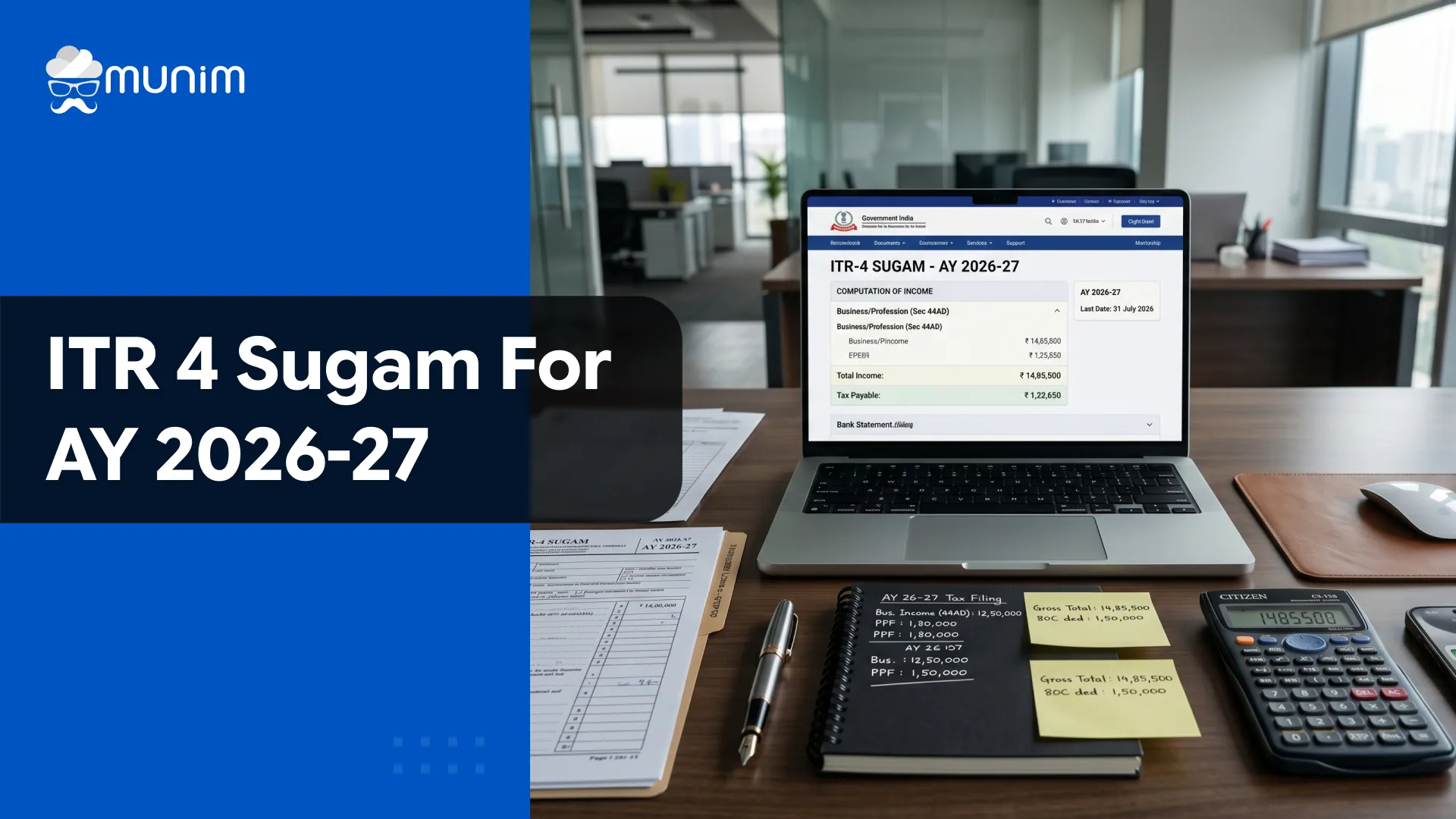
Summary:
ITR 4 Sugam is the simplified income tax return form meant for resident individuals, HUFs, and partnership firms (excluding LLPs) who opt for the presumptive taxation scheme under Sections 44AD, 44ADA, or 44AE. For AY 2026-27, the CBDT has introduced several notable changes, including expanded eligibility to cover two house properties, mandatory bank balance and investment disclosures, a new unrealised rent field, and stricter AIS validation. The ITR4 filing last date for non audit cases is now permanently set at 31st August 2026 under the Finance Act 2026
The income tax return form ITR 4, commonly known as Sugam, is the go to filing option for small business owners, freelancers, and professionals across India who opt for the presumptive taxation scheme. For AY 2026-27, the CBDT has rolled out several important changes to this form, including expanded eligibility for two house properties, mandatory bank balance and investment disclosures, and a permanently revised filing deadline of 31st August 2026.
Whether you are a kirana store owner, a CA in independent practice, or a freelance designer, this guide covers what ITR 4 is, who it applies to, every change that matters this year, and how to file it correctly before the deadline.
What Is ITR 4?
In simple terms, it is a simplified return form designed by the Income Tax Department specifically for taxpayers who do not want to maintain detailed books of accounts. Instead of computing actual profits and filing a full profit and loss statement, eligible taxpayers declare a fixed percentage of their turnover or gross receipts as their income. This is the core idea behind presumptive taxation, and ITR 4 is the form that makes it possible.
ITR 4 for Whom: Understanding Eligibility
Before filing, every taxpayer must first confirm whether this form actually applies to them. The ITR 4 applicability criteria are specific, and even a single disqualifying factor can push a taxpayer towards ITR 2 or ITR 3.
Who Can File ITR 4 Sugam?
The form is available to three categories of taxpayers:
Resident individuals who earn income from business or profession and have opted for the presumptive taxation scheme.
Hindu Undivided Families (HUFs) that meet the same presumptive taxation conditions.
Partnership firms (excluding LLPs) with presumptive business or professional income.
To put it plainly, ITR 4 for whom is a question with a clear answer: it is for small taxpayers who choose to declare income at prescribed rates rather than maintaining full books of accounts.
Designed for Modern Tax Professionals
A premium filing solution for CAs and tax consultants who need speed, scale, and operational clarity.
 Handle multiple clients with ease
- Reconcile and validate with confidence
- Overcome the limitations of the GST portal
 Handle multiple clients with ease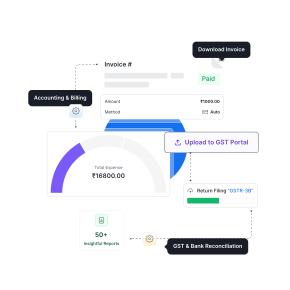
Conditions That Must Be Met
All of the following conditions must be satisfied simultaneously:
Total income must not exceed Rs 50 lakh. This includes income from all sources combined: salary, house property, business or profession under presumptive taxation, and other sources like interest income.
Business income must fall under the presumptive taxation scheme. This means the taxpayer must have opted for one or more of the following sections:
- Section 44AD
- Section 44ADA
- Section 44AE
Income from house property must not exceed two properties (this is a new relaxation for AY 2026 27, as discussed in the changes section below).
The taxpayer may also have salary or pension income alongside the presumptive business income. Additionally, long term capital gains on listed equity shares and equity mutual funds up to Rs 1.25 lakh (with no brought forward or carry forward capital losses) can also be reported in ITR 4.
Who Cannot File ITR 4?
This is equally important. Even a single disqualifying condition bumps a taxpayer to ITR 2 or ITR 3. The disqualifications fall into four broad categories.
Income Related Disqualifications
- Total income exceeds Rs 50 lakh.
- Income from capital gains beyond the limited exemption allowed, or any brought forward or carry forward capital losses.
- Income from lottery, racehorses, or legal gambling.
- Agricultural income exceeding Rs 5,000.
- Income from Virtual Digital Assets such as cryptocurrency or similar digital tokens.
Entity and Status Related Disqualifications
- The taxpayer is a non resident or a resident not ordinarily resident (RNOR).
- The taxpayer is a director in any company at any time during the financial year.
- The taxpayer has invested in unlisted equity shares at any time during the year.
- The taxpayer is a partner in a Limited Liability Partnership (LLP). LLPs must file ITR 5.
Foreign Holdings and Cross Border Disqualifications
- The taxpayer holds assets (including financial interest in any entity) outside India.
- The taxpayer is a signing authority in any account located outside India.
- The taxpayer is claiming relief of foreign tax paid or double taxation relief under Sections 90, 90A, or 91.
Compliance Related Disqualifications
- Business or professional turnover exceeds the prescribed limits under the applicable presumptive section.
- The taxpayer is required to maintain books of accounts under the Income Tax Act (other than under the presumptive scheme).
- TDS has been deducted under Section 194N (cash withdrawals exceeding prescribed limits).
- If even one of these conditions applies, the taxpayer must move to ITR 3 (for business income with actual computation) or ITR 2 (if there is no business income but other disqualifying factors exist).
Example 1: Ramesh runs a small electronics repair shop in Jaipur with an annual turnover of Rs 40 lakh. He has opted for Section 44AD and declares 8% of turnover as his business income. He also has salary income from a part time teaching role. His total income is Rs 6.5 lakh. He has no foreign assets, no directorship in any company, and no capital gains. Ramesh is a perfect fit for ITR 4 Sugam.
Example 2: Priya is a freelance content strategist based in Mumbai. Her gross receipts for FY 2025 26 are Rs 60 lakh and she opts for Section 44ADA. She also holds shares in a private limited company. Because she has invested in unlisted equity shares, she cannot file ITR 4 even though her professional income qualifies under 44ADA. Priya will need to file ITR
Sections 44AD, 44ADA, and 44AE: A Side by Side Comparison
The entire foundation of ITR 4 rests on presumptive taxation. These three sections cover different categories of taxpayers, and confusing them is a common mistake. Here is how they compare:
| Parameter | Section 44AD | Section 44ADA | Section 44AE |
| Applicable to | Any eligible business (retail, trading, manufacturing, services, etc.) | Specified professionals (doctors, lawyers, CAs, architects, engineers, interior decorators, and others under Sec 44AA) | Taxpayers engaged in plying, hiring, or leasing goods carriages |
| Turnover / Receipts Limit | Rs 3 crore (Rs 2 crore if cash receipts exceed 5% of total receipts) | Rs 75 lakh (Rs 50 lakh if cash receipts exceed 5% of gross receipts) | No specific turnover limit, but must own 10 or fewer vehicles |
| Minimum Presumptive Profit | 8% of turnover (6% for digital receipts) | 50% of gross receipts | Prescribed per vehicle rate (Rs 7,500 per month per heavy vehicle; Rs 7,500 per month per other vehicle, or actual earnings, whichever is higher) |
| Books of Accounts Required? | No (unless declaring profit below prescribed rate) | No (unless declaring profit below 50%) | No |
| Tax Audit Required? | Not if profit is at or above prescribed rate | Not if profit is at or above 50% | Not required |
| Advance Tax | Single instalment by 15th March | Single instalment by 15th March | Single instalment by 15th March |
How the 6% digital rate works under Section 44AD: If a shopkeeper has a turnover of Rs 1 crore with Rs 80 lakh received digitally (UPI, NEFT, RTGS, cards, net banking) and Rs 20 lakh in cash, the minimum declared profit would be: 6% of Rs 80 lakh (Rs 4.8 lakh) plus 8% of Rs 20 lakh (Rs 1.6 lakh), totalling Rs 6.4 lakh.
Key Changes in ITR 4 Sugam for AY 2026 27
Several changes this year directly impact how taxpayers fill out the Sugam ITR form. Not all 13 changes carry equal weight. Here they are, tiered by their practical impact on filers.
Major Changes (Affect Eligibility or Tax Liability)
1. Two House Properties Now Allowed
This is arguably the biggest eligibility expansion for ITR 4 filers this year. Previously, taxpayers could report income from only one house property while using ITR 1 or ITR 4. If they owned two properties, they had to switch to the more complex ITR 2 or ITR 3.
From AY 2026 27 onwards, taxpayers can report income from up to two house properties in ITR 4, provided all other eligibility conditions are met. This is a significant relief for small business owners and professionals who own a second residential property, perhaps an ancestral home in their hometown or a rented flat in the city where they work.
2. New Tax Regime as Default with Stricter Opt Out Rules
The New Tax Regime under Section 115BAC continues to be the default for all individual taxpayers. If a taxpayer with business income wants to opt for the Old Tax Regime, they must actively file Form 10 IEA before filing their return. And this choice, once reversed, is a one time switch. Salaried individuals without business income have more flexibility and can switch regimes every year.
An important detail for AY 2026 27: first time opt outs who are choosing the Old Regime for the first time must provide the Form 10 IEA acknowledgment number and filing date in the ITR. Those who had opted out in AY 2024 25 must also declare and confirm their regime choice or switch for AY 2026 27. Form 10 IEA must be filed before the due date of the return.
For most ITR 4 filers, especially those without significant deductions under 80C, 80D, or housing loan interest, the New Tax Regime with its lower slab rates often works out more favourably. However, each case is different, and a quick comparison before choosing the regime is strongly recommended.
3. Permanent Shift of Filing Deadline to 31st August
The Finance Act 2026 has permanently moved the ITR 4 due date for non audit cases from 31st July to 31st August. This is not a one time extension but a structural change. More details in the deadline section below.
Moderate Changes (Affect How the Form Is Filled)
4. Mandatory Bank Balance Disclosure
For AY 2026 27, individuals filing income tax return form ITR 4 must now disclose the total closing balance of all active bank accounts as on 31st March 2026. Previously, this level of financial detail was not required in ITR 4. The intent is to give tax authorities a clearer picture of the taxpayer’s financial position, especially for those not maintaining books of accounts.
5. Investment Disclosure for Presumptive Taxpayers
A new column has been added to the business section of ITR 4 that requires taxpayers to disclose investments made during the financial year. This is another first for the Sugam form and reflects the department’s push towards greater transparency among presumptive filers.
6. New Field for Unrealised Rent
A field titled “The amount of rent which cannot be realized” has been added to the house property schedule of ITR 4. Landlords who were unable to recover rent from tenants during FY 2025 26 can now report those amounts separately. Earlier, there was no dedicated disclosure mechanism for unrealised rent in ITR 1 or ITR 4.
7. Mandatory Tenant Disclosures
Where tax has been deducted under Section 194 IB (TDS on rent by individual or HUF tenants), the taxpayer must now furnish the tenant’s PAN or Aadhaar number. Similarly, if tax has been deducted under Section 194 I (TDS on rent by other persons), the tenant’s TAN must be reported. This was not a mandatory requirement in earlier years.
8. Expanded House Property Schedule
The house property section has been restructured with more granular fields. Taxpayers now need to provide specific details for municipal taxes paid, interest on borrowed capital, and classification of each property as self occupied or deemed let out. The earlier version had fewer fields, and much of this detail was lumped together.
9. Stricter Validation Against AIS and Form 26AS
The e filing portal now runs more rigorous validation checks when taxpayers submit ITR 4. The data entered in the return is cross verified more strictly with the Annual Information Statement (AIS) and Form 26AS. Mismatches between declared income and the data available with the department are more likely to trigger warnings or rejection during processing.
10. Enhanced Deductions Disclosure with Drop Down Selection
Deductions under Sections 80C to 80U must now be selected from a drop down menu on the e filing portal. The taxpayer is required to specify the exact clause or sub section under which the deduction is being claimed. Earlier, the deduction entry was more open ended.
Minor Changes (Administrative and Procedural)
11. Aadhaar Enrolment ID No Longer Accepted
From AY 2026 27, the 28 digit Aadhaar Enrolment ID is no longer accepted. The form now only accepts a valid 12 digit Aadhaar Number. Taxpayers who were previously using the enrolment ID must ensure they have obtained their final Aadhaar number before filing.
12. Additional Column Under Schedule TDS
An additional column has been introduced under the Schedule TDS Details section. Taxpayers now need to specify the exact section under which TDS has been deducted (for example, 194A, 194C, 194J, etc.).
13. Updated Capital Gains Reporting Fields and Secondary Address
Since the old capital gains tax rates for listed equity securities (15% for short term and 10% for long term) are no longer applicable from FY 2025 26, the respective fields have been removed from the form. A new “Secondary Address” field has also been added across all ITR forms, including ITR 4.
ITR 3 vs ITR 4: When to Use Which Form
The blog has referenced ITR 3 multiple times, and for good reason. Choosing the wrong form is one of the most common filing mistakes. Here is a direct side by side comparison:
| Parameter | ITR 4 (Sugam) | ITR 3 |
| Designed for | Small taxpayers opting for presumptive taxation | Taxpayers with business or professional income computed on actual basis |
| Books of Accounts | Not required (unless declaring below presumptive rate) | Full books of accounts required |
| Profit & Loss Statement | Not required | Mandatory |
| Balance Sheet | Not required (only basic financial particulars) | Mandatory |
| Tax Audit | Generally not applicable | Required if turnover exceeds prescribed limits or profit is below presumptive rate |
| Income Sources Allowed | Salary, up to 2 house properties, presumptive business/profession, other sources, limited LTCG | All income sources including capital gains, foreign income, multiple properties |
| Foreign Assets | Not allowed | Allowed (with Schedule FA) |
| Directorship in Company | Not allowed | Allowed |
| Unlisted Equity Shares | Not allowed | Allowed |
| Filing Complexity | Low (can be completed in under 30 minutes) | High (requires detailed financial statements) |
| Due Date (non audit, AY 2026 27) | 31st August 2026 | 31st August 2026 |
When you must switch from ITR 4 to ITR 3:
You want to declare profit lower than the presumptive rate and your income exceeds the basic exemption limit (triggering mandatory audit).
You have income from more than two house properties.
You hold foreign assets or are a director in a company.
Your turnover exceeds the prescribed limits.
You have speculative business income or Virtual Digital Asset income.
The choice of form has real consequences. Filing the wrong form can result in a Defective Return Notice under Section 139(9), giving the taxpayer just 15 days to correct the error. If the correction is not made within that window, the return is treated as if it was never filed.
ITR4 Filing Last Date for AY 2026 27
One of the most important changes this year concerns the filing deadline itself. The Finance Minister announced staggered ITR deadlines during the Union Budget 2026 presentation on 1st February. This means different forms now have different due dates, unlike the earlier approach where most non audit taxpayers shared the 31st July deadline.
Here is how the deadlines are structured for AY 2026 27:
| Category | Due Date |
| ITR 1 and ITR 2 (salaried individuals, pensioners, investors) | 31st July 2026 |
| ITR 3 and ITR 4 (non audit business and professional cases) | 31st August 2026 |
| ITR 3 and ITR 4 (cases requiring tax audit) | 31st October 2026 |
| Transfer pricing cases | 30th November 2026 |
| Belated return | 31st December 2026 |
| Revised return | 31st March 2027 |
| Updated return (ITR U) | 31st March 2031 |
The key takeaway for ITR 4 filers: the ITR4 filing last date is 31st August 2026 for non audit cases. This is now a permanent change under the Finance Act 2026, giving small businesses and professionals an extra month compared to salaried taxpayers filing ITR 1 or ITR 2.
This staggered approach was introduced to reduce server load on the e filing portal during peak season and to give business taxpayers more time to prepare their accounts.
Documents Needed Before Filing ITR 4
Having all documents ready before starting the filing process saves time and reduces errors. Here is a practical checklist:
Identity and Access Documents
PAN Card (must be linked with Aadhaar)
Aadhaar Card (12 digit number; enrolment ID is no longer accepted)
E filing portal login credentials (PAN as user ID, password, and mobile number for OTP)
Income Related Documents
Form 16 (if salaried or pensioned, issued by employer)
Form 16A (TDS certificates from banks or other deductors)
Form 26AS (annual tax credit statement; download from e filing portal or TRACES)
Annual Information Statement (AIS) (comprehensive view of financial transactions; download from e filing portal)
Bank statements for all active accounts (to verify interest income and closing balance as on 31st March 2026)
Business turnover or gross receipts records (sales invoices, GST returns, or summary from accounting software)
Rent receipts or rental agreements (if claiming house property income or HRA)
Deduction and Tax Payment Documents
Investment proofs under Section 80C (PPF, ELSS, LIC premium receipts, tuition fee receipts, etc.; applicable only under Old Regime)
Health insurance premium receipts under Section 80D
Donation receipts under Section 80G
Form 10 IEA acknowledgment (only if opting for Old Tax Regime for business income)
Advance tax challans (if advance tax was paid by 15th March)
Self assessment tax challans (if paying remaining tax before filing)
Property Related Documents (If Applicable)
Property address and classification (self occupied or deemed let out)
Municipal tax payment receipts
Home loan interest certificate from bank (for interest on borrowed capital)
Tenant PAN/Aadhaar (if TDS deducted under Section 194 IB) or Tenant TAN (if TDS deducted under Section 194 I)
Keeping these documents organised before logging in to the portal makes the entire filing process significantly faster.
Step by Step: How to File ITR 4 Online for AY 2026 27
The e filing portal at incometax.gov.in now supports online filing for ITR 4 for AY 2026 27. Here is a practical walkthrough:
Step 1: Log in to the e filing portal using your PAN, date of birth, and password. Complete OTP verification.
Step 2: Navigate to e File, then Income Tax Returns, then File Income Tax Return.
Step 3: Select Assessment Year 2026 27 and choose ITR 4 (Sugam) as the form type.
Step 4: Review the pre-filled data. The portal auto fills personal details, salary income (if any), TDS details, and information from AIS. Cross check this data carefully with Form 26AS.
Step 5: Choose your tax regime. If you want the Old Regime, ensure Form 10 IEA has been filed before this step. First time opt outs must enter the acknowledgment number and date.
Step 6: Fill Schedule BP (Business or Profession). Enter the turnover or gross receipts and the presumptive profit percentage. The system calculates the deemed profit automatically.
Step 7: Enter house property details, if applicable. For AY 2026 27, remember the expanded schedule with separate fields for municipal taxes, interest on borrowed capital, unrealised rent, and property classification.
Step 8: Disclose the closing bank balance of all active accounts as on 31st March 2026, and any investments made during the year. These are new mandatory fields this year.
Step 9: Claim eligible deductions under the chosen tax regime. Use the new drop down menu to select the exact section and sub section for each deduction.
Step 10: Verify the tax computation. Pay any self assessment tax if there is a shortfall.
Step 11: Submit the return and complete e verification through Aadhaar OTP, net banking, or EVC.
The entire process can be completed in under 30 minutes for most ITR 4 filers, provided all documents from the checklist above are ready.
Common Mistakes to Avoid When Filing ITR 4
Even though Sugam ITR is designed for simplicity, taxpayers frequently make errors that lead to notices or delayed processing. The stricter AIS validation this year makes these mistakes costlier than before.
Choosing the wrong form. This is the most frequent mistake. A taxpayer who holds unlisted shares, is a company director, or earns crypto income cannot file ITR 4, regardless of their income profile. Filing the wrong form triggers a Defective Return Notice with a 15 day correction window.
Not reconciling with AIS and Form 26AS. The department’s validation checks are stricter this year. Any mismatch between declared income and the data in AIS or 26AS will likely trigger a mismatch notice. Common mismatches include unreported interest income from savings accounts, dividend income from mutual funds, and TDS amounts that do not align.
Declaring profit below the prescribed rate. Under Section 44AD, the minimum is 8% (or 6% for digital receipts). Under Section 44ADA, it is 50%. Going below these thresholds triggers audit requirements and disqualifies the taxpayer from using ITR 4.
Forgetting the new bank balance and investment disclosures. These are new mandatory fields for AY 2026 27. Leaving them blank will cause validation errors during submission. Gather closing balances for every active bank account before starting.
Not filing Form 10 IEA before the return. Business owners who want to opt for the Old Tax Regime must file this form before submitting their ITR. Many forget and end up defaulting to the New Regime, which cannot be changed after the due date.
Ignoring advance tax obligations. Presumptive taxpayers must pay 100% advance tax by 15th March. Missing this results in interest charges under Sections 234B and 234C, even if the return itself is filed on time.
Using Aadhaar Enrolment ID instead of Aadhaar Number. The 28 digit enrolment ID is no longer accepted from AY 2026 27. Only the 12 digit Aadhaar Number works. Taxpayers who have not yet received their Aadhaar should apply well before filing.
Not specifying TDS section codes. The new Schedule TDS column requires the exact section under which TDS was deducted. Leaving this blank or entering the wrong code can cause processing delays.
Closing Notes
Filing ITR 4 Sugam for AY 2026 27 is more straightforward than ever for small businesses, freelancers, and professionals who meet the eligibility criteria. The changes introduced this year, especially the allowance for two house properties and the permanent shift of the deadline to 31st August 2026, are welcome steps towards reducing compliance burden. At the same time, the new mandatory disclosures around bank balances and investments signal that the department is tightening its data verification net.
Frequently Asked Questions
What is the turnover limit for filing ITR 4 under Section 44AD?
The turnover limit under Section 44AD is Rs 3 crore. However, if cash receipts exceed 5% of total receipts, the limit is reduced to Rs 2 crore.
What is the gross receipts limit for professionals under Section 44ADA?
The gross receipts limit is Rs 75 lakh. If cash receipts exceed 5% of total gross receipts, the limit drops to Rs 50 lakh.
Can a director of a company file ITR 4?
No. An individual who is a director in any company at any time during the financial year cannot file ITR 4, even if all other eligibility conditions are met.
Can a person with foreign income or foreign assets file ITR 4?
No. Taxpayers with any foreign income or foreign assets (including foreign bank accounts) are not eligible for ITR 4 and must use ITR 2 or ITR 3 depending on their income profile.
What are the new disclosures required in ITR 4 for AY 2026 27?
For AY 2026 27, ITR 4 filers must mandatorily disclose: (a) closing balance of all active bank accounts as on 31st March 2026, (b) investments made during the financial year, (c) unrealised rent (if applicable), and (d) tenant PAN/Aadhaar or TAN where TDS has been deducted on rental income.
Is this the last filing cycle under the Income Tax Act 1961?
Yes. AY 2026 27 is the final full filing cycle under the existing Income Tax Act, 1961. From FY 2026 27 onwards, the new Income Tax Act 2025 framework will apply, with new forms and potentially different procedures.
Can an LLP file ITR 4?
No. Limited Liability Partnerships are not eligible for ITR 4. They must file ITR 5.
Is the Aadhaar Enrolment ID still accepted in ITR 4 for AY 2026 27?
No. From AY 2026 27, the 28 digit Aadhaar Enrolment ID is no longer accepted. Only a valid 12 digit Aadhaar Number can be used while filing ITR 4. Taxpayers must ensure their Aadhaar is linked to PAN before filing.
Can a taxpayer with agricultural income file ITR 4?
If agricultural income exceeds Rs 5,000, the taxpayer is not eligible to file ITR 4. They must use ITR 2 or ITR 3 as applicable.
Disclaimer: "This blog post is for informational purposes only. For specific tax advice related to your business, please consult a qualified Chartered Accountant or GST practitioner."
About the author

Mehul is a seasoned content writer with a passion for simplifying complex accounting and GST topics. With a keen interest in entrepreneurship and business management, he specializes in creating informative and engaging content for themunim.com. His goal is to help businesses understand and implement accounting and GST software solutions effectively. When he's not crafting content, Mehul enjoys exploring new places and spending time with his Golden Retriever.
Related Articles
Explore the latest market news, useful resources for business, and Munim updates.