Purchase Order vs. Invoice: Key Differences Explained
 AuthorJayant Surana
 Reviewed ByAjay Savani


Summary:
Navigating Purchase Order vs. Invoice is essential as it helps prevent operational mistakes. This complete guide explains their differences.
Understanding order and billing documents prevents financial bottlenecks. Clear financial processes prevent unexpected business delays. Understanding a purchase order vs. an invoice is vital.
Let us examine the simple flow from request to payment. The process begins when a buyer needs to purchase goods, and they issue a formal document to their chosen supplier.
What is a Purchase Order (PO)?
A purchase order represents a formal request to buy materials, and the buyer drafts this document for the seller to review. It outlines the exact items the buyer expects to receive.
This document serves a distinct and clear business purpose. Both parties must agree on the terms before work starts. For deeper details, read What is a purchase order? in our guide.
Careful buyers outline their exact needs for clarity. The buyer creates this form with essential elements:
- PO Number: This unique tracking number helps identify the items.
- Item Details: Covers details like quantities, descriptions, and agreed prices.
- Delivery Date: It helps buyers prepare for the expected arrival of goods.
- Terms: It outlines conditions related to the transaction along with shipping rules.
What is an Invoice?
An invoice functions as a formal demand for pending payment. Sellers create this document after delivering the requested physical goods. It tells the buyer the monetary amount they must pay.
The primary goal involves collecting funds for completed corporate services. This critical step finalises the commercial transaction between both parties. Explore our invoice management system guide for deeper insights.
Standard invoices contain vital details for accurate corporate accounting. The seller prepares this specific file containing core details:
- Invoice Number: Accounts teams use this to track pending payments.
- PO Reference: The document must feature the matching PO number.
- Amount Due: It confirms the final financial amount for payment.
- Payment Details: Bank details and the specific deadline appear here.
Simplify Your Business Operations
Designed to give you speed, control, and accuracy in daily accounting tasks.
 Save time with automated accounting workflows
- Get 35+ detailed business reports easily
- Access your business anytime, anywhere
 Save time with automated accounting workflows
Purchase Order vs. Invoice: The Key Differences
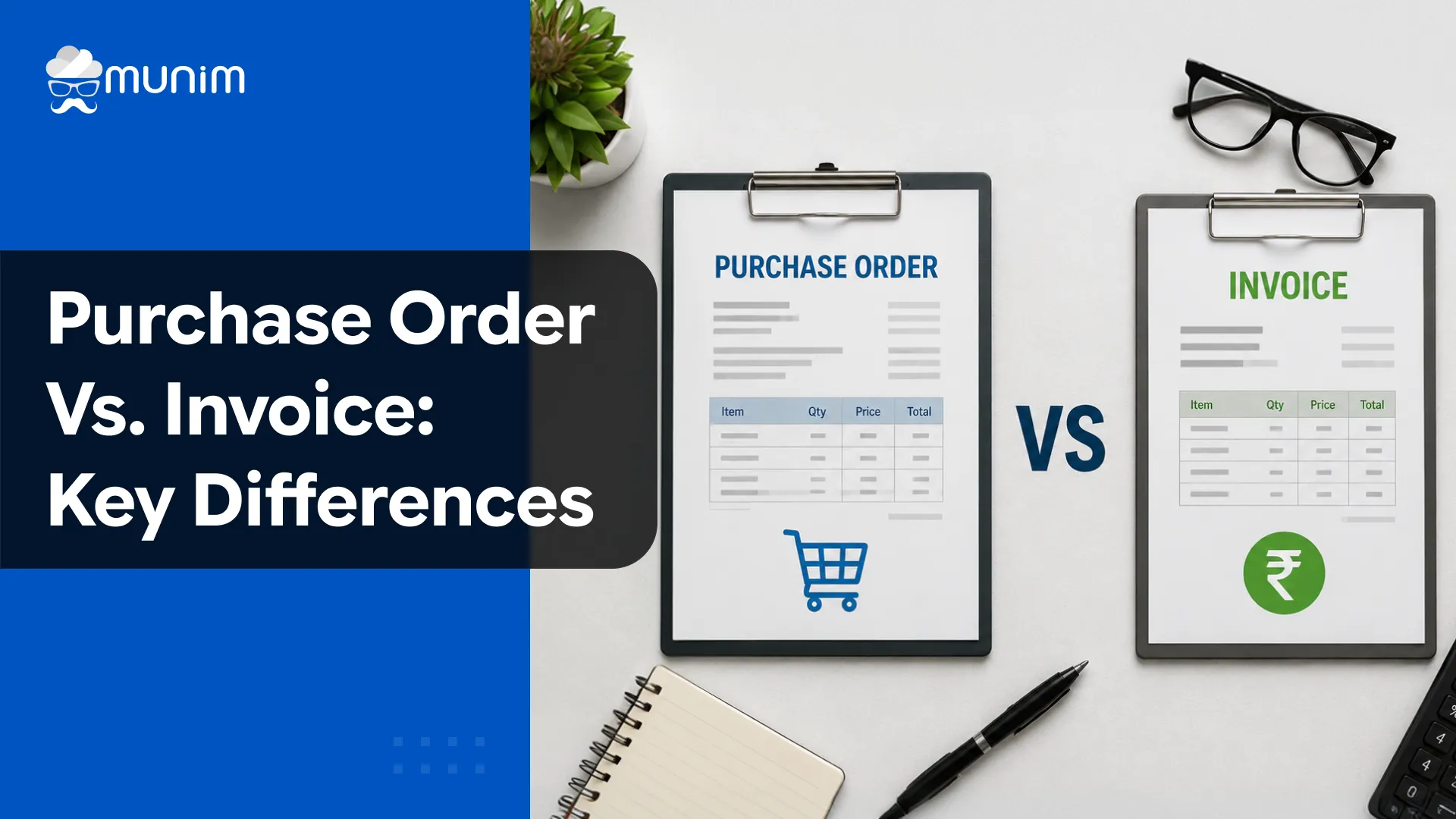
Comparing a purchase order vs. an invoice is straightforward. A purchase order provides official authorisation for a new transaction, while an invoice acts as a collection tool for completed work. These fundamental forms sit at opposite ends of the procurement cycle.
The buyer sends the initial order to start the relationship. The seller sends the final invoice to close the loop. Please review the detailed comparison table to understand the clear differences between the two distinct documents.
| Feature | Purchase Order (PO) | Invoice |
| Creator | The buyer creates this initial request. | The seller drafts this final billing document. |
| Recipient | The seller receives this initial order request. | The buyer receives this final payment notice. |
| Purpose | It requests specific goods for a business. | It demands payment for completed commercial work. |
| Timing | Buyers send it early in the process. | Sellers create it after delivering the items. |
| Finance | It authorises financial spending for the company. | It collects funds for the completed transaction. |
The Procurement Lifecycle: From PO to Invoice
The procurement lifecycle connects the initial order to final payment. This structured process keeps business operations organised and transparent.
The Five-Step Lifecycle Process:
Step 1: The buyer issues the purchase order to request goods. This document specifies the exact quantity and expected delivery date.
Step 2: The seller accepts the purchase order and begins fulfilment. Both parties share a binding legal agreement for the transaction.
Step 3: The seller delivers the physical goods to the buyer. A delivery challan accompanies the shipment for initial inspection purposes.
Step 4: The seller issues the final invoice to demand payment. This billing document references the original purchase order number.
Step 5: The buyer pays the invoice and records the transaction. This final action completes the procurement lifecycle for the business.
Real-World Example: An Indian Retail Scenario
Let us look at a practical Indian retail scenario and it will help you understand a purchase order vs. an invoice easily.
An Indian electronics retailer needs new smartphones for the holidays. The store manager creates PO #101 for fifty mobile devices. This order lists the agreed price and standard delivery terms.
The regional distributor receives the order and ships the phones. They include a delivery challan with the sealed inventory boxes.
The distributor emails Invoice #505 to the retail store headquarters. The invoice shows the phone prices plus applicable GST charges. The retailer verifies the amounts and pays the total balance.
Document Distinctions: PO vs SO vs Invoice vs Quotation
A standard supply chain uses multiple commercial records. Exploring purchase order vs. invoice provides clarity, but you must also understand quotations and sales orders.
- Quotation: Vendors provide this initial price estimate to prospective clients.
- Purchase Order: Clients use the PO form to order materials.
- Sales Order: Suppliers generate this internal file to get approval for the request.
- Invoice: The vendors issue this final bill to collect the payment.
The quotation phase occurs before any official commitments, and the invoice concludes the cycle during the payment stage.
The Power of Three-Way Matching
The accounts payable team reviews three distinct documents before payment. They compare the invoice, purchase order, and delivery receipt. Every single detail must match across all three forms.
Three-way matching protects a business from paying fraudulent vendor bills. If goods arrive damaged, teams initiate effective purchase returns.
This strict verification prevents accidental duplicate payments from happening. It catches vendor overbilling issues before any funds leave.
GST Compliance and E-Invoicing in India
Purchase order data transforms into compliant GST tax invoices. Indian businesses must follow strict GST rules for every transaction.
Matching HSN codes and GSTIN details prevents critical tax errors. Both documents must display identical information to remain legally valid. Learn about handling goods returned under GST for exceptions, as accuracy ensures smooth ITC claims for buyers.
Electronic invoicing systems streamline this process for medium and large enterprises. Automated portals validate the data and generate digital reference numbers.
Best Practices for Managing Procurement and Payments
Optimising your payment workflows eliminates frustrating operational delays. Strong financial habits require reliable digital tools and procedures. Organisations boost their efficiency by adopting standard industry practices.
- Buyers must confirm available funds before sending purchase requests.
- Suppliers should regularly review their warehouse stock to avoid shortages.
- Start using a professional accounting software to connect document cycles.
- Deploy digital systems that eliminate costly human data entry mistakes.
Streamline Documents With the Munim App
The Munim app automates critical financial paperwork for businesses. Users generate new purchase orders and compliant tax invoices, and this software connects both sides of the procurement cycle.
Download the best invoicing software for small enterprise businesses to save hours of routine administrative work.
Digital tools keep remote accounting teams organised and efficient. Business owners gain improved visibility into their operational expenses. Smart systems secure crucial corporate financial data from threats.
Next Steps
Purchase orders authorise requested work before physical delivery begins, while invoices demand monetary payment after the contract project ends. These important documents serve distinct purposes in modern business.
Companies need strict internal controls for both financial documents. Proper record tracking prevents severe fraud and payment disputes.
Upgrade your manual billing processes to automated digital software. Download Munim templates to streamline everyday organisational accounting tasks. Take charge of your business bookkeeping routines this quarter.
Frequently Asked Questions (FAQs)
Can you pay for a purchase order?
You cannot pay for a purchase order document. This specific form acts as a formal request for goods, and buyers must wait for the official final invoice.
Does an invoice require a PO?
An invoice functions without an order in minor transactions. Small office purchases might skip the formal authorisation step. Large corporations mandate order numbers for every major transaction.
Is an invoice a legal document?
A standard invoice represents a binding commercial legal document. It provides concrete proof of an active business transaction. Tax authorities request these records during strict financial audits.
What comes first, a PO or an invoice?
The purchase order starts the initial formal business transaction. Buyers send this request before the vendor starts work, and the sellers issue the final invoice after completing the delivery.
Is an invoice the same as a purchase order?
These two vital documents serve two distinct business purposes. A purchase order authorises a new commercial supply request. An invoice demands final payment for the provided materials.
Can you invoice without a purchase order?
Vendors can bill smaller clients without a formal order. Small service projects skip the initial complex authorisation paperwork. Large enterprise corporations require order numbers for security tracking.
What are the 5 P’s of purchasing?
This classic procurement framework guides effective supply chain management. The concepts include people, process, policy, payment, and performance. Mastering these elements builds a robust internal purchasing department.
Disclaimer: "This blog post is for informational purposes only. For specific tax advice related to your business, please consult a qualified Chartered Accountant or GST practitioner."
About the author

Jayant is a senior content writer and digital marketer, known for his extensive experience in commercial SEO writing, blog content, website copy, and B2B communication. Since 2019, he has worked on diverse freelance projects across industries. His portfolio includes articles, landing pages, social media content, and web development collaborations. Blending clarity, creativity, and strategic messaging, he specialises in crafting professional, audience-focused content for themunim.com.
Related Articles
Explore the latest market news, useful resources for business, and Munim updates.