
E-Commerce GST Registration Rules 2026: When Online Sellers Must Register Even Below Threshold
 AuthorMehul Jagwani
 Reviewed ByMadhav Bhayani



- Who Needs GST Registration for E Commerce in India?
- GST Registration for E Commerce Business: Step by Step Process
- Documents Required for E Commerce GST Registration
- Understanding TCS and How It Affects E Commerce Sellers
- Do E Commerce Sellers Need Multi State GST Registration?
- GST Returns E Commerce Sellers Must File
- Conclusion
- Frequently Asked Questions
Summary:
Every seller who supplies goods or services through an e-commerce platform in India must obtain GST registration, regardless of turnover. The standard exemption thresholds of ₹40 lakh for goods and ₹20 lakh for services do not apply to most e-commerce sellers. The CGST Act, under Section 24, makes this registration compulsory from the very first sale on platforms like Amazon, Flipkart, or Meesho.
A lot of new online sellers in India assume they can skip GST registration because their monthly sales are just a few thousand rupees. That assumption is wrong, it can be expensive.
The rules around e-commerce GST registration 2026 are stricter and more closely enforced than ever before. Platforms like Amazon and Flipkart will not even activate a seller account without a valid GSTIN.
Let us break this down clearly so that any seller, whether a beginner or someone already active on marketplaces, understands exactly what applies to them.
Who Needs GST Registration for E Commerce in India?
The short answer: almost every e-commerce seller.
Under Section 24 of the CGST Act, 2017, any person who supplies goods or services through an e-commerce operator (ECO) is required to register under GST. The usual turnover based exemption does not apply here.
Here is who falls under this mandatory requirement:
Sellers on marketplace platforms such as Amazon, Flipkart, Meesho, Myntra, JioMart, and similar platforms. Even if a seller earns only ₹5,000 a month, they need a GSTIN to list products.
Service providers operating through aggregators like Urban Company, Practo, or similar apps. If the platform collects payment on behalf of the service provider, GST registration becomes compulsory.
E commerce operators themselves, meaning any business that owns, manages, or operates a digital platform facilitating the sale of goods or services. These entities must register regardless of turnover and are required to collect TCS (Tax Collected at Source).
Foreign e-commerce operators that facilitate transactions in India must also register in every state and union territory where they operate.
GST Registration for E Commerce Business: Step by Step Process
Getting GST registration for e-commerce business is similar to normal GST registration, but there are a few additional considerations sellers should know.
Step 1: Prepare Part A on the GST Portal
Visit the GST portal at www.gst.gov.in and navigate to the Registration section. Fill out Part A of Form GST REG 01 with basic details: legal name, PAN, email address, and mobile number. After verification through OTP on both email and mobile, the system generates a Temporary Reference Number (TRN).
Important: Sellers have exactly 15 days to complete Part B after receiving the TRN. If this window is missed, the entire application resets and must be started from scratch.
Designed for Modern Tax Professionals
A premium filing solution for CAs and tax consultants who need speed, scale, and operational clarity.
 Handle multiple clients with ease
- Reconcile and validate with confidence
- Overcome the limitations of the GST portal
 Handle multiple clients with ease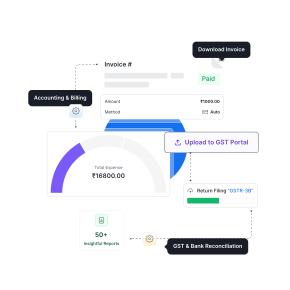
Step 2: Complete Part B
Log in using the TRN and fill out Part B. This includes:
Business details such as the principal place of business address, additional places of business (if any), and the nature of business activity.
For the Reason for Registration field, e-commerce sellers should select “Liable to be registered under Section 24” rather than citing a turnover threshold, since the registration is mandatory irrespective of turnover.
Authorized signatory details, bank account information, and HSN or SAC codes for the products or services being supplied.
Step 3: Upload Required Documents
Upload all documents in PDF or JPEG format, keeping each file under 1 MB. The GST portal uses sophisticated technology for document verification, which means blurry scans, oversized files, or unclear images get flagged automatically.
Rename files clearly (for example, “PAN_RajeshKumar.pdf” rather than “scan0012.pdf”) to help the reviewing officer process the application faster.
Step 4: Submit and Track
Use Aadhaar based e KYC if possible. It is the fastest route and eliminates the need for a Digital Signature Certificate in most cases. After submission, an Application Reference Number (ARN) is generated. Use it to track the application status.
Clean applications typically get approved in 3 to 7 working days. If the officer seeks clarification, the timeline may extend by a few more days.
Documents Required for E Commerce GST Registration
The documents required for e-commerce GST registration are largely the same as for regular GST registration, here is the complete checklist, broken down by business type.
For Sole Proprietors and Individuals
PAN card of the proprietor. This is the primary tax identity document and must match the details entered on the portal.
Aadhaar card of the proprietor for identity verification and e KYC.
Photograph of the proprietor (passport size, recent).
Address proof of the principal place of business. If the premises are owned, a property tax receipt, electricity bill, or ownership deed works. If rented, a rent agreement along with a No Objection Certificate (NOC) from the landlord is required. Home based sellers can use their residential address.
Bank account details: a cancelled cheque, first and last pages of the bank passbook, or a recent bank statement showing the account holder name, account number, and IFSC code.
For Partnership Firms
All documents listed above for each partner.
Partnership deed.
Letter of authorization for the authorized signatory.
For Companies and LLPs
PAN card and Aadhaar of all directors or designated partners.
Certificate of Incorporation issued by the Ministry of Corporate Affairs.
Memorandum of Association (MOA) and Articles of Association (AOA) for companies.
LLP Agreement for LLPs.
Board resolution or authorization letter appointing the authorized signatory.
Address proof of the registered office.
Additional Tips for E Commerce Sellers
Choose the correct HSN or SAC codes for products. Selecting a broad or incorrect code does not just affect the tax rate; it creates mismatches in every GSTR 1 filed later. Spend a few minutes using the HSN code finder on the GST portal before submitting.
If enrolling in Fulfillment by Amazon (FBA) or Flipkart Fulfilment (FBF), be aware that stock may be stored across warehouses in multiple states. This could trigger the need for separate GSTIN registration in each state where inventory is held.
Understanding TCS and How It Affects E Commerce Sellers
Every e-commerce operator in India is required to collect TCS at the rate of 1% (split as 0.5% CGST and 0.5% SGST or UTGST) on the net value of taxable supplies made through its platform.
Here is how it works in practice.
Suppose a registered seller makes ₹1,00,000 in monthly sales through Amazon. Amazon deducts ₹1,000 as TCS, pays ₹99,000 to the seller, and deposits the ₹1,000 with the GST department under the seller’s GSTIN. When the seller files their GST return, this TCS amount appears in Form GSTR 2A and can be claimed as Input Tax Credit.
This TCS mechanism is governed by Section 52 of the CGST Act. It is the backbone of the government’s monitoring system for online transactions, and it is precisely why every seller needs a GSTIN. Without it, the TCS has no GSTIN to map to, and the platform cannot process payments properly.
For sellers, the good news is that TCS is not an additional cost. It is a tax already collected on their behalf, and they can set it off against their GST liability when filing returns.
Do E Commerce Sellers Need Multi State GST Registration?
This is one of the most commonly overlooked compliance areas.
If a seller stores inventory in warehouses across multiple states, whether through FBA, FBF, or any other fulfillment service, they may need a separate GSTIN in each state where stock is held. The GST law requires registration in every state from which supplies are made, and when goods are shipped from a warehouse in a different state, that warehouse location effectively becomes a place of supply.
Example: A seller based in Jaipur enrolls in Amazon FBA and sends inventory to warehouses in Maharashtra, Karnataka, and Tamil Nadu. That seller now needs GSTIN registration in all four states: Rajasthan (home state), Maharashtra, Karnataka, and Tamil Nadu.
GST Returns E Commerce Sellers Must File
Once registered, compliance does not stop at getting a GSTIN. Sellers must file returns regularly, even during months with zero sales.
GSTR 1 is filed monthly (or quarterly for those under the QRMP scheme) and covers all outward supplies. It must be filed by the 11th of the following month.
GSTR 3B is the summary return for tax payment, filed monthly by the 20th of the following month (or quarterly under QRMP).
GSTR 9 is the annual return, due by 31st December of the following financial year.
E-commerce operators separately file GSTR 8, which reports all TCS collected. Sellers should reconcile their own GSTR 1 and GSTR 3B with the TCS data reflected in GSTR 2A to catch and resolve mismatches early.
Conclusion
GST registration for e-commerce is not a choice; it is a prerequisite for selling online in India. The law is clear, the enforcement is real, and platforms will not let sellers bypass it. Whether someone is just starting out on Meesho or scaling a multi category store on Amazon, the first step is the same: get a GSTIN.
The good news is that the process is straightforward, the portal is free, and with Aadhaar based e-KYC, approvals come through faster than they ever have. Sellers who take care of their registration properly and stay on top of monthly filings will avoid penalties, claim their TCS credits, and build a compliant foundation for growth.
Frequently Asked Questions
Is GST registration mandatory for all e-commerce sellers in India?
Yes. Under Section 24 of the CGST Act, any person supplying goods or services through an e-commerce operator must register under GST, irrespective of their turnover. The standard exemption thresholds do not apply.
Can I sell on Amazon or Flipkart without GST registration?
No. These platforms require a valid GSTIN at the time of seller account activation. Without it, the account cannot be created or activated.
What is the turnover limit for e-commerce GST registration 2026?
There is no turnover limit for e commerce sellers. Registration is mandatory from the first sale, even if total earnings are below ₹10,000 a month.
How long does e-commerce GST registration take?
Applications with complete and clear documents typically get approved within 3 to 7 working days. Aadhaar based e KYC speeds up the process. If the GST officer requests clarification, it may take a few additional days.
Is there a fee for GST registration on the GST portal?
No. The government does not charge any fee for GST registration. The process on the GST portal is entirely free. However, sellers may incur costs if they hire a professional or consultant to handle the filing.
Disclaimer: "This blog post is for informational purposes only. For specific tax advice related to your business, please consult a qualified Chartered Accountant or GST practitioner."
About the author

Mehul is a seasoned content writer with a passion for simplifying complex accounting and GST topics. With a keen interest in entrepreneurship and business management, he specializes in creating informative and engaging content for themunim.com. His goal is to help businesses understand and implement accounting and GST software solutions effectively. When he's not crafting content, Mehul enjoys exploring new places and spending time with his Golden Retriever.
Related Articles
Explore the latest market news, useful resources for business, and Munim updates.