GST on petrol and diesel: What Would Change for Businesses if Fuel is Included
 AuthorJayant Surana
 Reviewed ByMadhav Bhayani



- Is GST Applicable on Petrol and Diesel Today?
- Anticipating the Petrol GST Rate in India
- The "Revenue-Neutral" Catch: Could GST Reach 80% to 100%?
- The ITC Trap: What if Businesses Cannot Claim Credit?
- How Businesses Will Benefit?
- The Roadblock: Why is Fuel Still Outside GST?
- Frequently Asked Questions (FAQs)
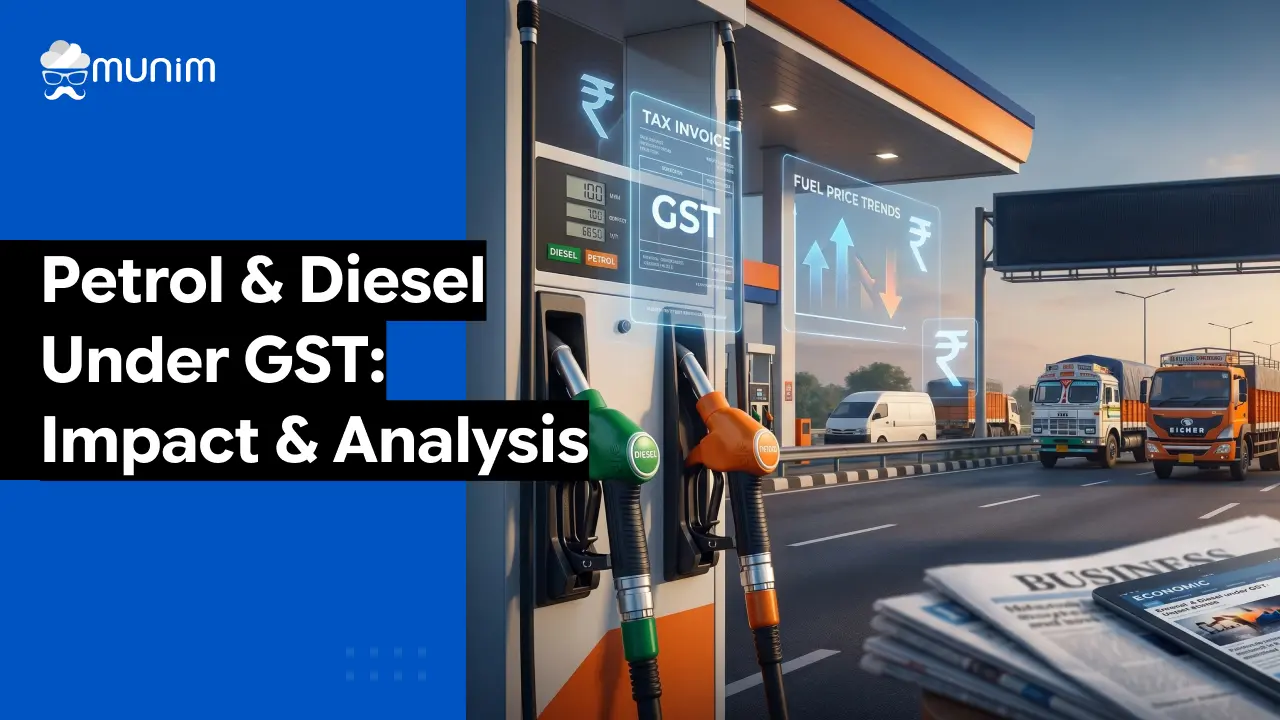
Fuel prices dictate the cost of doing business. From logistics to manufacturing, crude oil rates impact every supply chain. This makes the debate around GST on petrol and diesel highly relevant today.
Industry leaders are urging the GST Council to act. Bringing petroleum products under a unified tax system would reshape the economy.
But how exactly will this shift alter business operations? Let us break down the current rules, expected rates, and the massive financial impact on businesses.
Is GST Applicable on Petrol and Diesel Today?
No. As of 2026, petroleum crude, motor spirit (petrol), high-speed diesel, aviation turbine fuel, and natural gas remain outside the GST framework.
When India rolled out its new tax regime, the Constitution (101st Amendment) Act specifically excluded five items: petroleum crude, motor spirit (petrol), high-speed diesel, aviation turbine fuel (ATF), and natural gas.
Legally, under Article 279A(5) of the Constitution read with Section 9(2) of the CGST Act, these five fuels will only be brought under the GST net from a date formally recommended by the GST Council.
Until that Council decision and subsequent legal amendments occur, fuel remains taxed under an older, dual-tax system. It comprises separate statutory levies.
The Central Government imposes Central Excise Duty (often a fixed amount per litre) under central laws. Entirely separate from this, individual State Governments impose their own State VAT or Sales Tax under state-specific laws.
Crucially, in most states, VAT is calculated ad valorem on the base price plus the central excise duty. This creates a severe “tax-on-tax” cascading effect. It inflates the final retail price significantly and leads to wildly different fuel costs across state borders.
Designed for Modern Tax Professionals
A premium filing solution for CAs and tax consultants who need speed, scale, and operational clarity.
 Handle multiple clients with ease
- Reconcile and validate with confidence
- Overcome the limitations of the GST portal
 Handle multiple clients with ease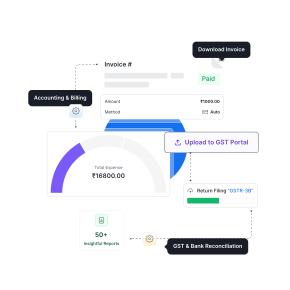
Anticipating the Petrol GST Rate in India
If the GST Council finally brings fuel into the new system, setting the tax bracket is the next major hurdle. Tax experts are actively modeling what the petrol GST rate in India might look like under the updated GST rate slabs.
If fuel is brought into the GST system, there are two likely scenarios:
1. 18% GST – Standard Tax Rate:
If the government sets the petrol GST rate at the standard 18%, fuel prices would drop dramatically. This would offer immense financial relief to commercial buyers and transport fleets.
2. 40% GST – High Tax Rate:
A more realistic scenario places GST on diesel and petrol in the highest 40% bracket to protect government revenue. However, even at 40%, removing the cascading VAT effect means the final retail price will likely fall below current levels.
The “Revenue-Neutral” Catch: Could GST Reach 80% to 100%?
State and central governments cannot afford a massive revenue drop. To bring fuel under GST without losing money, lawmakers might engineer a “revenue-neutral rate” that effectively taxes fuel at 80% to 100% to match current prices.
Legally, they cannot just create an 80% standard GST slab. Instead, they would likely place fuel in the 40% slab and attach a massive GST Compensation Cess to make up the difference.
This exact strategy is used for “sin goods” like tobacco and pan masala, where the total tax burden far exceeds the base GST rate. In this scenario, the sticker price of fuel at the pump would remain exactly the same as it is today.
The ITC Trap: What if Businesses Cannot Claim Credit?
The biggest promised benefit of bringing fuel under GST is the ability to claim Input Tax Credit (ITC). But what if the government blocks it? If fuel is taxed via a heavy Compensation Cess (similar to tobacco), there is a major catch.
Under the Indian GST law, Compensation Cess is ring-fenced. You cannot use it to offset GST liabilities. You can only use Compensation Cess ITC to offset an output liability of Compensation Cess. A standard manufacturing or logistics company does not collect cess on its sales. Therefore, the massive cess paid on fuel would remain a sunk cost.
Further, the government could legally restrict fuel credits entirely. Section 17(5) of the CGST Act already blocks ITC on specific business expenses, such as passenger vehicles, food, and beverages.
If lawmakers add petroleum products to the Section 17(5) blocked credit list, businesses would not be allowed to claim standard ITC on fuel at all. If this happens, the transition to GST would offer almost zero financial benefit to corporate supply chains.
How Businesses Will Benefit?
Assuming the government does not block credits, moving fuel into the GST net would completely overhaul corporate operations. Here are the critical benefits.
1. Unlocking Input Tax Credit (ITC)
If full ITC is allowed, it would be the biggest potential win for businesses. Currently, commercial fuel buyers cannot claim an Input Tax Credit. The excise duty and VAT paid on fuel become a permanent, sunk cost.
If fuel falls under GST, registered businesses can claim ITC on their fuel expenses. They can offset the GST paid on fuel against the GST collected on their final products. This directly improves cash flow and profit margins.
2. Eliminating the Cascading Tax Effect
The current structure forces buyers to pay state VAT on top of central excise duties. Bringing fuel under GST eliminates this anomaly instantly. To understand how direct tax and indirect tax interact differently, it helps to compare how cascading works under the old regime versus the single-tax GST structure.
A single, transparent tax is applied to the base value. Businesses are taxed only on the actual value of the fuel, wiping out unnecessary layers of taxation.
3. Improved Interstate Logistics
Varying state taxes force truck drivers to plan specific refueling stops across state borders just to save money. This causes route delays and massive inefficiencies.
A nationwide petrol GST rate guarantees almost uniform pricing across all states (with minor differences due to freight cost). Logistics companies can optimise travel routes based on distance rather than state borders. This improves supply chain speed and lowers freight costs.
4. Reduced Inflation and Production Costs
Fuel drives the cost of freight. Freight directly impacts the price of raw materials and finished goods.
Lowering fuel prices through GST will significantly reduce transportation costs. This creates a ripple effect, lowering the final retail prices of FMCG products, electronics, and agricultural goods. Ultimately, it helps control broader economic inflation.
5. Simplified Tax Compliance
Managing separate state VAT returns alongside central GST filings is a major administrative headache for accounting departments.
Integrating fuel into the GST system centralises compliance. Companies can track, manage, and report their fuel expenses on the exact same GST portal they use for all other business transactions.
The Roadblock: Why is Fuel Still Outside GST?
If the business benefits are so overwhelmingly clear, why the delay? The primary obstacle is state government revenue.
State governments rely heavily on fuel VAT to fund their annual budgets. It is one of the very few areas where they retain complete pricing control. Agreeing to a unified GST forces states to surrender this financial autonomy.
The Bottom Line
Taxes on petroleum products make up a large chunk of revenue for many state governments. So, GST on petrol and diesel is unlikely until the central government guarantees a long-term revenue compensation plan for the states.
An inclusion into GST will only be beneficial if it comes with the unrestricted right to claim Input Tax Credit. So, when it finally does transition, businesses must watch the fine print closely.
Frequently Asked Questions (FAQs)
What will happen to fuel prices if petrol and diesel are brought under GST?
Prices would likely drop and become almost uniform across India. The current system applies state VAT on top of central excise duties, creating a cascading “tax-on-tax” effect. GST would replace this with a single, transparent tax, stabilising fuel costs.
Can businesses claim Input Tax Credit (ITC) on fuel expenses?
Currently, no. Because fuel is taxed under excise and VAT, the taxes paid are a sunk cost. If moved to GST, registered businesses may claim ITC to offset their output tax. However, the government can legally restrict this by adding fuel to the blocked credit list under Section 17(5).
How much tax do we currently pay on 1 litre of petrol?
Taxes generally make up over 50% of the retail price of petrol. This is a combination of Central Excise Duty (which varies based on central cuts) and State VAT. VAT is calculated as a percentage of the base price plus excise duty. So, the tax burden varies widely across states.
Which 5 petroleum products are currently kept out of GST?
When the GST Act was introduced, five petroleum products were kept outside its scope under transitional provisions agreed by the GST council:
- Petroleum Crude
- Motor Spirit (Petrol)
- High-Speed Diesel
- Aviation Turbine Fuel (ATF)
- Natural Gas
Why are petrol and diesel still not included in the GST framework?
State governments heavily rely on fuel VAT for their independent tax revenue. Moving fuel to a unified GST forces states to surrender their ability to adjust fuel taxes. Until the central government guarantees long-term revenue compensation, states will likely oppose the move.
What would be the likely GST on petrol and diesel?
Under the simplified 2026 GST 2.0 structure, GST on petrol and diesel would likely fall into the standard 18% slab or the highest 40% slab. However, it is unlikely to happen unless the centre compensates for the potential revenue loss to states.
Will bringing fuel under GST eliminate State VAT?
Yes. A unified GST structure would entirely replace both the Central Excise Duty and individual State VAT, resulting in a single nationwide tax system for fuel.
Could the government use a Compensation Cess on fuel?
Yes. To avoid massive revenue losses, the GST Council could place fuel in the 40% luxury/demerit slab and attach a heavy Compensation Cess. This would keep the final retail price roughly the same as it is today while still technically bringing it under the GST umbrella.
Disclaimer: "This blog post is for informational purposes only. For specific tax advice related to your business, please consult a qualified Chartered Accountant or GST practitioner."
About the author

Jayant is a senior content writer and digital marketer, known for his extensive experience in commercial SEO writing, blog content, website copy, and B2B communication. Since 2019, he has worked on diverse freelance projects across industries. His portfolio includes articles, landing pages, social media content, and web development collaborations. Blending clarity, creativity, and strategic messaging, he specialises in crafting professional, audience-focused content for themunim.com.
Related Articles
Explore the latest market news, useful resources for business, and Munim updates.