GSTR-9 and GSTR-9c: What’s the Difference Between These Annual GST Forms?
 AuthorPriyanka Chaudhari
 Reviewed ByCA Madhav Bhayani



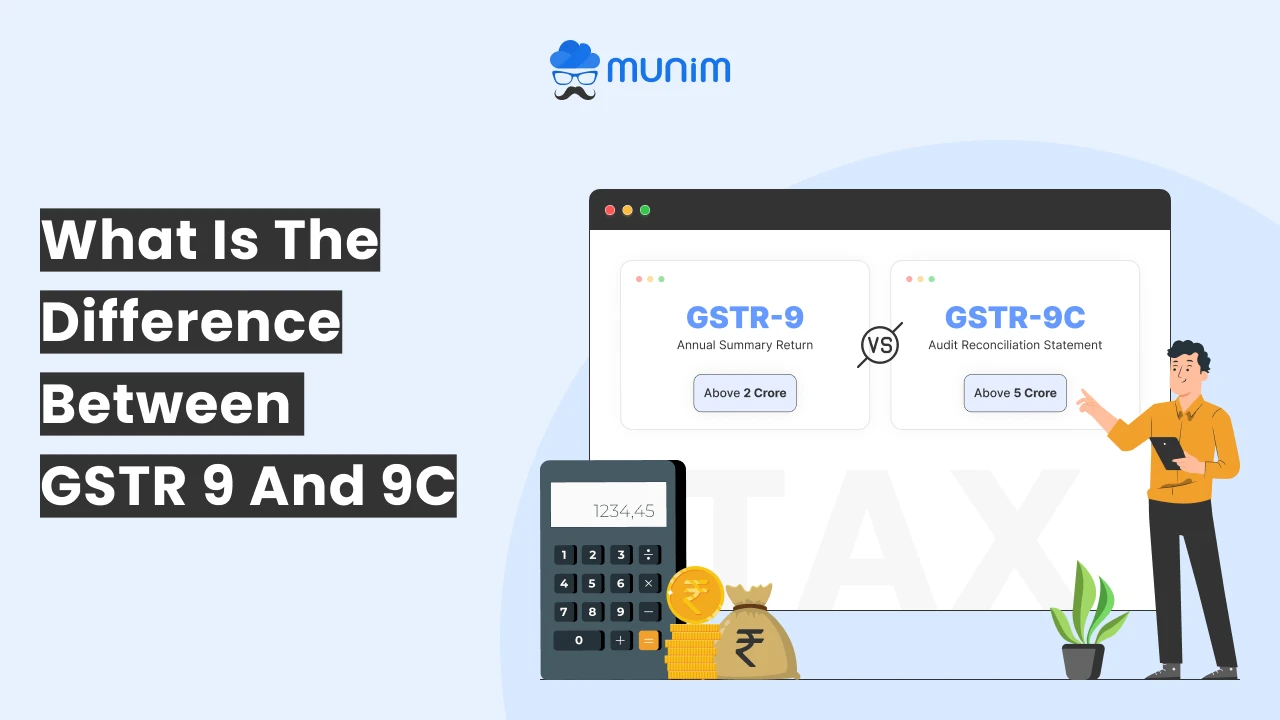
Filing returns annually can be confusing as it caters to multiple forms and compliance regulations. Out of which, GSTR 9 and 9C are the two commonly known annual return filing forms.
As the annual return filing due dates approach, most of us get confused about which form to file and what is the difference between 9 and 9C. Though both are filed annually, they serve different purposes.
Let’s scroll down to understand the difference between the two and their definitions.
Introduction to GSTR 9 and GSTR 9C
What is GSTR 9? (Meaning & Purpose)
GSTR-9 refers to the annual return filing form, which is to be filed by all the regular taxpayers except those who are exempted from filing. It is filed once every year.
GSTR 9 consolidates the summary of all monthly/ quarterly filings like GSTR-1 and GSTR-3B filed in the respective financial year. It offers a complete overview of outward and inward supplies, ITCs, taxes paid, as well as adjustments made for the financial year.
What is GSTR 9C? (Meaning & Purpose)
GSTR-9C refers to the reconciliation statement, which is filed along with GSTR-9 by a few taxpayers whose turnover limit exceeds ₹5 crore.
It is an audit form that validates the numbers specified in the form GSTR 9 with the figures from the audited financial statements.
What is the Difference between GSTR-9 and 9C?
Now, as we have understood the difference in their definitions, it is time to understand how GSTR 9 and GSTR 9C differ in turnover ratios, applicability, type, purpose, and more. Let’s check out the difference right away!
| Differential Category | GSTR 9 | GSTR 9C |
| Type of Form | Annual return filing form | Reconciliation Statement |
| Nature of forms GSTR 9 and 9C | It a consolidation of monthly and quarterly returns | It is an analytical statement for that checks if the entered figures are accurate |
| GSTR 9 and 9C turnover limit | For GSTR 9 the turnover limit is ₹2Cr | For GSTR 9C the turnover limit is ₹5Cr |
| GSTR 9 and 9C applicability | Normal registered taxpayer | Registered taxpayer with turnover exceeding ₹5Cr |
| Not Applicable to | Composition Scheme Holders Casual Taxable Individuals Input Service Distributor Individuals with Unique Identification Number OIDAR service providers Individuals leveraging TCS and TDS facility | Not applicable to the ones mentioned under GSTR 9 along with the individuals having turnover below ₹5Cr |
| Filing Due Date for GSTR 9 and 9C | 31st December of next financial year | 31st December of next financial year or after filing GSTR 9 |
| Late Fees and Penalties | For businesses with turnover up to ₹5Cr, ₹50/day (₹25 for CGST and ₹25 SGST) For business whose turnover exceeds ₹5Cr and is less than ₹20Cr, Late fee applied is ₹100 (₹50 for CGST and ₹50 for SGST) For business with turnover above ₹20Cr, late fee is ₹200 (₹100 for CGST and ₹100 for SGST) | There’s no segmentation of penalties, a generic penalty of ₹25000 is applied. |
| Medium for return filing | GSTR 9 can be filed through the GST portal or nearby offline centers | GSTR 9C can be filed through GST portal or offline centers |
| Return filing format for GSTR 9 and 9C | It includes consolidated summary of turnover, ITCs, late fees if applicable, and adjustments made for the financial year. Also, details like demands/ refunds, supply information from composition dealers, job works, goods traded on approvals, HSN summary, and late fees applicable should be stated wherever needed. | Part A caters to turnovers, taxes paid, and ITCs. Record additional tax liabilities. Part B: Self-certificate from CFO or finance head |
| Who should certify the form | No certification needed for GSTR 9 | CFO or finance head needs to attest sign it |
| Annexures to be attached for GSTR 9 and 9C | No need to attach annexures | Proof of financial statements should be attached. |
Filing GSTR 9 and 9C Easily with Munim
Say goodbye to 9 and 9C filing hassles right away. Here’s what Munim offers for GSTR 9 and 9C filing:
- Auto-data population from GSTR-3B
- Clear bifurcation of demands and refunds
- HSN validation with ease
- ITC reconciliation
- GSTR 9 and GSTR 9C filing with just a few clicks
& More…
Want to know more about Munim? Click here.
Conclusion
GSTR 9 and 9C differ from each other in applicability, penalties, purpose, annexures, and more. While GSTR 9 summarizes monthly / quarterly returns, GSTR 9C is a reconciliation form. Filing them accurately ensures compliance with GST norms, but before moving ahead, you need to understand the difference between 9 and 9C.
Hopefully, this blog has helped you to differentiate between the two forms. Save the blog and stay tuned until we publish the next one.
Related GST Blog
FAQs on GSTR 9 and 9C
1. Are GSTR 9 and 9C same?
No, GSTR 9 and 9C are different from each other and serve different purposes.
2. Is filing GSTR 9 and GSTR 9C mandatory?
Yes, GSTR 9 is mandatory for all regular taxpayers, while GSTR 9C is mandatory for taxpayers exceeding turnover above ₹5Cr.
3. What are the threshold limits for GSTR 9 and 9C?
The threshold limit for GSTR 9 is ₹2Cr while for GSTR 9C is ₹5Cr.
4. What is the difference between 9 and 9C in terms of their objective?
GSTR 9 maintains accuracy in its annual GST summary while GSTR 9C ensures credibility in the GST data.
5. Who prepares form GSTR 9 and GSTR 9C?
Taxpayers prepare form GSTR 9 and CAs prepare form GSTR 9C.
Disclaimer: "This blog post is for informational purposes only. For specific tax advice related to your business, please consult a qualified Chartered Accountant or GST practitioner."
About the author
Related Articles
Explore the latest market news, useful resources for business, and Munim updates.