How to Keep Track of Business Expenses: 7 Easy Steps for Indian Owners
 AuthorJayant Surana
 Reviewed ByAjay Savani




Summary:
Stop letting messy paper receipts turn your tax season into a massive headache. Start by opening a dedicated business account to keep your finances separate. Next, choose one simple tracking spreadsheet and update it every single Friday. Spending fifteen minutes on this habit catches costly errors before they multiply. Finally, back up those digital financial records safely for six full years. Mastering these simple steps guarantees a much calmer and richer financial future.
India has over 7.85 crore registered MSMEs. Most of these businesses run on one busy person’s energy. That person rarely has a dedicated finance team. Receipts pile up. Small payments slip away. Tax season turns into a scramble. Sound familiar?
Learning how to keep track of business expenses fixes that faster than you’d expect. It protects both your profit margins and your peace of mind. This guide stays simple and practical. No accounting degree is required. Let’s make expense tracking feel easy, not scary.
Why Tracking Expenses Matters More Than You Think?
Money leaks quietly when nobody is watching. A forgotten cab bill here. An unrecorded supplier payment there. It adds up fast over a financial year.
Beyond profit, there is a legal angle. Good tracking is not optional; it is protection.
- Income Tax Act (Section 44AA): For individuals and freelancers, books must be maintained if your income crosses ₹2.5 lakh or turnover crosses ₹25 lakh in any of the three preceding years (the limit is ₹1.2 lakh / ₹10 lakh for corporate firms).
- Penalty Risks (Section 271A): Failing to maintain these records can attract a penalty of up to ₹25,000.
- Retention Rules: Tax law expects you to retain books for six years from the end of the relevant assessment year. (Note: If you are registered as a company, the Companies Act requires keeping records for 8 years).
How to Keep Track of Business Expenses in 7 Easy Steps?
Knowing how to keep track of business expenses comes down to a simple routine. Follow these seven actionable steps to build a routine that takes minutes, not hours.
Step 1: Separate Business and Personal Money
Open a dedicated business bank account immediately. Run every business rupee through it. Personal lunches stay on your personal card. Your bank statements will instantly become a clean expense record.
Step 2: Save Every Receipt Digitally
Paper receipts fade and get lost. Photograph each one the moment you get it. Store the images in a cloud folder. Name them by date and vendor. Income tax rules accept electronic records, making digital copies perfectly valid for audits.
If you didn’t get a receipt from a vendor, create a cash voucher. Just write the date, amount, and purpose on a slip of paper, sign it, and snap a photo of that. Income tax rules accept these electronic records.
Step 3: Pick One Tracking Method and Stick to It
Don’t juggle five apps at once. Choose one place to log spending. If you need a How to keep track of business expenses spreadsheet, starting with a basic template beats paying for fancy software early on. Consistency matters more than the tool.
Step 4: Categorise Every Expense
Group your spending into clear buckets. Use categories like rent, salaries, travel, supplies, software, and marketing. This is the best way to figure out how to keep track of expenses for small business operations and spot wasted money quickly.
Step 5: Set a Weekly Money Date
Block out 15 minutes every Friday. Memory fades fast. Log the week’s expenses while the context is still fresh in your mind. Building this weekly rhythm prevents the dreaded month-end backlog and turns financial tracking into a quick, stress-free habit.
Simplify Your Business Operations
Designed to give you speed, control, and accuracy in daily accounting tasks.
 Save time with automated accounting workflows
- Get 35+ detailed business reports easily
- Access your business anytime, anywhere
 Save time with automated accounting workflows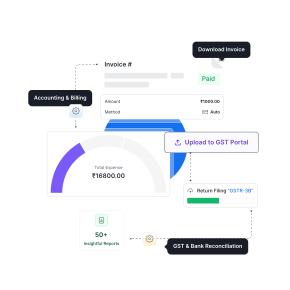
Step 6: Reconcile With Your Bank
Match your internal records against your bank statement every month. Tick off what matches. Investigate anything that doesn’t. This catches double charges, missed entries, and fraud.
Step 7: Keep Records for Six To Eight Years
Tax law expects you to retain books for six years. (Note: If your business is registered as a Company, the Companies Act requires keeping records for eight years).
Store backups in two places. One on cloud, and another one on drive. Future-you will thank present-you during any scrutiny. For an in-depth routine, see our guide on how to manage your business expenses end-to-end.
A Real Example: Meera’s Boutique in India
Meera runs a small clothing boutique in India. Her monthly expenses hover around ₹2,40,000. For years, she ignored small cash purchases. Thread, packaging, courier charges, chai for staff.
When she finally started categorising, the picture shocked her. Roughly ₹18,000 each month went untracked. Over a year, that’s ₹2,16,000 in costs she could have recorded and claimed. That’s real money lost to messy habits. Her fix took one spreadsheet and ten minutes a day.
Spreadsheet vs App: Which Should You Choose?
Both methods work well. Your current business stage decides the winner.
| Feature | Spreadsheet | Expense Tracking App |
| Best For | Freelancers and early-stage setups | Growing businesses and GST-registered firms |
| Cost | Free | Monthly/Annual Subscription |
| Learning Curve | Very low | Moderate |
| Automation | Manual entry required | Auto-imports bank feeds and categorises them |
| Reporting | Build your own charts | Automated profit/loss and tax reports |
A spreadsheet is free, flexible, and fast to learn. Columns for date, vendor, category, amount, and payment mode are enough to get started.
Apps shine as you scale. Once you cross GST registration limits (turnover exceeding ₹40 lakh for goods or ₹20 lakh for services in most states), automation saves hours of administrative work. Start simple, then upgrade.
Conclusion
Expense tracking is not glamorous, but it is powerful. It guards your profit, simplifies tax filing, and keeps you legally compliant. Start with a separate bank account today. Pick one method and review it weekly.
Properly recording your expenses with valid GST invoices is the only way to claim Input Tax Credit (ITC) and directly reduce your tax liability.
Mastering how to keep track of business expenses really is this straightforward. Begin with a single spreadsheet this week to reclaim your weekends and organise your finances.
Frequently Asked Questions (FAQs)
How do I start tracking business expenses with no accounting knowledge?
Open a separate business account, save every receipt digitally, and log spending in one place weekly. That covers how to keep track of expenses for small business owners with zero finance background.
Is a spreadsheet good enough for a small business?
Yes, especially in the early stages. A basic sheet with columns for date, vendor, category, and amount works perfectly. Many owners use a simple spreadsheet template before ever buying dedicated software.
How long must I keep my expense records in India?
You must keep your financial records for six years from the end of the relevant assessment year, as required under the Income Tax Act. Digital backups are highly recommended.
When does my business need GST registration?
Generally, registration is required when turnover crosses ₹40 lakh for goods or ₹20 lakh for services in normal-category states. Lower limits apply in special-category states.
How often should I review my expenses?
Weekly logging combined with a monthly bank reconciliation is the ideal routine. It keeps your financial records fresh and catches accounting errors early.
What is the easiest way to keep track of business expenses?
The easiest way to keep track of business expenses is to open a dedicated business bank account. Keep logging your spending in a simple spreadsheet every week. This routine takes just minutes a day and requires no complex software.
What are 5 examples of a business expense?
Five common examples of business expenses include office rent, employee salaries, monthly software subscriptions, business travel, and marketing costs. Essentially, any everyday operational cost incurred wholly to keep your business running counts as a valid expense.
What business expenses are 100% tax deductible in India?
Under the Income Tax Act, everyday operational costs incurred wholly for your business are generally 100% deductible. These include rent, salaries, and utility bills. Always verify specific deductions with your Chartered Accountant to ensure legal compliance.
How do small businesses keep track of receipts?
Small businesses efficiently track receipts by taking a snap immediately after a purchase and storing it in a dedicated cloud folder. As they scale, many upgrade to receipt-scanning apps that automatically extract the transaction date and amount.
Disclaimer: "This blog post is for informational purposes only. For specific tax advice related to your business, please consult a qualified Chartered Accountant or GST practitioner."
About the author

Jayant is a senior content writer and digital marketer, known for his extensive experience in commercial SEO writing, blog content, website copy, and B2B communication. Since 2019, he has worked on diverse freelance projects across industries. His portfolio includes articles, landing pages, social media content, and web development collaborations. Blending clarity, creativity, and strategic messaging, he specialises in crafting professional, audience-focused content for themunim.com.
Related Articles
Explore the latest market news, useful resources for business, and Munim updates.