How to Open a Pharmacy or Medical Store in India: A Complete Step-by-Step Guide
 AuthorMehul Jagwani
 Reviewed ByMadhav Bhayani



- What Documents Are Required to Apply for a Drug Licence?
- Step-by-Step Process: How to Open a Medical Store in India
- What Are the Educational Qualifications Required to Open a Medical Store?
- What Licences Are Required to Open a Pharmacy in India?
- What Are the Infrastructure Requirements for a Medical Store?
- How Much Does It Cost to Open a Medical Store in India?
- Conclusion
- Frequently Asked Questions (FAQs)

Summary:
Opening a pharmacy or medical store in India involves obtaining a Drug Licence from the State Drug Control Department, registering the business entity, securing GST registration, and hiring a qualified pharmacist. The store must meet minimum area and infrastructure requirements under the Drugs and Cosmetics Act, 1940.
For anyone thinking about how to open a medical store in India, the timing is genuinely favourable. Yet this is not a business one can set up overnight. Strict regulatory requirements govern every aspect – from the qualifications of the staff to the temperature of the storage unit. This guide covers everything needed to start a pharmacy store in India, legally and efficiently.
What Documents Are Required to Apply for a Drug Licence?
Having complete documentation speeds up the approval process significantly. Below is a standard document checklist.
- Completed application forms (Form 19, 20, and 21 for retail)
- Key plan and site plan of the premises
- Rental agreement or ownership proof of the shop
- Identity proof and address proof of the proprietor or partners
- Pharmacist’s registration certificate from the State Pharmacy Council or PCI
- Affidavit from the proprietor and the pharmacist
- Proof of refrigerator purchase (invoice or bill)
- Partnership deed or MOA and AOA (for firms and companies)
- Passport-size photographs of the applicant and pharmacist
Editorial note: Document requirements may vary by state. Always verify with the local State Drug Control Department before submitting the application.
Step-by-Step Process: How to Open a Medical Store in India
Here is a practical, sequential breakdown of the process.
Step 1: Decide the Business Structure Choose between sole proprietorship, partnership, LLP, or private limited company. Register the entity with the appropriate authority.
Step 2: Finalise the Premises Select a commercial space that meets the minimum area requirements. Ensure proper ventilation, shelving, and refrigeration facilities are in place. Secure a rental agreement if the space is leased.
Step 3: Hire a Registered Pharmacist If the owner does not hold a pharmacy degree, hire a pharmacist who is registered with PCI and the State Pharmacy Council. Their documents will form part of the drug licence application.
Step 4: Apply for the Drug Licence Visit the State Drug Control Department portal or office. Submit the application with all required documents. A drug inspector will inspect the premises before the licence is approved. Approval typically takes 30 to 60 days.
Step 5: Register for GST Apply for GST registration on the GST portal (gstin.gov.in). Submit the required documents including PAN, Aadhaar, business incorporation certificate, and proof of premises. Once registered, ensure GSTR-1 and GSTR-3B are filed on time every month.
Step 6: Obtain the Shop and Establishment Licence Register with the local municipal authority under the state’s Shop and Establishment Act.
Step 7: Source Medicine Stock Partner only with licensed wholesalers and authorised distributors. Maintain proper purchase records and invoices. Stock medicines in line with the licence category — allopathic, ayurvedic, surgical, or a combination.
Step 8: Set Up Billing and Accounting A pharmacy generates hundreds of transactions daily. Maintain proper sales records, purchase registers, and prescription logs. These records are subject to drug inspector inspections at any time. Using a cloud-based accounting and billing software from the outset helps maintain accurate books, track inventory, and stay GST-compliant without manual errors.
What Are the Educational Qualifications Required to Open a Medical Store?
This is one of the most frequently asked questions among first-time pharmacy entrepreneurs. The short answer: a registered pharmacist must be present during working hours. This is a non-negotiable legal requirement.
For a retail pharmacy, the sale of medicines must take place only in the presence of a registered pharmacist during operational hours. For a wholesale pharmacy, a registered pharmacist must oversee all transactions.
Who qualifies as a registered pharmacist?
- A holder of a D.Pharm (Diploma in Pharmacy) degree
- A holder of a B.Pharm or M.Pharm degree
- A graduate with at least one year of experience in drug sales (in certain states and specific conditions)
All practising pharmacists must be registered with the Pharmacy Council of India (PCI) and the relevant State Pharmacy Council. Registration without a valid PCI certificate is not permitted. If the business owner does not hold a pharmacy degree personally, they must hire a qualified, registered pharmacist to be present at the store.
Simplify Your Business Operations
Designed to give you speed, control, and accuracy in daily accounting tasks.
 Save time with automated accounting workflows
- Get 35+ detailed business reports easily
- Access your business anytime, anywhere
 Save time with automated accounting workflows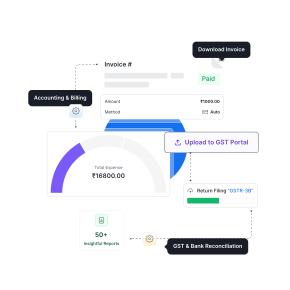
What Licences Are Required to Open a Pharmacy in India?
Licences are the backbone of a pharmacy business. Operating without valid licences is illegal and can result in heavy penalties or shutdown. Here are the primary licences required.
Drug Licence (Retail or Wholesale)
Issued by the State Drug Control Department (SDCO) or State Drug Controller, this is the single most important document. There are two types:
- Form 20 and Form 21 for retail drug licences (covering allopathic and restricted medicines respectively)
- Form 20B and Form 21B for wholesale drug licences
The licence is valid for five years and must be renewed before expiry. Fees typically range between Rs. 3,000 to Rs. 5,000, depending on the state and type of licence.
Shop and Establishment Licence
This is obtained from the local municipal authority or the state labour department. It is required for any commercial establishment and is typically one of the first registrations to complete.
Business Entity Registration
A pharmacy can be set up as:
- Sole Proprietorship — simplest structure, suitable for a standalone store
- Partnership Firm — common for two or more co-founders
- LLP (Limited Liability Partnership) — offers liability protection with operational simplicity
- Private Limited Company — suitable for chain pharmacies or investor-backed ventures
Standalone and township medical stores are generally set up as sole proprietorships or partnership firms. Hospital pharmacies and chain models tend to incorporate as companies or LLPs.
GST Registration
Any pharmacy with an annual turnover exceeding Rs. 40 lakh (Rs. 20 lakh for special category states) must register under GST. In practice, most pharmacies register proactively since they purchase medicine stock from GST-registered distributors and must claim Input Tax Credit (ITC).
What Are the Infrastructure Requirements for a Medical Store?
The Drugs and Cosmetics Act lays down clear physical requirements. Meeting them is not optional — a drug inspector will inspect the premises before issuing the licence.
Minimum Area
- Retail pharmacy: 10 square metres
- Retail and wholesale combined: 15 square metres
Storage and Equipment
- A refrigerator or air conditioner is mandatory. Certain medicines such as vaccines, insulin injections, and sera must be stored between 2°C and 8°C. Without a refrigerator, the licence will not be issued.
- Proper shelving and storage cabinets for organised medicine stock
- A counter with adequate space for dispensing
Premises Compliance
- The shop must be a commercial premises with a valid rental agreement or ownership proof
- A layout plan (key plan and site plan) must be submitted with the drug licence application
- The premises must be clean, well-ventilated, and free from pest infestation
How Much Does It Cost to Open a Medical Store in India?
Investment varies significantly based on city tier and store size.
- Small retail store in a semi-urban or Tier 2 city: Rs. 3 to 5 lakh
- Medium store in a Tier 1 or metro city: Rs. 8 to 15 lakh or more
- Licensing and registration costs: Rs. 50,000 to Rs. 1 lakh approximately (drug licence fees, GST registration, business registration)
The major cost heads include shop rent, interior fit-out and shelving, refrigeration unit, initial medicine stock, billing software, and employee salary (especially if hiring a pharmacist). In metropolitan cities, prime location rent alone can push the total investment higher.
Conclusion
Opening a pharmacy or medical store in India in 2026 is a structured process, but it is absolutely manageable with the right preparation. The key is getting the sequence right: decide the business structure, secure the premises, ensure pharmacist credentials are in order, apply for the Drug Licence, register for GST, and set up clean operational systems from day one.
Once the store is live, managing the financial side cleanly matters just as much as the regulatory side. From GST filings and ITC claims to daily billing and purchase records, keeping the books accurate is non-negotiable.
Frequently Asked Questions (FAQs)
Can a person without a pharmacy degree open a medical store?
Yes, but they must hire a qualified pharmacist who is registered with PCI.
Is GST registration mandatory for a pharmacy?
Yes, if the annual turnover exceeds Rs. 40 lakh (Rs. 20 lakh for special category states).
Does a pharmacy need to file GST returns every month?
Yes. Most pharmacies file GSTR-1 and GSTR-3B on a monthly basis. Small businesses with turnover below Rs. 5 crore may opt for quarterly GSTR-1 filing under the QRMP scheme, though GSTR-3B remains monthly.
Disclaimer: "This blog post is for informational purposes only. For specific tax advice related to your business, please consult a qualified Chartered Accountant or GST practitioner."
About the author

Mehul is a seasoned content writer with a passion for simplifying complex accounting and GST topics. With a keen interest in entrepreneurship and business management, he specializes in creating informative and engaging content for themunim.com. His goal is to help businesses understand and implement accounting and GST software solutions effectively. When he's not crafting content, Mehul enjoys exploring new places and spending time with his Golden Retriever.
Related Articles
Explore the latest market news, useful resources for business, and Munim updates.