
Form 183 Under the Income Tax Act, 2025: Complete Guide for Oil and Gas Businesses
 AuthorMehul Jagwani
 Reviewed ByMadhav Bhayani



- What Is Form 183 Under the Income Tax Act, 2025?
- Who Needs to File Form 183?
- Is Filing Form 183 Compulsory?
- What Is the Due Date for Filing Form 183?
- Structure of Form 183: What Are the Different Parts?
- What Documents Are Required to Prepare Form 183?
- Final Thoughts
- FAQs on Form 183 Under the Income Tax Act, 2025
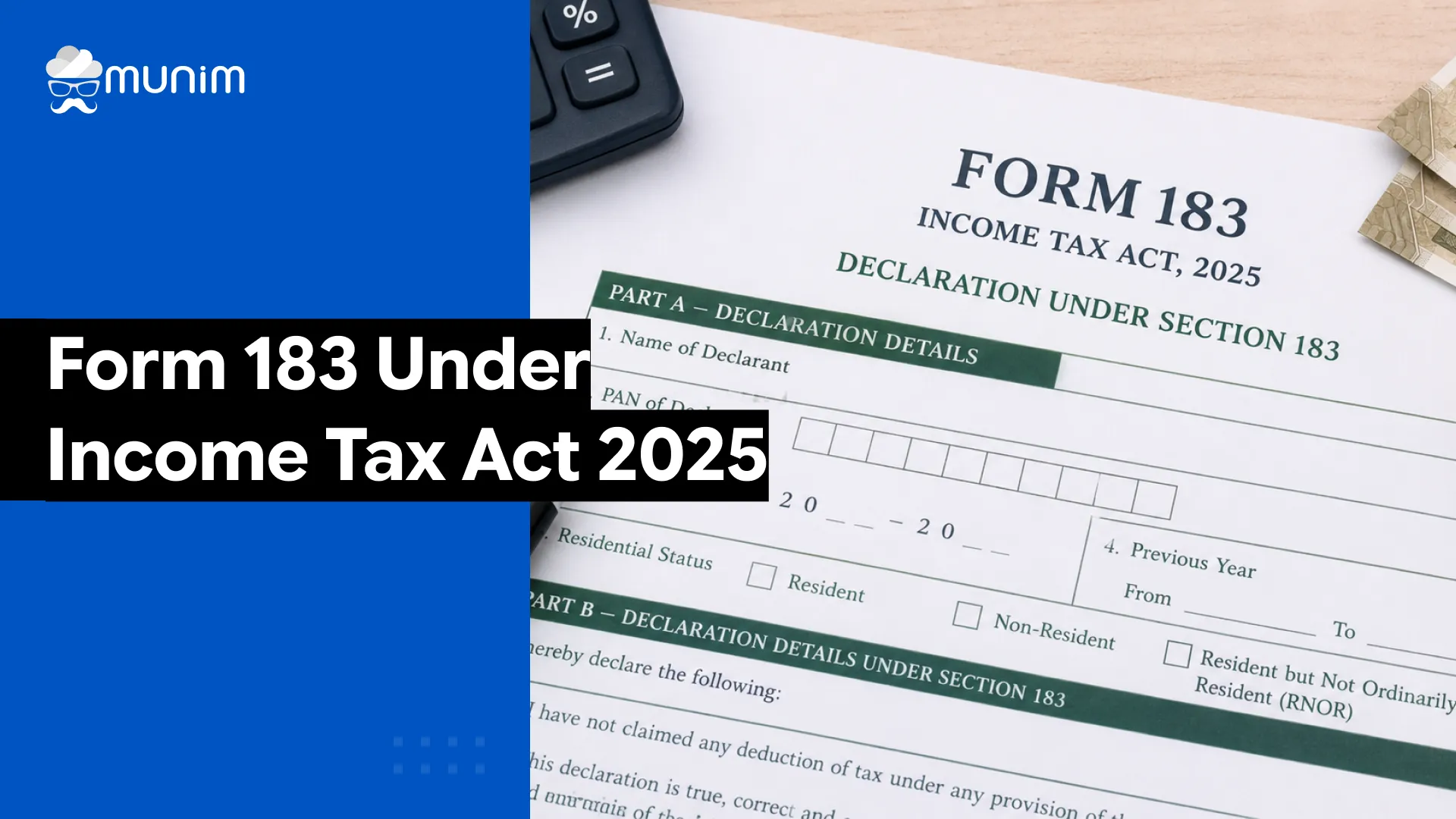
The Income Tax Act, 2025 introduced several new compliance forms, and Form 183 is one that directly impacts businesses operating in India’s petroleum and natural gas sector. If an assessee is engaged in prospecting, extracting, or producing petroleum or natural gas and wishes to claim a deduction under Section 49, filing Form 183 is not optional. It is a mandatory audit report, and skipping it means the deduction gets rejected outright.
This guide breaks down everything: what Form 183 is, who files it, how the process works, and what documents are needed. Whether the reader is a Chartered Accountant handling such audits or a business owner in the oil and gas space, this article covers it all clearly.
What Is Form 183 Under the Income Tax Act, 2025?
Form 183 is an audit report prescribed under Rule 291 of the Income Tax Rules, 2026, read with Section 49 of the Income Tax Act, 2025. In plain terms, it is the official document through which a Chartered Accountant certifies that an oil and gas business has correctly claimed its deduction — and that the claim does not exceed the allowable 20% of profits from such business under the head “Profits and Gains of Business or Profession.”
Who Needs to File Form 183?
The filing obligation under Form 183 applies to assessees engaged in the business of prospecting, extracting, or producing petroleum, natural gas, or both in India, provided they are claiming a deduction under Section 49.
In practice, this includes:
- Companies and firms involved in oil and gas exploration or production in India
- Joint ventures and consortiums operating under petroleum exploration licenses
- Any taxpayer under the Income Tax Act, 2025 who deposits funds into a “specified account” and claims a deduction for the same
Designed for Modern Tax Professionals
A premium filing solution for CAs and tax consultants who need speed, scale, and operational clarity.
 Handle multiple clients with ease
- Reconcile and validate with confidence
- Overcome the limitations of the GST portal
 Handle multiple clients with ease
Is Filing Form 183 Compulsory?
Yes, absolutely. Filing Form 183 is mandatory if deduction under Section 49 is being claimed. There is no discretion here. If the audit report in Form 183 is not furnished before the due date, the Income Tax Department will not allow the deduction at all.
What Is the Due Date for Filing Form 183?
Form 183 must be filed annually, one month before the due date for furnishing the return of income under Section 263(1) of the Income Tax Act, 2025.
Structure of Form 183: What Are the Different Parts?
Form 183 is divided into four parts, each serving a distinct purpose:
Part A (previously Part I): Audit report for cases where the assessee’s accounts have already been audited under any other law (for example, under the Companies Act, 2013 or any other applicable statute).
Part B (previously Part II): Audit report for cases where the accounts have not been audited under any other law and the audit is being conducted specifically under Section 49 of the Income Tax Act, 2025.
Part C: Particulars of the assessee — basic identification information including PAN, name, and relevant business details.
Part D (previously Part III): The detailed Statement of Claim of Deduction under Section 49, which includes:
- Accounting information: books of account examined, method of accounting followed, whether separate accounts are maintained for the petroleum/gas business
- Deposit information: amounts deposited into the specified account within the prescribed time
- Withdrawal information: amounts withdrawn, purpose of each withdrawal, proof of utilization, and identification of any withdrawals made for non-permitted purposes
- Deduction permissible: the final computed figure of the deduction allowed under Section 49
What Documents Are Required to Prepare Form 183?
A Chartered Accountant will need the following documents before preparing and certifying Form 183:
1. Books of Account
2. Prior Audit Report (if applicable)
3. Evidence of Deposits
4. Withdrawal Details Complete documentation of all withdrawals made from the specified account, including:
- Date of withdrawal
- Amount withdrawn
- Purpose stated at the time of withdrawal
- Proof that funds were actually used for that purpose
5. Asset Transfer Documentation
6. Deduction Computation
7. CA Credentials
Read More: Income Tax Rules 2026
Final Thoughts
Form 183 is not a complex form, but it is an important one. For any business involved in petroleum or natural gas operations in India and claiming deductions under Section 49 of the Income Tax Act, 2025, this audit report is the foundation of that claim. Miss it, and the deduction disappears entirely.
The compliance chain here involves both the Chartered Accountant and the assessee working together – the CA prepares and files the form, and the assessee must accept it before the process is complete. Both need to be aligned well in advance of the deadline, especially given that the form is due a full month before the return filing date.
FAQs on Form 183 Under the Income Tax Act, 2025
1. Which section of the Income Tax Act, 2025 corresponds to Form 183?
Form 183 corresponds to Section 49 of the Income Tax Act, 2025. This is the equivalent of Section 33ABA of the old Income Tax Act, 1961.
2. What was the old form equivalent to Form 183?
The old equivalent was Form 3AD, filed under Rule 5AD of the Income Tax Rules, 1962, for claiming deduction under Section 33ABA of the Income Tax Act, 1961.
3. Who files Form 183 – the assessee or the CA?
The Chartered Accountant files Form 183 on the e-filing portal using DSC. After that, the assessee must log in and accept the form for the filing to be considered complete.
4. Is Form 183 mandatory?
Yes. If deduction under Section 49 is being claimed, filing Form 183 is compulsory. Without it, the deduction is disallowed.
Disclaimer: "This blog post is for informational purposes only. For specific tax advice related to your business, please consult a qualified Chartered Accountant or GST practitioner."
About the author

Mehul is a seasoned content writer with a passion for simplifying complex accounting and GST topics. With a keen interest in entrepreneurship and business management, he specializes in creating informative and engaging content for themunim.com. His goal is to help businesses understand and implement accounting and GST software solutions effectively. When he's not crafting content, Mehul enjoys exploring new places and spending time with his Golden Retriever.
Related Articles
Explore the latest market news, useful resources for business, and Munim updates.