Is PAN Mandatory for Post Office Savings? New Income Tax Rules 2026
 AuthorJayant Surana
 Reviewed ByMadhav Bhayani



- Old Rules vs. New Rules 2026 (At a Glance)
- The Big Shift: The ₹10 Lakh Cumulative Limit
- TDS Changes: Form 121 Replaces Form 15G/15H
- No PAN Card? Here is What You Need to Know (Form 97)
- How to Open Account in Post Office? (Offline & Online)
- Action Plan: What Savers Must Do Now
- The Bottom Line
- Frequently Asked Questions (FAQs)
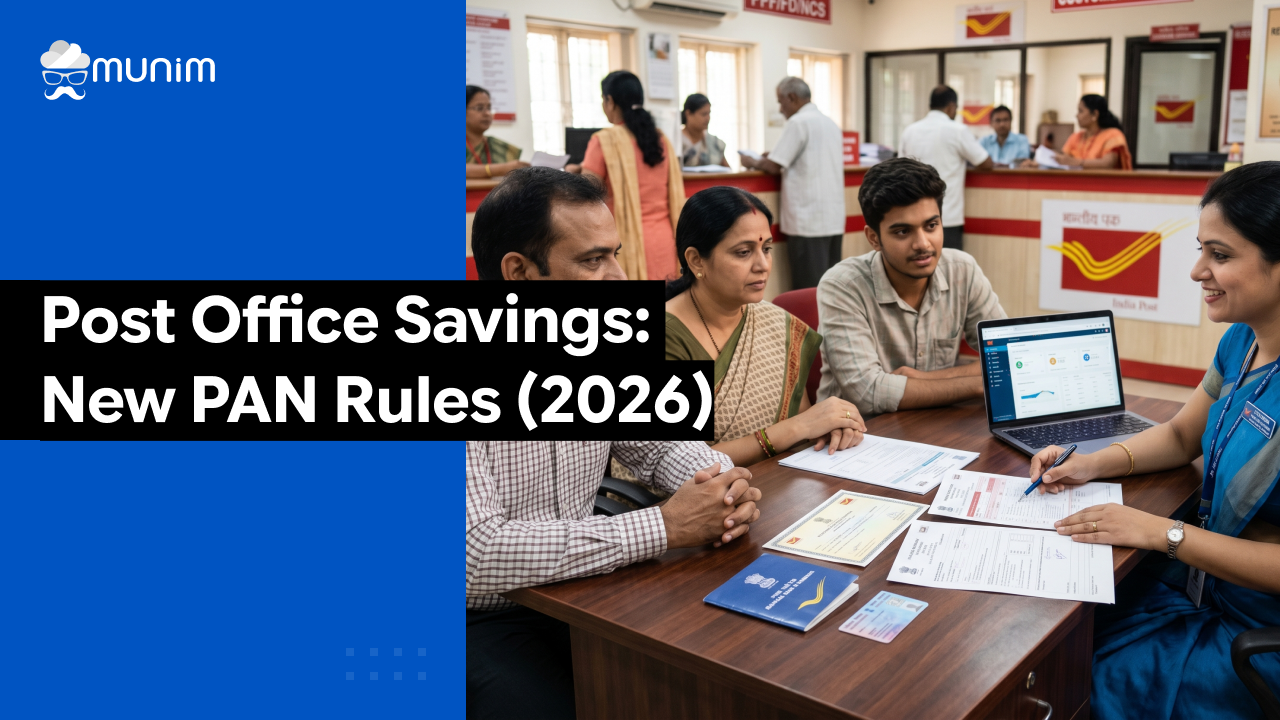
Millions of Indians rely on a post office savings account for secure, guaranteed returns. But major compliance changes are on the horizon.
Effective April 1, 2026, the government has announced new income tax rules for 2026. These updates are designed to strictly monitor large cash transactions across all financial institutions.
If you use your local dak ghar to save, you need to be prepared. The new PAN card rules 2026 make quoting your Permanent Account Number mandatory for many routine activities.
Here is exactly what you must know to keep your money accessible and your accounts active.
Old Rules vs. New Rules 2026 (At a Glance)
| Feature | Old Rules (Until March 2026) | New Rules (From April 2026) |
| Cash Transaction Limit | ₹50,000 per day | ₹10 lakh per financial year (Aggregate) |
| No PAN Declaration | Form 60 | Form 97 (Reported bi-annually) |
| TDS Exemption Form | Form 15G / Form 15H | Form 121 (Unified for all ages) |
The Big Shift: The ₹10 Lakh Cumulative Limit
Previously, the rules were simple: if you walked into a post office and deposited more than ₹50,000 in cash in a single day, you had to show your PAN card.
The 2026 rules completely remove that daily limit and replace it with an annual ceiling.
- Mandatory PAN cash deposit: Under the new Rule 159, you need a PAN card for cash deposit transactions that cross the ₹10 lakh mark in a single financial year.
- Post office cash withdrawal limit 2026: For the first time, a matching rule applies to taking your money out. If your total cash withdrawals exceed ₹10 lakh in a financial year, providing your PAN is mandatory.
If you hit these financial limits without linking a PAN card, your transactions will be temporarily blocked.
Why Splitting Your Deposits Won’t Work Anymore?
Splitting your cash deposits into smaller chunks (like ₹40,000 at a time) will no longer exempt you from providing your PAN. Further, this ₹10 lakh threshold is an aggregate limit.
The system tracks your combined cash activity for the entire year across all your accounts. It includes post offices, commercial banks, and co-operative banks.
The Impact on FDs, PPF, and Senior Citizen Schemes
These updates do not just affect your standard daily savings. They directly impact long-term investments as well.
For instance, the post office Senior Citizen Saving Scheme remains highly popular among Indian retirees. If you are depositing a large retirement corpus into this scheme, your PAN is absolutely required to manage TDS properly.
The same rule applies to the Public Provident Fund (PPF) and Fixed Deposits (FDs). Linking your PAN ensures your tax deductions are tracked accurately for your ITR filings.
Designed for Modern Tax Professionals
A premium filing solution for CAs and tax consultants who need speed, scale, and operational clarity.
 Handle multiple clients with ease
- Reconcile and validate with confidence
- Overcome the limitations of the GST portal
 Handle multiple clients with ease
TDS Changes: Form 121 Replaces Form 15G/15H
Do you rely on interest from a post office Senior Citizen Saving Scheme or standard fixed deposits? If so, you likely want to prevent TDS (Tax Deducted at Source) on your earnings. In the past, this meant submitting Form 15G if you were under 60, or Form 15H for senior citizens.
Under the new tax laws taking effect in April 2026, both of these older forms have been completely retired. They are consolidated into a single, digital-friendly document.
You must now submit the unified Form 121 to your post office to declare that your estimated total tax liability for the financial year is zero. The system no longer uses separate forms based on your age; Form 121 applies universally to all eligible resident taxpayers.
Once submitted, the deductor (the post office) must assign a 26-character Unique Identification Number (UIN) to your declaration, which you should keep for your tax records.
It is highly recommended to submit Form 121 at the start of the financial year. It helps ensure that your interest payouts arrive without unexpected tax deductions.
No PAN Card? Here is What You Need to Know (Form 97)
In rural and semi-urban India, many senior citizens and agricultural workers hold post office accounts but do not have a PAN card. If you fall into this category and need to make a high-value transaction, the government has introduced a new alternative.
Under the 2025 Income Tax Act, the old Form 60 has been officially retired. Now, individuals without a PAN must fill out and submit a Form 97 post office declaration to complete transactions that exceed the ₹10 lakh annual limit.
However, Form 97 is a temporary bridge, not a permanent fix. Post offices are required to report Form 97 submissions to the Income Tax Department twice a year. So, regular high-value transactors will eventually need to apply for a formal PAN.
How to Open Account in Post Office? (Offline & Online)
If you are setting up a new savings base, getting your KYC right from day one will save you from the ₹10 lakh limit freezes later.
Offline:
If you are wondering how to open an account at a post office, simply visit your nearest branch with your Aadhaar, PAN card, and two passport-sized photographs.
Because of the new PAN card rules 2026, bringing your PAN at the time of account creation is highly recommended. It can help you avoid issues later when you reach the yearly limit.
Online:
Existing India Post customers who have activated internet banking can streamline this process. Post office account opening online is available for schemes like Recurring Deposits (RD) and Time Deposits (FD) directly through the India Post e-banking portal.
Simply log in, navigate to the ‘General Services’ or ‘Service Requests’ tab, and select your desired scheme. This digital method takes only a few minutes, provided your PAN and KYC are already updated and linked to your primary savings account.
Action Plan: What Savers Must Do Now
To avoid having your deposits blocked or your withdrawals frozen, take these steps before the new rules cause a rush at the counters:
- Check Your Status: Visit your local post office branch and check if your PAN is already linked to your passbook.
- Apply Online: If you don’t have one, applying for a PAN is currently free and can be done online via the NSDL (Protean) e-Governance PAN portal or the UTIITSL portal. It typically arrives in 7 to 10 days.
- Consolidate Your Tracking: Since the ₹10 lakh limit applies to your total activity across all accounts (including banking and co-operative banks), start tracking your annual cash flow carefully.
By updating your KYC now, you ensure uninterrupted access to your hard-earned savings when the new rules take effect.
The Bottom Line
The new PAN card rules 2026 are a clear signal that the government is unifying tax tracking across all financial institutions, including the local dak ghar.
Whether you are managing a standard post office savings account or drawing interest from a high-value post office Senior Citizen Saving Scheme, updating your KYC is no longer optional.
Link your PAN card, switch to the new Form 121 if you need TDS exemptions, and track your annual cash flow closely to ensure zero disruptions to your hard-earned savings.
Frequently Asked Questions (FAQs)
Is a PAN card mandatory for a post office savings account?
Yes. While you can open a basic account with Aadhaar, the new tax rules make a post office PAN card link mandatory if your total cash deposits or withdrawals exceed ₹10 lakh in a single financial year. PAN is also mandatory for high-value investments like PPF and NSC.
What are the new PAN card rules effective from April 2026?
From April 1, 2026, Rule 159 replaces the old daily ₹50,000 cash limit with an annual aggregate limit. You must now provide a PAN for a PAN card for cash deposit or withdrawal if your total cash transactions hit ₹10 lakh or more in a financial year across your accounts.
What is the post office cash withdrawal limit for 2026?
Under the new income tax rules 2026, there is no strict cap on how much you can withdraw, but if your cumulative cash withdrawals cross ₹10 lakh in a financial year, providing your PAN becomes legally mandatory to process the transaction.
What is Form 97 for post office transactions?
Form 97 is a new declaration introduced in the 2025 Income Tax Act that officially replaces the old Form 60. It allows individuals (such as farmers or rural workers) who do not possess a PAN card to temporarily carry out high-value post office transactions.
Can I open a post office account online?
Yes. If you are an existing customer with an active internet banking profile, post office account opening online is available for term investments like Fixed Deposits (FD) and Recurring Deposits (RD). New customers will generally need to visit a branch to complete their initial KYC.
How do the 2026 rules affect the Post Office Senior Citizen Saving Scheme?
If you invest in the post office Senior Citizen Saving Scheme, linking your PAN is critical for tax tracking. Additionally, to prevent TDS from being deducted, you must now submit the new Form 121, which has replaced the older Form 15H.
Disclaimer: "This blog post is for informational purposes only. For specific tax advice related to your business, please consult a qualified Chartered Accountant or GST practitioner."
About the author

Jayant is a senior content writer and digital marketer, known for his extensive experience in commercial SEO writing, blog content, website copy, and B2B communication. Since 2019, he has worked on diverse freelance projects across industries. His portfolio includes articles, landing pages, social media content, and web development collaborations. Blending clarity, creativity, and strategic messaging, he specialises in crafting professional, audience-focused content for themunim.com.
Related Articles
Explore the latest market news, useful resources for business, and Munim updates.