
What Are Fixed Assets in Accounting? Complete Guide (2026)
 AuthorJayant Surana
 Reviewed ByAjay Savani



- Understanding the Fixed Assets Definition in Accounting
- Common Ways to Classify All Assets
- What is Tangible Fixed Assets in Accounting?
- What is the Fixed Asset Accounting Process?
- Fixed Assets Accounting Entries
- The Fixed Asset Accounting Standard in India
- Accounting vs. Tax Depreciation in India
- Final Thoughts
- Frequently Asked Questions (FAQs)
Summary:
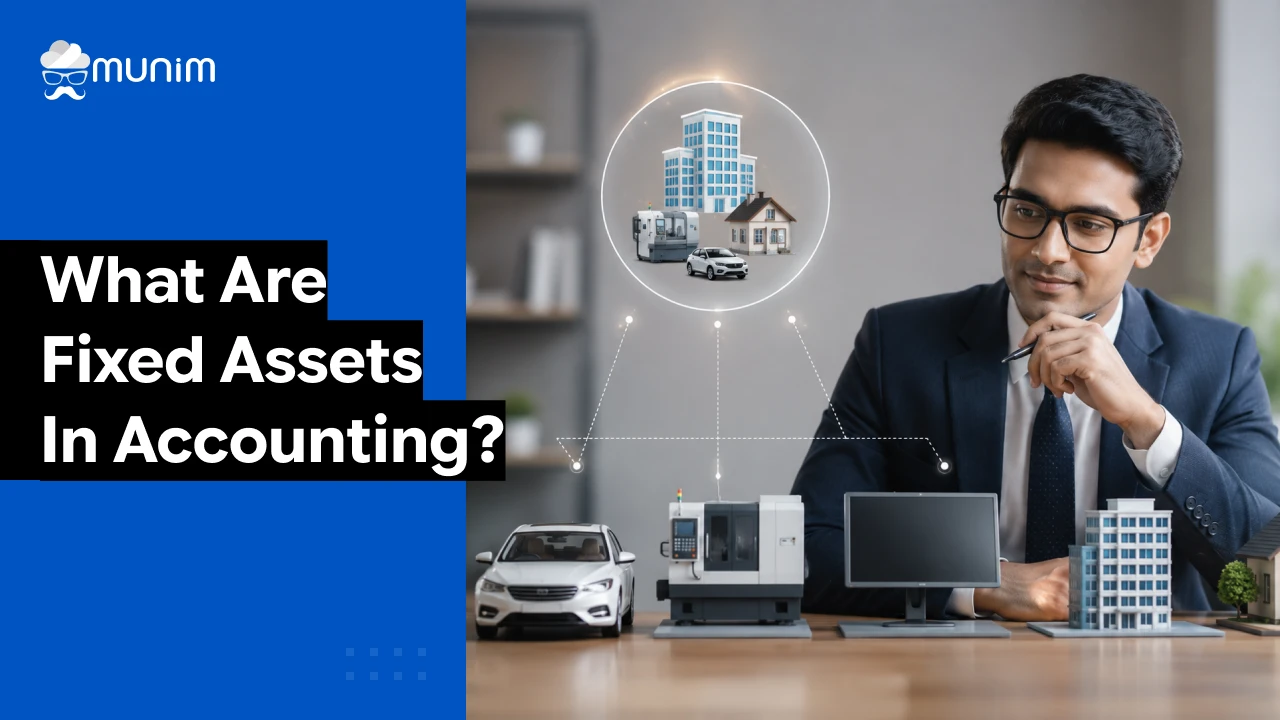
The Definition: Fixed assets are long-term, tangible items (like machinery, buildings, or vehicles) that a business owns and uses to generate income for more than one financial year.
The Lifecycle: The complete fixed asset accounting process involves four main stages: acquisition, annual depreciation, revaluation/impairment, and eventual disposal.
Indian Standards: Fixed asset reporting in India is primarily governed by AS 10 or Ind AS 16, and companies must maintain distinct depreciation calculations for accounting (Companies Act) and tax (Income-tax Act) purposes.
Every successful business relies on a solid physical foundation to operate and grow. But how do companies accurately track the valuable, long-term resources that make their daily operations possible? This brings up a foundational financial question: What are fixed assets in accounting?
Simply put, fixed assets are the physical foundation of a company. By mastering fixed asset accounting, Indian businesses can easily track their value and manage expenses. It also ensures strict compliance with the Companies Act and Income Tax rules.
In this guide, we will define fixed assets. We will also explain their lifecycle, show key journal entries, and summarise the Indian accounting standards.
Understanding the Fixed Assets Definition in Accounting
Let’s look at the standard fixed assets definition in accounting. These are long-term, tangible pieces of property or equipment. A firm owns and uses them to generate income.
Unlike inventory, fixed assets are not sold right away. You do not expect to consume them or convert them to cash within a single financial year.
Because of their long-term nature, they are treated as capital expenditure (CapEx). They are not immediate operating expenses. On a balance sheet, you will usually see them listed as Property, Plant, and Equipment (PP&E).
Common Ways to Classify All Assets
Before diving deeper, how do assets fit into the big picture? On an Indian company’s balance sheet, all assets are generally classified along two main axes:
1. By Liquidity (Convertibility to Cash):
- Current Assets: Short-term resources used up within one financial year (e.g., bank balances, inventory).
- Non-Current (Fixed) Assets: Long-term resources used for more than one year.
2. By Physicality:
- Tangible Assets: Physical items you can touch (e.g., machinery, real estate).
- Intangible Assets: Non-physical resources with long-term value (e.g., software, patents).
What is Tangible Fixed Assets in Accounting?
Tangible fixed assets are physical items you can touch and see. They form the physical infrastructure of a business. Common examples include:
- Land and factory buildings
- Manufacturing machinery
- Company vehicles like delivery trucks
- Computer hardware and office furniture
Track Fixed Assets & Depreciation with Smart Accounting Software. Know More!
What is the Fixed Asset Accounting Process?
Managing these assets is a continuous loop. Read ahead to know what the fixed asset accounting process is, in four distinct phases:
1. Acquisition and Capitalisation
When an Indian business buys an asset, the cost is capitalised on the balance sheet.
- What to capitalise: You include the purchase price plus any costs to get it ready for use. This includes freight, installation, and non-refundable taxes.
- Repairs vs. Improvements: Routine repairs are expensed immediately. However, major upgrades that extend the asset’s life are capitalised.
2. Depreciation
Fixed assets lose value over time due to wear and tear. Depreciation spreads this cost over the asset’s “useful life.” Under Indian rules, companies must also use component accounting. This means significant parts of an asset (like an airplane’s engine vs. its body) are depreciated separately.
3. Revaluation and Impairment
Companies must regularly check what their assets are worth:
- Revaluation: Some accounting standards let companies adjust asset values upward to match fair market value.
- Impairment: Impairment loss gets recorded when the market value drops way below the book value.
4. Disposal or Sale
Eventually, an asset reaches the end of its life. It is retired, sold, or scrapped. The asset and the accumulated depreciation associated with it are removed from the books. Any profit or loss from the sale is then recorded.
Simplify Your Business Operations
Designed to give you speed, control, and accuracy in daily accounting tasks.
 Save time with automated accounting workflows
- Get 35+ detailed business reports easily
- Access your business anytime, anywhere
 Save time with automated accounting workflows
Fixed Assets Accounting Entries
To keep the balance sheet balanced, accountants use standard fixed assets accounting entries.
Note: Accumulated Depreciation is a “contra-asset” account. It holds a credit balance that offsets the fixed asset’s value.
| Lifecycle Event | Account to Debit | Account to Credit |
| 1. Asset Purchase | Fixed Asset A/c (Original Cost) | Bank A/c / Accounts Payable |
| 2. Annual Depreciation | Depreciation Expense A/c | Accumulated Depreciation A/c |
| 3. Asset Sale | Bank A/c (Sale Proceeds) Accumulated Depreciation A/c | Fixed Asset A/c (Original Cost) Gain on Sale A/c (if in profit) |
Example: The Full Lifecycle
Imagine a company buys a delivery van for ₹10,00,000.
- Purchase: Debit Vehicles ₹10,00,000 | Credit Bank ₹10,00,000.
- Depreciation: They depreciate ₹2,00,000 annually. Debit Depreciation Expense ₹2,00,000 | Credit Accumulated Depreciation ₹2,00,000.
- Sale: After 3 years, the accumulated depreciation is ₹6,00,000. The book value is ₹4,00,000. They sell it for ₹5,00,000.
- Debit Bank ₹5,00,000
- Debit Accumulated Depreciation ₹6,00,000
- Credit Vehicles ₹10,00,000
- Credit Gain on Sale ₹1,00,000.
The Fixed Asset Accounting Standard in India
Accurate reporting means following the rules. The specific fixed asset accounting standard an Indian company uses depends on its size:
- AS 10 (Property, Plant and Equipment): Issued by the ICAI. This older standard applies to non-corporate entities and smaller unlisted companies.
- Ind AS 16 (Property, Plant and Equipment): Larger listed companies must follow Ind AS. This standard allows companies to choose between a cost model and a revaluation model.
Accounting vs. Tax Depreciation in India
Indian businesses actually navigate two rulebooks for depreciation:
- Companies Act (Accounting): Useful life is based on Schedule II of the Companies Act, 2013.
- Income-tax Act, 1961 (Tax): Depreciation is calculated using specific block-wise rates. Revaluations are ignored for tax purposes.
Track fixed assets, and financial records easily with Munim’s smart bookkeeping software for Indian businesses.
Final Thoughts
Proper fixed asset accounting is the backbone of financial health. It starts with the initial fixed assets accounting entries. It ends with adhering to the correct ICAI standard.
Every step ensures your balance sheet reflects reality. By understanding Indian regulations, businesses can optimise tax strategies and plan for growth.
Frequently Asked Questions (FAQs)
What is a fixed asset in simple words?
A fixed asset is a long-term piece of physical property. A business owns it and uses it to generate income. It is kept for more than one year, rather than being sold quickly for cash.
What are examples of fixed assets?
Common examples of fixed assets include land, office buildings, manufacturing machinery, company vehicles, and office furniture.
What is fixed asset accounting?
It is the financial process of recording a company’s long-term assets on the balance sheet. It involves tracking their loss in value (depreciation) and recording gains or losses when they are sold.
What are the three types of fixed assets?
While all assets are classified by liquidity and physicality, fixed assets specifically fall into three categories on an Indian balance sheet:
- Tangible assets (physical items like machinery).
- Intangible assets (non-physical items like software).
- Capital Work-in-Progress (CWIP) (assets currently under construction, like a new factory).
How is depreciation calculated on fixed assets in India?
For accounting, depreciation is based on the asset’s “useful life” under Schedule II of the Companies Act, 2013. For tax filing, it is based on block-wise rates set by the Income-tax Act, 1961.
Are fixed assets a debit or credit?
Fixed assets are debit accounts. When you buy a fixed asset, you debit the account to increase its balance. If you sell it, you credit the account to decrease the balance.
Is a laptop a fixed asset or a current asset?
A laptop is categorised under computers or office equipment. It is considered as a fixed asset because it is used for business operations and provides value for more than one year.
Disclaimer: "This blog post is for informational purposes only. For specific tax advice related to your business, please consult a qualified Chartered Accountant or GST practitioner."
About the author

Jayant is a senior content writer and digital marketer, known for his extensive experience in commercial SEO writing, blog content, website copy, and B2B communication. Since 2019, he has worked on diverse freelance projects across industries. His portfolio includes articles, landing pages, social media content, and web development collaborations. Blending clarity, creativity, and strategic messaging, he specialises in crafting professional, audience-focused content for themunim.com.
Related Articles
Explore the latest market news, useful resources for business, and Munim updates.