How to Use Invoice Payment Terms Strategically to Get Paid Faster
 AuthorMehul Jagwani
 Reviewed ByCA Ajay Savani




Summary:
Invoice payment terms define when and how a buyer must pay a seller after receiving an invoice. For Indian SMEs, choosing the right terms and writing them clearly on every invoice is one of the most direct ways to reduce payment delays, avoid disputes, and maintain steady cash flow.
Late payments are one of the most common problems faced by small and medium businesses in India. You deliver a product or complete a service and send the invoice, but the payment still takes weeks or even months to come in. Most of the time, this doesn’t happen because the buyer is avoiding payment, it usually happens because the invoice payment terms are not clear or are missing.
Getting this right doesn’t need complicated legal wording. It’s simply about understanding what payment terms should be, writing them in clear and simple language, and making sure you use the same format every time you send an invoice.
Take Control of Your Cash Flow with Smart Billing. Read More
What Are Payment Terms & Conditions in an Invoice?
Payment terms in an invoice are the conditions under which a seller expects to be paid. They communicate three things to the buyer:
- When the payment is due
- How it should be made
- What happens if payment is late
In simple words, payment terms answer the question, "When do you need to be paid, and on what conditions?"
Why Are Invoice Payment Terms Important?
Without clear payment terms and conditions for the invoice, the buyer has no formal deadline. They may pay in 15 days or in 90 days, and technically, neither is wrong because nothing was agreed upon.
Clear payment terms do three things well:
1. They set expectations upfront. When the buyer sees the due date on the invoice, they know what is expected. There is no ambiguity, no room for "I thought we had more time."
2. They create a paper trail. If a payment dispute arises, the invoice with clearly stated terms serves as a document both parties referenced at the time of the transaction.
3. They improve cash flow predictability. When a business knows most clients pay within 15 or 30 days, it can plan expenses, vendor payments, and GST liability accordingly. Unpredictable cash flow is far more damaging than occasional delays.
Still Facing Late Payments Even After Setting Terms? Read Now!
What Are Payment Terminologies on an Invoice?
There are several standard payment terms used in business. Here is a breakdown of the most common ones:
Net 7, Net 15, Net 30, Net 45, Net 60
This is the most widely used format. Net means the full invoice amount, and the number indicates the number of days from the invoice date within which payment is expected.
- Net 7 — Payment within 7 days. Suitable for small orders or existing clients with strong relationships.
- Net 15 — Payment within 15 days. Common in retail and service-based businesses.
- Net 30 — The most standard term. Payment within 30 days. Works well for most B2B transactions.
- Net 45 or Net 60 — Used for large corporate clients or project-based work where the buyer's payment cycles are longer.
Due on Receipt
This term means payment is expected as soon as the buyer receives the invoice. It is common in cash-based businesses, freelancers, or first-time transactions with new clients.
2/10 Net 30 (Early Payment Discount)
It means pay within 10 days and get a 2% discount; otherwise, full payment is due within 30 days. Offering small early payment discounts can speed up collections noticeably, especially with cost-conscious buyers.
Advance Payment or Upfront Payment
Some businesses, particularly those taking on large projects or custom orders — ask for 25%, 50%, or even 100% payment before work begins. This is common in manufacturing, construction, and bespoke services.
Milestone-Based Payments
For long-term projects, payments are tied to delivery milestones rather than dates. For example: 30% on order, 40% on delivery of first batch, 30% on final handover.
COD (Cash on Delivery)
Common in product-based businesses. Payment happens at the time of physical delivery.
How to Write Invoice Payment Terms: A Practical Guide
Knowing the terms is one thing. Writing them correctly on an invoice is another. Here is how to do it properly.
Step 1: Choose the Right Term for Each Client
Not all clients are the same. A long-standing client with a clean track record may deserve Net 30. A new buyer or a high-risk account may need stricter terms like Net 7 or upfront payment.
Before writing the term, assess the client relationship, order value, and industry payment norms.
Step 2: State the Due Date Clearly
Rather than just writing "Net 30," consider adding the actual due date on the invoice. For example:
"Payment due by 15 May 2026 (Net 30 from invoice date of 15 April 2026)"
This removes any confusion about when the clock starts.
Step 3: Mention the Accepted Payment Methods
Write clearly how payment should be made. Include:
- Bank account details (account number, IFSC code, bank name)
- UPI ID if applicable
- Whether cheques are accepted and to whose name
Step 4: State Late Payment Consequences
If the business charges interest on overdue payments, this must be mentioned clearly. A common practice is to charge 1.5% to 2% per month on unpaid amounts after the due date. Write it as:
"A late payment charge of 1.5% per month will apply on outstanding amounts after the due date."
This must be communicated before the transaction, not after a payment is missed.
Step 5: Keep the Language Simple
Avoid legal jargon. A buyer should be able to read the payment terms section in under 30 seconds and understand exactly what is expected. If it is complicated, it gets ignored.
Payment Terms and Conditions for Invoice: What to Include
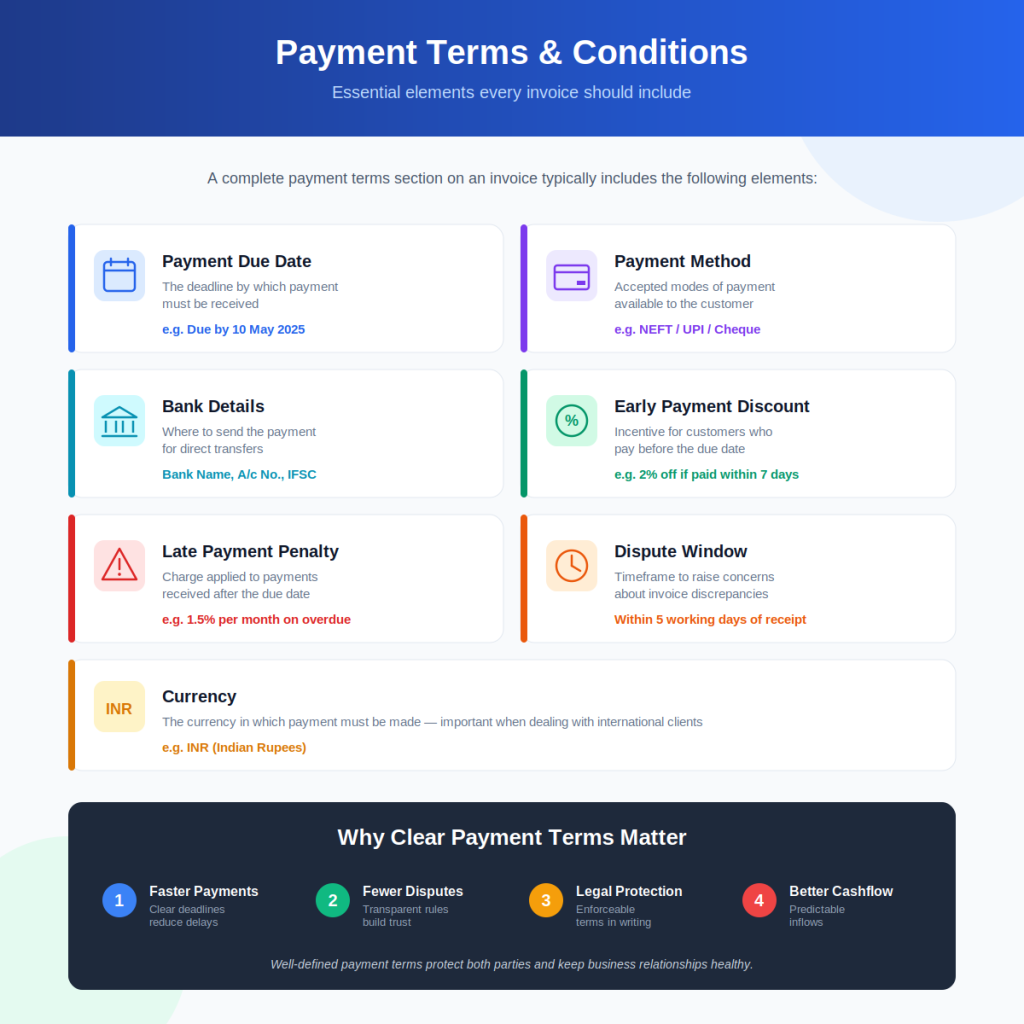
A complete payment terms section on an invoice typically includes the following elements:
Closing Notes
Getting paid on time isn’t just about chasing customers. It mostly depends on how clearly and consistently payment terms are explained from the beginning. When an invoice clearly mentions the due date, payment method, and what will happen if payment is delayed, there is very little chance of confusion.
For Indian SMEs managing multiple clients, products, and GST compliance simultaneously, handling all of this manually gets complicated fast. A cloud-based invoicing tool that lets businesses set standard payment terms, automate reminders, and track outstanding invoices saves time and reduces follow-up effort meaningfully.
Get Paid Faster with Smart Invoicing. Get a Free Demo Now!
FAQs on Invoice Payment Terms
What does "Net 30" mean on an invoice?
Net 30 means the full invoice amount is due within 30 days from the invoice date.
Should payment terms be the same for all clients?
No. Payment terms should reflect the client relationship, order size, client's payment behavior, and industry norms.
Are invoice payment terms legally binding in India?
Yes, when agreed upon between both parties, either through a contract, purchase order, or accepted invoice, payment terms form part of the commercial agreement and are enforceable.
What is a milestone-based payment term?
In milestone-based terms, payment is tied to project progress rather than calendar dates. For example, 30% upfront, 40% on delivery of the first phase, and 30% on final completion.
Is COD a valid payment term for B2B invoices?
Yes. Cash on Delivery or Cash on Dispatch is a valid and commonly used term for product-based B2B transactions.
Disclaimer: "This blog post is for informational purposes only. For specific tax advice related to your business, please consult a qualified Chartered Accountant or GST practitioner."
About the author
Related Articles
Explore the latest market news, useful resources for business, and Munim updates.