
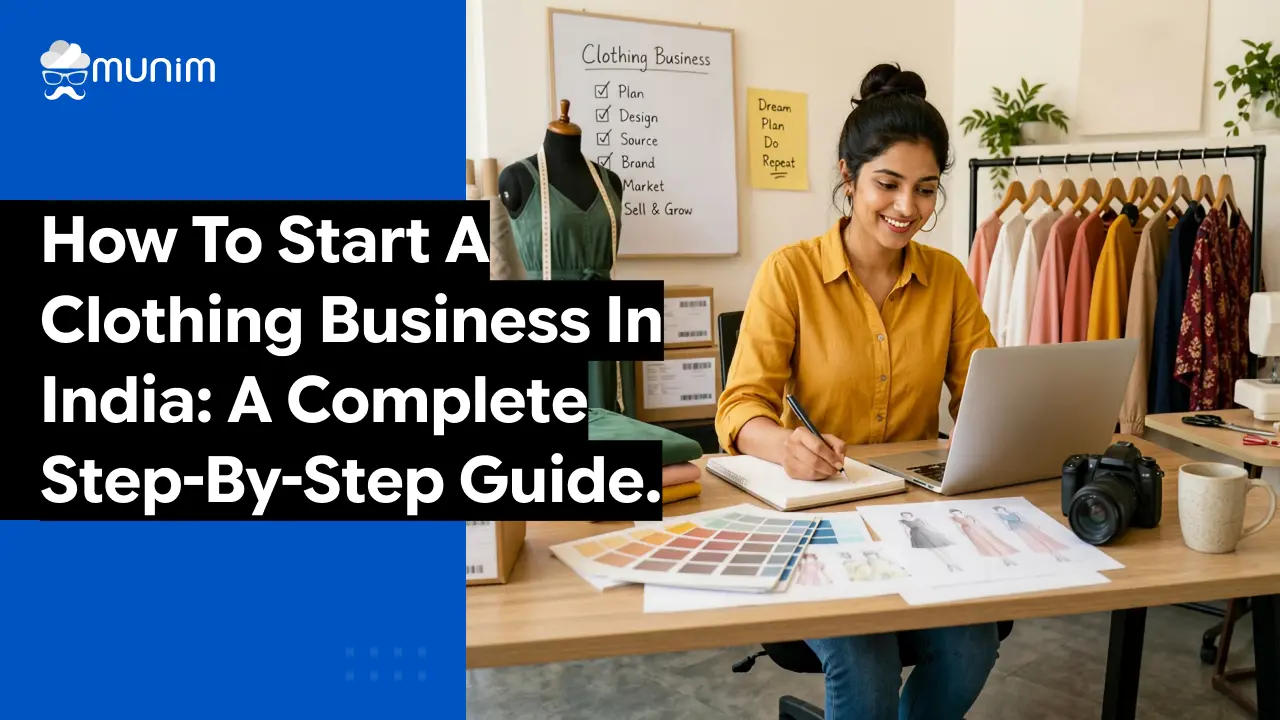
How to Start a Clothing Business in India: A Complete Step-by-Step Guide (2026)
 AuthorMehul Jagwani
 Reviewed ByMadhav Bhayani



- Step 1: Decide Your Clothing Business Model
- Step 2: Research the Market and Find Your Niche
- Step 3: Write a Business Plan
- Step 4: Register Your Business
- Step 5: Obtain the Required Licenses and Registrations
- Step 6: Set Up Your Supply Chain
- Step 7: Build Your Brand Identity
- Step 8: Set Up Your Online Presence
- Step 9: Sort Out Your Finances and Accounting
- Step 10: Plan Your Marketing and Sales Strategy
- Closing Notes
- Frequently Asked Questions
Summary:
Starting a clothing business in India needs a clear idea, the right products, and understanding your target customers. From choosing a business model to GST registration, sourcing materials, and setting up sales channels, each step is important. Managing pricing, branding, and daily operations properly helps your business grow smoothly.
If you are thinking about how to start a clothing business in India, you are entering a space with real and growing demand. From ethnic wear and sustainable fashion to affordable casuals and premium workwear, the market has room for businesses of all sizes.
The real challenge lies in understanding the legal requirements, the right business structure, how GST applies to garments, and how to manage your money once sales start coming in. This guide covers all of that, step by step.
Start Your Clothing Business with Proper Financial Setup. Explore Now!
Step 1: Decide Your Clothing Business Model
You need to decide what kind of clothing business you want to run. The model you choose will determine your startup cost, legal requirements, and operational setup.
Manufacturing
A clothing manufacturing business involves producing garments at scale, either for your own brand or as a third-party manufacturer for other brands. This model requires the highest investment, a factory or production unit, workers, and raw material sourcing.
Retail or Wholesale
This model involves buying ready-made garments from manufacturers and selling them either directly to customers (retail) or to other shop owners (wholesale). The investment is moderate and the turnaround can be faster.
Online Clothing Brand
An online model means you sell through your own website, platforms like Meesho, Myntra, or Ajio, or through social media. For anyone researching how to start an online clothing business in India, this is often the most accessible entry point. You can even begin with a small inventory and scale gradually.
Home-Based Boutique
This model suits designers, tailors, or individuals who want to start small. If you are looking at how to start a clothing business from home in India, a boutique-style model combining custom stitching with social media outreach is a practical starting point.
Step 2: Research the Market and Find Your Niche
The Indian clothing market is massive and competitive, but niche players consistently do well. Some niches worth considering:
- Ethnic and traditional wear such as sarees, salwar kameez, or lehengas
- Sustainable or organic clothing, which is seeing rising demand among urban buyers
- Children’s clothing, a segment with high repeat purchases
- Activewear and athleisure, growing fast post the fitness boom
- Plus-size fashion, still underpenetrated in India
Step 3: Write a Business Plan
A solid business plan does not need to be a 50-page document. It needs to clearly answer a few key questions:
- What are you selling and to whom?
- Where will you source your materials or stock?
- What is your pricing strategy?
- What are your startup costs and break-even targets?
- How will you market and sell?
Step 4: Register Your Business
Choosing the right business structure affects your tax liability, legal protection, and ability to scale. The following are the business structure you can consider for your clothing business.
Sole Proprietorship
The simplest form. One person owns and runs the business. Minimal paperwork, but you are personally liable for all debts. Suitable for home-based or small operations.
Partnership Firm
Two or more people share ownership. Governed by a Partnership Deed. Liability is shared, and the setup is relatively straightforward.
Private Limited Company
The most credible structure if you plan to scale, raise funding, or work with large retailers. Registration happens through the Ministry of Corporate Affairs (MCA) portal. More compliance, but better legal protection.
LLP (Limited Liability Partnership)
A middle ground between a partnership and a private company. Good for small to medium clothing businesses with a partner.
Step 5: Obtain the Required Licenses and Registrations
Running a clothing business in India requires several registrations. Missing any one of them can lead to penalties or operational disruptions.
GST Registration
This is mandatory if your annual turnover exceeds Rs 40 lakh (Rs 20 lakh for special category states). For online sellers, GST registration is compulsory regardless of turnover, since e-commerce platforms require it.
Clothing attracts different GST rates depending on the product:
- Garments priced below Rs 1,000 attract 5% GST
- Garments priced at Rs 1,000 or above attract 12% GST
Understanding these rates matters for pricing, invoicing, and claiming input tax credit (ITC).
MSME Registration (Udyam)
Registering as a Micro, Small, or Medium Enterprise on the Udyam portal gives you access to government schemes, priority lending, and subsidies. It is free, online, and takes less than an hour.
Step 6: Set Up Your Supply Chain
For a manufacturing business, raw material sourcing is everything. The major textile hubs in India are:
- Surat for synthetic fabrics
- Tiruppur for knitwear and cotton
- Ludhiana for woollens
- Jaipur for printed fabrics and ethnic textiles
- Mumbai’s Dharavi and Bhiwandi for wholesale fabric
If you are running a retail or online model without manufacturing, you can source from wholesale markets like Chandni Chowk in Delhi, the textile markets in Ahmedabad, or directly from factory agents.
Step 7: Build Your Brand Identity
In a market where hundreds of brands compete for attention, your brand is what makes you recognisable. This includes:
- A business name that is easy to remember and spell
- A logo and consistent colour palette
- Packaging that feels intentional, especially for online shipments
- A clear value proposition: Are you affordable? Premium? Sustainable? Ethnic?
Step 8: Set Up Your Online Presence
Whether you are purely online or running a hybrid model, your digital presence matters enormously.
Your Own Website
Use platforms like Shopify, WooCommerce, or Instamojo to build an online store.
Marketplace Listings
Register as a seller on Myntra, Meesho, Amazon Fashion, Flipkart Fashion, or AJIO. Each platform has its own seller onboarding process and GST requirements.
Social Media
Instagram, Pinterest, and WhatsApp Business are powerful tools for clothing brands. Visual-led platforms naturally suit the fashion category. Regular content, reels showcasing your designs, and customer photos (with permission) build trust fast.
Step 9: Sort Out Your Finances and Accounting
This is a step many new clothing business owners put off, and it almost always causes problems later.
From day one, you need:
- A dedicated business bank account (never mix personal and business money)
- A system to track every sale, purchase, and expense
- Monthly GST return filing (GSTR-1 and GSTR-3B are the standard returns for regular taxpayers)
- Proper invoicing with your GSTIN and HSN codes for each product
Step 10: Plan Your Marketing and Sales Strategy
A great product without a marketing plan will not sell itself. For clothing businesses in India, the most effective marketing approaches include:
Influencer Marketing
Micro-influencers with 10,000 to 100,000 followers in fashion, lifestyle, or regional niches often deliver better ROI than celebrity tie-ups, especially for emerging brands.
WhatsApp Marketing
A well-managed WhatsApp broadcast list with regular catalogue updates drives repeat purchases without any advertising spend.
Google Ads and Meta Ads
Paid campaigns on Google Shopping and Instagram/Facebook can deliver measurable results. Start small, test audiences, and scale what works.
Referral and Loyalty Programs
Word of mouth still works remarkably well in India, especially in tier 2 and tier 3 cities. A simple referral discount can significantly reduce your customer acquisition cost.
Closing Notes
Starting a clothing business in India is entirely achievable, whether you are planning a large manufacturing setup or a small home-based boutique. The market is big enough for focused, well-prepared entrepreneurs at every level. What makes the difference is the groundwork: the right business structure, proper licences, GST compliance from day one, and a clear sense of who you are selling to.
Build a Fully Managed Clothing Business System. Request a Demo Today!
Frequently Asked Questions
What is the minimum investment to start a clothing business in India?
It depends on the model. A home-based boutique can start with Rs 20,000 to Rs 50,000. A small online clothing brand might need Rs 1 to Rs 3 lakh. A manufacturing unit typically requires Rs 10 lakh and above, depending on the scale..
What accounting software should a clothing business use?
A cloud-based accounting software that supports GST billing, inventory tracking, and return filing is ideal. Munim is a good option for Indian clothing businesses, especially SMEs looking for affordable and compliance-ready accounting software.
Can a clothing business claim input tax credit on raw material purchases?
Yes, a GST-registered clothing business can claim ITC on raw material purchases.
How much does it cost to start a clothing business in India?
Starting a clothing business in India requires ₹2–10 lakhs minimum depending on scale, inventory, and location. This covers stock, registration, licensing, and setup costs.
Is the clothing business profitable in India?
Yes, clothing is highly profitable in India. Retail margins range 40–80%, with e-commerce reaching 60–150% on niche segments.
How can I start my own clothing brand in India?
Start a clothing brand by: choosing a niche, registering legally (GST, trademark), sourcing suppliers, designing products, building inventory, and setting up sales channels (online/retail).
Can I start a clothing business from home?
Yes, absolutely. Home-based clothing businesses work best for tailoring, custom design, online resale, or dropshipping—low overhead, flexible hours, zero rent.
Disclaimer: "This blog post is for informational purposes only. For specific tax advice related to your business, please consult a qualified Chartered Accountant or GST practitioner."
About the author

Mehul is a seasoned content writer with a passion for simplifying complex accounting and GST topics. With a keen interest in entrepreneurship and business management, he specializes in creating informative and engaging content for themunim.com. His goal is to help businesses understand and implement accounting and GST software solutions effectively. When he's not crafting content, Mehul enjoys exploring new places and spending time with his Golden Retriever.
Related Articles
Explore the latest market news, useful resources for business, and Munim updates.