
How Does the RSP-Based Valuation Impact the Taxation of Tobacco Products?
 AuthorMehul Jagwani
 Reviewed ByMadhav Bhayani



- What is RSP-Based Valuation?
- What is the Objective of RSP-Based Valuation?
- Which Tobacco Products are Covered Under RSP-Based Valuation?
- How is RSP-Based Valuation Calculated? The Formula Explained
- Long-Term Implications for the Tobacco Sector
- Conclusion
- FAQs on RSP-Based Valuation for Notified Tobacco Products
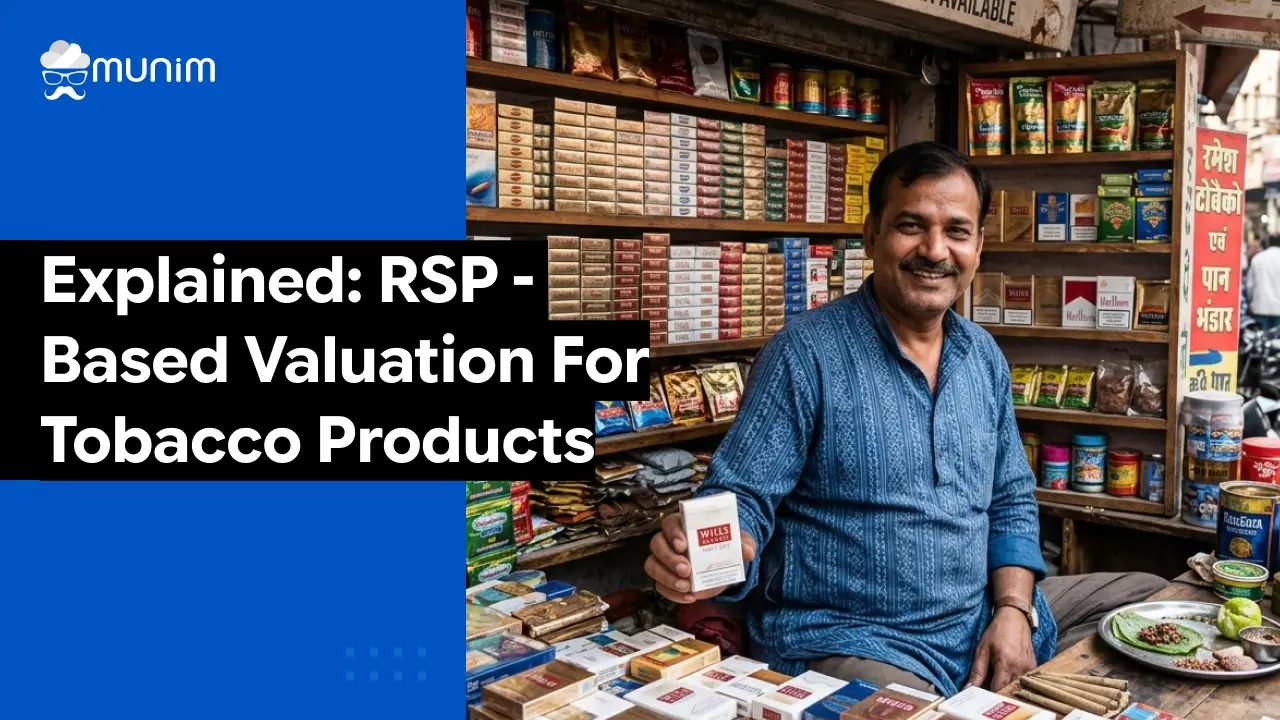
As of 1 February 2026, a significant change in India’s GST law will impact the taxation of certain tobacco products. GST will no longer be calculated based on the transaction value (the price agreed between the buyer and seller). Instead, it will be determined by the Retail Sale Price (RSP) printed on the product’s packaging. This shift will affect how businesses calculate, report, and document GST in their GSTR-1, e-invoices, and e-way bills. If your business deals in any of the notified tobacco products, understanding and adapting to this change is crucial for maintaining compliance.
What is RSP-Based Valuation?
RSP stands for Retail Sale Price, the maximum price declared on a packaged product at which it may be sold to the end consumer. Under RSP-based valuation, GST is computed on this printed price, not on the actual commercial consideration received from the buyer.
The key point: the actual selling price and the GST taxable base are now decoupled for notified goods. The RSP printed on the pack is the anchor.
What is the Objective of RSP-Based Valuation?
The objectives behind introducing RSP-based valuation are simple:
- Eliminate undervaluation by anchoring tax computation to a publicly declared consumer price
- Standardise GST liability across the entire supply chain, a manufacturer and a distributor selling the same pack now pay GST derived from the same RSP
- Reduce disputes between taxpayers and tax authorities over what the “correct” value should be
- Curb revenue leakage in a high-tax, high-scrutiny sector
- Align with broader sin-goods policy – the 56th GST Council meeting in September 2025 had already recommended enhanced taxation on demerit goods
Which Tobacco Products are Covered Under RSP-Based Valuation?
The RSP-based valuation mechanism applies only to products specifically notified under Notification Nos. 19/2025 and 20/2025–Central Tax. The covered products, along with their HSN codes, are:
| HSN Code | Product Description |
| 2106 90 20 | Pan masala |
| 2401 | Unmanufactured tobacco (excluding leaves) |
| 2402 | Cigars, cheroots, cigarillos, and cigarettes |
| 2403 | Other manufactured tobacco and substitutes; homogenised or reconstituted tobacco; tobacco extracts and essences (other than bidis) |
| 2404 11 00 | Products containing tobacco or reconstituted tobacco intended for inhalation without combustion |
| 2404 19 00 | Products containing tobacco or nicotine substitutes intended for inhalation without combustion |
A critical condition applies: these products must have the RSP printed on their packaging for the RSP-based valuation mechanism to apply.
Bidis (HSN 2403, specifically) are not covered under the 40% RSP-based valuation framework. Their GST rate has been revised downward to 18% and they continue under the transaction-value model.
Loose or unpackaged tobacco products with no RSP declaration are also generally outside the scope of this mechanism unless separately notified.
Munim supports RSP-based valuation for tobacco products. Click here to explore how it works.
How is RSP-Based Valuation Calculated? The Formula Explained
This is where precision matters most. The RSP is treated as tax-inclusive under the new rules. That means the tax amount must be derived backward from the RSP using the following formula prescribed under Rule 31D:
Tax Amount = (RSP × Applicable GST Rate%) ÷ (100 + Sum of Applicable Tax Rates)
Deemed Taxable Value = RSP − Tax Amount
Most notified tobacco products now attract 40% GST (split as 20% CGST + 20% SGST for domestic supply, or 40% IGST for inter-state supply).
Example:
Suppose a distributor purchases 1,000 packs of a notified tobacco product with an RSP of ₹100 per pack. The commercial price agreed with the manufacturer after trade discount is ₹60,000.
Step 1: Compute Total RSP 1,000 packs × ₹100 = ₹1,00,000
Step 2: Compute Tax Amount using the RSP formula Tax Amount = (₹1,00,000 × 40) ÷ (100 + 40) = ₹40,00,000 ÷ 140 = ₹28,571.43
Step 3: Compute Deemed Taxable Value ₹1,00,000 − ₹28,571.43 = ₹71,428.57
Step 4: Compute Total Invoice Value for Reporting Net Sale Value (₹60,000) + Tax Amount (₹28,571.43) = ₹88,571.43
Notice what happened here. The GST paid (₹28,571.43) is derived from the RSP of ₹1,00,000, even though the actual commercial consideration was only ₹60,000. The buyer effectively pays a higher tax on fewer rupees of commercial value.
Long-Term Implications for the Tobacco Sector
Over time, RSP-based valuation is expected to bring more predictability to tax planning in the tobacco sector. The key long-term shifts include:
Standardised tax liability across the supply chain. Whether a product is sold at a premium to a high-end retailer or at a lower price to a regional distributor, the GST derived from RSP remains consistent. This eliminates the advantage previously gained through deep trade discounts.
Reduced valuation disputes. Most disputes in this sector historically arose from disagreements over transaction value, related-party pricing, and discount structures. RSP-based valuation removes much of this ambiguity.
Cleaner GST return reconciliation. Over time, once billing systems are updated and teams are trained, reconciliation between GSTR-1 and GSTR-3B for notified products will become more straightforward.
Higher aggregate tax collection. The government’s decision to shift to RSP-based valuation, combined with a 40% GST rate (up from 28%), is expected to significantly increase revenue from the tobacco sector – which has historically been a key source of indirect tax revenue in India.
Conclusion
For businesses, the RSP-based valuation change goes well beyond a formula update. It requires system reconfiguration, packaging reviews, pricing strategy rethinks, team training, and careful attention to GSTR-1 and e-invoice reporting.
Businesses that adapt this early and rectify their processes accordingly will face far fewer disruptions and audit risks going forward.
FAQs on RSP-Based Valuation for Notified Tobacco Products
1. Are bidis covered under RSP-based valuation?
No. Bidis are not covered under the RSP-based valuation framework.
2. What is the formula for computing GST under RSP-based valuation?
Tax Amount = (RSP × GST Rate%) ÷ (100 + Sum of Applicable Tax Rates). The Deemed Taxable Value = RSP − Tax Amount. For products attracting 40% GST, the formula is: Tax Amount = (RSP × 40) ÷ 140.
3. Can trade discounts reduce GST liability under RSP-based valuation?
No. The GST liability is computed on the RSP printed on the pack, irrespective of what discount is offered to the buyer.
4. What happens if the RSP printed on the pack is incorrect?
An incorrectly declared RSP can result in wrong tax computation, leading to demand notices, interest, and penalties from GST authorities.
5. What changes must businesses make in their billing and ERP software?
Businesses must configure their software to capture RSP per unit for notified products, compute tax using the RSP formula, and allow manual correction of auto-computed tax fields.
Disclaimer: "This blog post is for informational purposes only. For specific tax advice related to your business, please consult a qualified Chartered Accountant or GST practitioner."
About the author

Mehul is a seasoned content writer with a passion for simplifying complex accounting and GST topics. With a keen interest in entrepreneurship and business management, he specializes in creating informative and engaging content for themunim.com. His goal is to help businesses understand and implement accounting and GST software solutions effectively. When he's not crafting content, Mehul enjoys exploring new places and spending time with his Golden Retriever.
Related Articles
Explore the latest market news, useful resources for business, and Munim updates.