Goods Return Under GST: Time Limits, and Format Explained
 AuthorMehul Jagwani
 Reviewed ByMadhav Bhayani



Goods returned under GST is a routine business reality. A buyer returns damaged goods. A retailer sends back expired stock. A customer rejects a shipment due to quality issues. Each of these situations has a defined compliance path under the GST framework, and ignoring the process can lead to tax mismatches, ITC disputes, and interest liability.
This guide explains the complete goods return procedure under GST, what documents are required, the time limit for goods return under GST, the correct format for a credit note, and what both the supplier and the recipient must do to stay compliant.
What is Goods Return Under GST?
When a buyer returns goods to a supplier after a tax invoice has been issued, the original supply is partially or fully reversed. Under GST, this is handled through a credit note issued by the supplier.
A credit note is a legal document governed by Section 34(1) of the CGST Act, 2017. Under Section 34(1), when a tax invoice has been issued for supply of goods or services, and the goods supplied are returned by the recipient, or where goods or services supplied are found to be deficient, the registered person who has supplied such goods may issue one or more credit notes for supplies made in a financial year.
The credit note serves two purposes. First, it acknowledges the physical return of goods. Second, it adjusts the supplier’s output tax liability for the GST already charged on the original invoice.
When Is a Credit Note Issued for Goods Return Under GST?
A supplier can issue a credit note under GST when goods or services are returned by the recipient, whether wholly or partly, when the taxable value was overstated in the original invoice, when GST was charged at a higher rate than applicable, or when the quantity delivered was less than what was invoiced.
For goods return specifically, the most common reasons include:
Quality issues or defects – The buyer receives damaged, defective, or substandard goods and returns them.
Expired stock – Retailers and distributors in the FMCG and pharmaceutical sectors regularly return time-expired stock to manufacturers.
Quantity mismatch – The buyer received fewer goods than what was billed.
Rejection of shipment – The entire consignment is rejected at delivery for quality or specification reasons.
Contractual disputes – A supply is reversed due to terms not being met.
Designed for Modern Tax Professionals
A premium filing solution for CAs and tax consultants who need speed, scale, and operational clarity.
 Handle multiple clients with ease
- Reconcile and validate with confidence
- Overcome the limitations of the GST portal
 Handle multiple clients with ease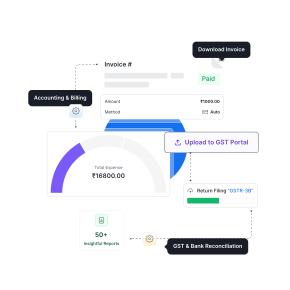
What Is the Time Limit for Goods Return Under GST?
This is one of the most searched questions and the most misunderstood aspect of goods returned under GST.
There is no specific time limit for issuing the credit note itself. The supplier can issue it anytime after the return occurs. However, the credit note must be declared in GST returns within a defined deadline.
For goods supplied in FY 2026-27, the credit note must be reported in GST returns by 30th November 2025 or before the date of filing the annual return (GSTR-9) for FY 2026-27, whichever is earlier.
What Happens If the Time Limit Has Lapsed?
If the time limit specified in Section 34(2) of the CGST Act has lapsed, a credit note may still be issued by the supplier for such return of goods, but the tax liability adjustment will not be permitted. In other words, the supplier cannot reduce their output tax liability through a late credit note, even if the goods were genuinely returned.
Sample Credit Note Layout
The following is the sample credit note layout that you should be aware of:
| Field | Details |
| Document Type | Credit Note |
| Credit Note Number | CN/2024-25/001 |
| Date | DD/MM/YYYY |
| Supplier GSTIN | 24ABCDE1234F1Z5 |
| Recipient GSTIN | 24XYZGH5678K1Z3 |
| Original Invoice No. | INV/2024-25/215 |
| Original Invoice Date | DD/MM/YYYY |
| Goods Description | [Item name, HSN code, quantity] |
| Taxable Value Reversed | ₹ |
| CGST @ [rate]% | ₹ |
| SGST @ [rate]% | ₹ |
| Total Amount Credited | ₹ |
| Reason for Credit | Goods returned due to [reason] |
This format works for both the supplier’s books and for data entry into any GST software or the GSTN portal.
Goods Return Scenario: Practical Example
Scenario: Rajan Traders, a wholesaler in Ahmedabad (Gujarat), supplies 500 units of a product to Mehta Retail, a retailer also in Ahmedabad, in December 2024. The invoice value is ₹1,00,000 with GST at 18% (CGST 9% + SGST 9%), totalling ₹18,000. Mehta Retail claims ITC of ₹18,000.
In February 2025, Mehta Retail found 100 units defective and returned them. The value of the returned goods is ₹20,000, and the proportionate GST is ₹3,600 (CGST ₹1,800 + SGST ₹1,800).
What Rajan Traders (supplier) must do: Issue a credit note for ₹20,000 + ₹3,600 GST. Report the credit note in GSTR-1 for February 2025. Reduce output tax liability in GSTR-3B by ₹3,600 (only after Mehta Retail reverses ITC).
What Mehta Retail (buyer) must do: Reverse ITC of ₹3,600 in GSTR-3B for February 2025. Report the reversal in Table 4(B).
The credit note must be reported by 30th November 2025, since the original supply was made in FY 2024-25.
Final Thoughts
Goods returned under GST is not just a business formality. It is a compliance event that involves a credit note, strict time limits, ITC reversal, and accurate reporting in both GSTR-1 and GSTR-3B. Getting any one of these steps wrong can result in mismatches, disallowed credits, or tax demands.
The key takeaways are simple: issue the credit note promptly, report it before 30th November of the following financial year, ensure the buyer reverses the ITC, and maintain proper documentation that includes all fields required under Rule 53.
Frequently Asked Questions: Goods Return Under GST
1. Is a credit note mandatory for goods returned under GST?
Yes. A credit note is the legally prescribed document under Section 34(1) of the CGST Act for recording a goods return. Without a credit note, the supplier cannot
2. Can a credit note be issued after 30th November?
Yes, a credit note can still be issued commercially after 30th November, but the supplier cannot adjust their output tax liability for a late-reported credit note. The adjustment window closes at the deadline.
3. Is ITC reversal required for partial goods return?
Yes. If a portion of the goods from an invoice is returned, ITC must be reversed proportionately to the value of goods returned.
4. Can an unregistered buyer trigger a goods return and credit note process?
A supplier can issue a credit note to an unregistered buyer. However, in such cases, the supplier cannot claim a reduction in output tax liability because the incidence of tax has typically been passed on to the end consumer and there is no ITC reversal to speak of.
Disclaimer: "This blog post is for informational purposes only. For specific tax advice related to your business, please consult a qualified Chartered Accountant or GST practitioner."
About the author

Mehul is a seasoned content writer with a passion for simplifying complex accounting and GST topics. With a keen interest in entrepreneurship and business management, he specializes in creating informative and engaging content for themunim.com. His goal is to help businesses understand and implement accounting and GST software solutions effectively. When he's not crafting content, Mehul enjoys exploring new places and spending time with his Golden Retriever.
Related Articles
Explore the latest market news, useful resources for business, and Munim updates.